




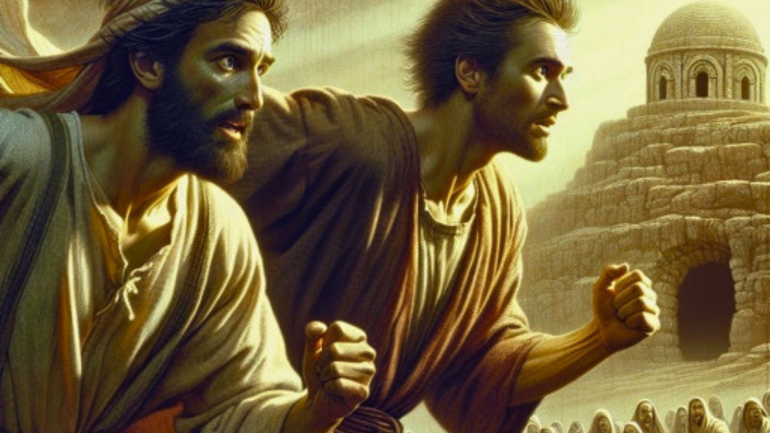
There is a figure who moves through the final chapters of the Fourth Gospel like a shadow made of light. He is never named outright, only described by a single, staggering identity: the disciple whom Jesus loved. Across centuries of tradition, we have called him John. But the Gospel itself seems less interested in his name than in his posture. He leans against Jesus at supper. He stands beneath the cross when nearly everyone else has fled. He runs to the empty tomb at dawn. What the Passion and Resurrection narratives reveal, when we read them closely, is not a hero but a witness. He is someone whose greatness lies entirely in his willingness to remain PRESENT.
At the Table: The Intimacy Before the Storm
The Last Supper is where we first encounter the Beloved Disciple in his most iconic posture, reclining against Jesus' chest. It is a startlingly physical image. The other disciples argue about who among them is the greatest. Judas slips bread into his mouth and darkness into his heart, while John rests against the body of his friend. Peter, characteristically restless, has to signal to John to ask Jesus who the betrayer is. John is close enough to whisper.
There is something here that Holy Week invites us to sit with. Intimacy is not the same as understanding. John does not comprehend what is about to happen any more than the others do. But proximity has its own kind of knowledge. He is near enough to feel the heartbeat of someone about to die, and he does not pull away.
At the Cross: The Courage of Remaining
The most remarkable detail in John's Passion narrative may be the simplest one: he was there. At the foot of the cross, when the Roman soldiers were still close enough to smell, when the blood was not metaphorical but actual, the Beloved Disciple stood with Mary, the mother of Jesus.
The other disciples had scattered. Peter, who had sworn he would die alongside Jesus, was somewhere in the city nursing the wound of his three denials. The rest had dissolved into the anonymity of the Jerusalem crowds. But John remained, not with a sword, not with a speech, not with a plan. He stood there. And in that standing, Jesus entrusted to him the most sacred responsibility imaginable: "Behold your mother."
We may read this moment as a domestic arrangement, Jesus making sure Mary would be cared for. But it is far more than that. It is the creation of a new kind of family, forged not by blood but by suffering shared. John becomes a son not through birth but through presence. He earns this not by doing something extraordinary but by refusing to leave.
This Holy season asks us the same question it asked the first disciples: Can you stay in the room when the story turns unbearable?
At the Tomb: The Race Toward Hope
Then comes Easter morning, and the Beloved Disciple is running. Mary Magdalene has brought the unthinkable news. The body is gone! And two men sprint toward the tomb. John, the Gospel tells us with almost boyish specificity, outrun Peter. He arrives first. He bends down, sees the linen cloths lying there, and waits. Peter barrels past him. And then John enters too, and the text delivers one of the most powerful lines in all of Scripture: "He saw, and he believed."
What did he see? Folded cloth. Absence. An empty shelf of rock. But something in that emptiness spoke to him. Perhaps because he had been close enough to the story all along to recognize its grammar even when the sentences rearranged themselves beyond all expectation. The one who had leaned against Jesus' chest at supper, who had stood beneath his cross in the afternoon, was now the first to read the meaning of an empty tomb at dawn.
The Invitation
The Beloved Disciple offers no theology of atonement, no theory of sacrifice. What he offers is something more unsettling and more accessible: a model of love as attention. He watched. He stayed. He ran toward what he did not yet understand. And in the end, that was enough.
This Holy Season, the Church does not ask us to explain the mystery of the cross and the empty tomb. It asks us to do what John did: to draw close, to remain present when presence is costly, and to let ourselves be astonished by what love makes possible when we refuse to look away.
Let us know how you feel!
Comments



- Reply
Permalink