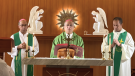



On the 2nd of November (while the rest of the world has long since moved on from the candy and costumes of Halloween) the Catholic Church quietly gathers in churches and cemeteries to pray for the dead. All Souls Day is easily missed but it has a rather interesting history and a fair bit of psychological insight.
Lesser-known facets
The feast is younger than many people think. For a very long time there was no fixed date on which to pray for the dead. In 998, Saint Odilo, Abbot of Cluny in France, directed all the monasteries under his jurisdiction to observe the day after All Saints as the day to remember all the faithful departed. It spread very rapidly and was in Rome by the 14th century.
Some of the features are rather odd. In 1915 Pope Benedict XV (who was very much moved by the horrors of the First World War) permitted every priest to say three Masses on the 2nd of November (an extraordinary permission in a Church which normally only allows a priest to say one Mass a day). A plenary indulgence can be gained by those who visit a church or cemetery and meet the normal requirements, but it can only be applied to the souls in Purgatory and not to oneself. The Church assumes that our love for the dead is something we show them.
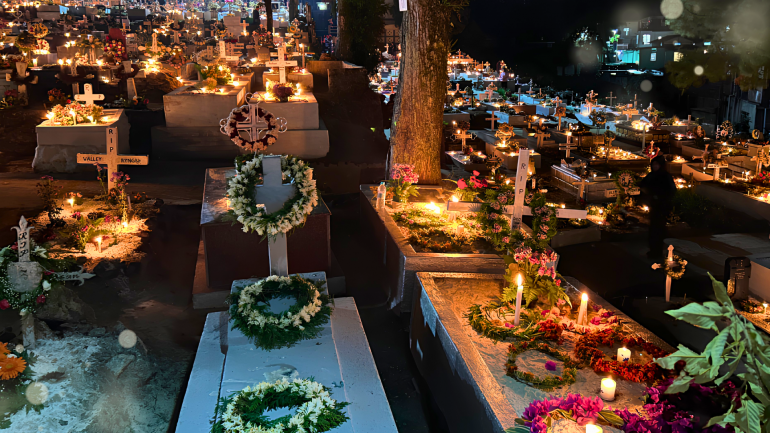
The feast has had a profound impact on popular culture. English 'souling' (where the poor would go from door to door offering prayers for the dead in return for soul cakes) is very likely the progenitor of modern-day trick-or-treating. Día de Muertos in Mexico is a mixture of Catholic observance and indigenous traditions. In Poland, the cemeteries are alight with millions of candles on the night of Zaduszki. The great Dies Irae from the Requiem Mass (which Mozart, Verdi and Berlioz all subsequently borrowed) is of course part of this liturgical tradition.
A psychological reading
The Church's theology of Purgatory is that the link between the living and the dead is not broken at the grave and that the living can still do something for the dead. Modern psychology has come to a very similar conclusion via a completely different route.
For most of the 20th century the prevailing view came out of Freud's essay "Mourning and Melancholia," in which healthy grief was seen as a process of gradually disengaging the emotional attachment to the deceased and moving on. Klass, Silverman and Nickman in their 1996 book Continuing Bonds went a long way towards challenging that view, demonstrating that many bereaved people do in fact maintain an ongoing inner relationship with the deceased (through conversation, through the perceived guidance of the deceased, through ritual etc.) and that this is frequently an indication of healthy adaptation rather than pathology. All Souls Day is the institutionalisation of that insight. It gives the continuing bond a date, a place, a script and a community.
Rituals matter here. Norton and Gino's research found that rituals performed after a loss reduced the intensity of the grief and increased a sense of control (even in people who didn't believe the rituals had any supernatural effect at all). Lighting a candle or standing at a grave provides structure to feelings which otherwise would be entirely unstructured.
The feast also fits the 'dual process model' of Margaret Stroebe and Henk Schut which describes healthy grieving as an oscillation between dealing with the loss and returning to normal life. All Souls Day is a day on which people can deal with loss (within bounds) and then go back to their normal lives. The liturgy provides a container for sorrow rather than a demand to stay in the sorrow forever.
Then there's mortality itself. Terror Management Theory (stemming from Ernest Becker's The Denial of Death) posits that the awareness of our own mortality is a source of anxiety which we manage via culture, meaning and belief. A lot of modern life deals with it through avoidance: hospitals hide death, funerals are getting smaller and smaller and we just change the subject in conversation. The Church's old doctrine of memento mori (remember that you will die) is the antithesis of that. There is some evidence that contemplating death can actually lead to increased levels of gratitude, generosity and clarity of values under the right circumstances rather than despair.
Why it matters now
There are a number of features of modern life which make this very old feast utterly pertinent again. The pandemic has left so many people in the position of grieving without a funeral, grieving without a goodbye. Prolonged grief disorder is now a recognised diagnosis (it's in the DSM-5-TR as of 2022). A lot of people are experiencing what Kenneth Doka termed 'disenfranchised grief' (grief which society doesn't recognise) in the form of miscarriage, the loss of an estranged relative, the loss of a friend to overdose or suicide. A feast which affirms that every soul is worthy of prayer, no matter what the circumstances of their death is precisely the sort of thing that speaks to those people.
The feast also combats isolation. Loneliness is such a well-recognised public health issue and All Souls Day places the individual within a community which stretches across the generations (the living and the dead). It is a rare thing in our day to be asked to remember people who can in no way reciprocate.
One doesn't have to buy into the Church's theology of purgatory to see the point. We all seem to need a time and a place to say the names of the dead. All Souls' Day makes it clear that grief is not a failure on our part to 'get over it' but is, in fact, a form of love which continues. A society which is unable to speak of its dead will be a society which is unable to speak honestly about how to live.