


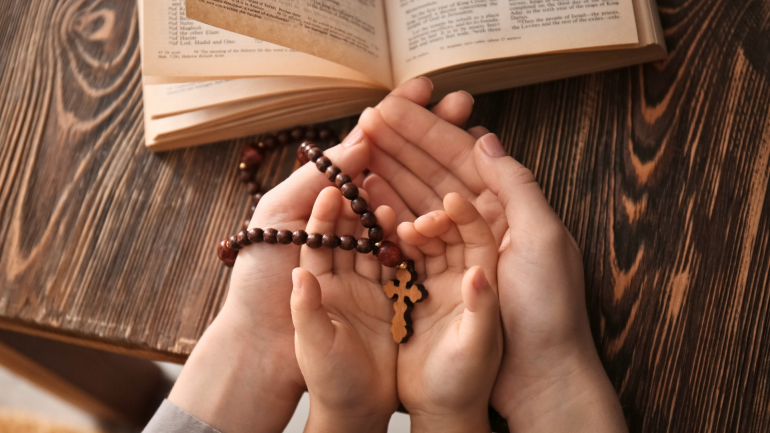
The Holy Rosary is one of the Catholic Church’s most cherished forms of prayer, inviting the faithful to meditate with Mary on the life, death, and Resurrection of Jesus Christ. Its name comes from the Latin rosarium, meaning “rose garden,” evoking the image of a spiritual bouquet offered to the Blessed Virgin Mary.
Although Marian in form, the Rosary is fundamentally Christ-centered and rooted in Scripture. Through its mysteries, Catholics contemplate the central events of salvation history, reflecting on them as Mary did in her heart. The prayer leads the faithful to Christ and, through him, to the Father in the unity of the Holy Spirit.
The Hail Mary draws much of its wording from the Gospel of Luke. The angel Gabriel greets Mary at the Annunciation, calling her highly favored by God (Luke 1:28), while Elizabeth’s words at the Visitation provide the prayer’s second biblical greeting: “Blessed are you among women, and blessed is the fruit of your womb” (Luke 1:42).
The prayer developed over centuries before reaching its familiar form. Its second part gradually emerged through the Church’s tradition, and the complete form was officially included in the Roman Breviary under Pope Pius V in 1568. The Hail Mary expresses the Church’s faith in Mary’s unique role in God’s plan of salvation and its confidence in her intercession.
From the Psalms to the Mysteries of Christ
The Rosary’s history is closely connected to medieval Christian prayer. During the Middle Ages, monks and religious communities prayed the 150 Psalms as part of their daily worship. For those who could not read or did not have access to a Psalter, reciting 150 Our Fathers offered an alternative. Beads were used to keep count.
As devotion to Mary developed, the practice of reciting Hail Marys became increasingly popular. Over time, the prayers were organized into decades, accompanied by meditation on events in the lives of Jesus and Mary. The Joyful, Sorrowful, and Glorious Mysteries became established traditions of the Rosary.
According to pious tradition, the Blessed Virgin Mary gave the Rosary to St. Dominic and encouraged him to promote the prayer. Although historians continue to examine the precise stages of its development, the Dominican Order played an important role in spreading the Rosary, particularly through the work of the 15th-century Dominican preacher Alan de la Roche, who promoted Rosary confraternities.
In 1571, Pope Pius V called Christians to pray the Rosary as European forces prepared for the Battle of Lepanto against the Ottoman fleet. The Christian victory on October 7 became closely associated with Marian devotion. The date later became the feast of Our Lady of the Rosary, commemorating the Church’s confidence in Mary’s intercession.
In 2002, Pope John Paul II introduced the Luminous Mysteries, which focus on significant moments in Jesus’ public ministry, including his baptism, the wedding feast at Cana, the proclamation of the Kingdom of God, the Transfiguration, and the institution of the Eucharist. These mysteries expanded the traditional 15-decade Rosary to 20 decades and offered the faithful further opportunities to contemplate Christ’s life.
A Prayer That Shapes Daily Life
The Rosary is more than the repetition of familiar prayers. Its spiritual value lies in the union of prayer and meditation, allowing the mysteries of Christ’s life to illuminate the circumstances of everyday living. The Joyful Mysteries invite reflection on God’s presence in ordinary family life; the Sorrowful Mysteries help believers face suffering with faith; the Glorious Mysteries proclaim the hope of resurrection; and the Luminous Mysteries deepen understanding of Christ’s mission.
Pope Paul VI described the Rosary as a “compendium of the entire Gospel,” emphasizing its connection to the central truths of Christian faith. Its repeated prayers encourage contemplation, patience, and a deeper relationship with Christ through Mary.
The Rosary also has a place in family prayer. Families who pray together can find in it a shared rhythm of faith, particularly during times of uncertainty, conflict, illness, or loss. It is not a substitute for addressing the problems people face, but a way of seeking God’s guidance and strength as they respond to them.
Catholics believe they can approach Jesus directly in prayer. Asking Mary to intercede does not replace Christ or diminish his unique role as mediator; rather, it expresses the communion of saints and the belief that Mary continues to pray for the Church. Her example directs believers toward her Son, as she did at Cana when she told the servants, “Do whatever he tells you” (John 2:5).
The Rosary as a Prayer for Peace
In a world marked by war, violence, division, and uncertainty, the Rosary offers an opportunity to pray for peace while examining one’s own life. Its mysteries invite the faithful to reject hatred, seek reconciliation, care for those who suffer, and become instruments of Christ’s love.
The prayer also reminds believers that the events of salvation history are not distant memories. Each time Catholics meditate on the birth of Jesus, his suffering, his Resurrection, or the coming of the Kingdom, they are invited to let these mysteries shape their choices and relationships today.
The Rosary can therefore become a daily school of discipleship. Its repetition is fruitful when it leads to conversion, compassion, and a more faithful response to the Gospel.
As Catholics pray for the intercession of the Blessed Virgin Mary, especially in times of suffering and at the hour of death, they are called to imitate her faith and trust in God. The ultimate purpose of the Rosary is not simply to complete a set of prayers, but to grow closer to Jesus Christ.
Prayed with attention and faith, the Rosary can help individuals and families renew their commitment to God and carry the message of peace into their homes, communities, and the wider world.