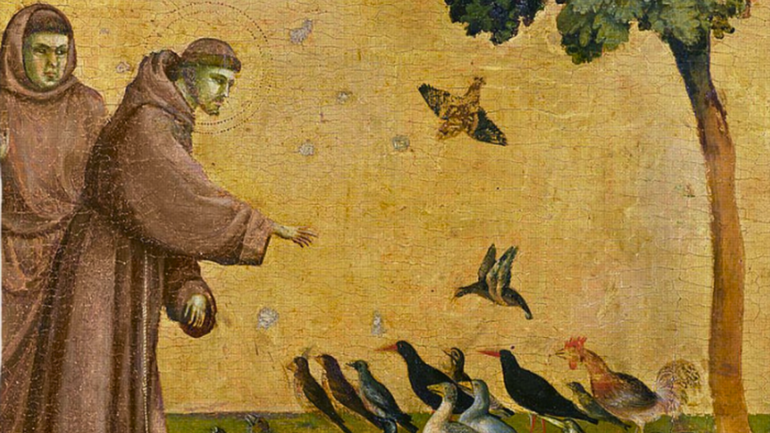
Francis of Assisi did not write theology in the academic sense. He sang it. In the Canticle of the Creatures, composed near the end of his life while he was seriously ill and nearly blind, he calls the sun “brother,” the moon and stars “sister,” and even death a sibling. The poem is not decorative piety. It is a claim about the structure of reality. If God is Creator and Father, then the world is not a warehouse of objects arranged for human use. Every creature belongs to a wider community of life.
Francis did not stand outside creation as its manager. He lived inside it as a relative.
That movement, from ownership to kinship, is what makes Franciscan spirituality feel startlingly current eight centuries later. We have inherited a language about nature that treats it mostly as inventory: resources to extract, land to develop, animals to process, and landscapes to place behind economic growth. Francis offers another vocabulary, built on relationship rather than utility. In an age of climate anxiety and an economy that turns living things into disposable products, that vocabulary is not sentimental. It is theological resistance.
From Dominion to Extraction
Christian teaching has spent decades correcting the idea that “dominion” in Genesis means permission to dominate. In Laudato Si’, Pope Francis draws on the spirituality of his namesake to argue that ecological destruction and human suffering are inseparable. The encyclical calls for an “integral ecology” that respects environmental and human dimensions, because the ecological crisis is also a social crisis.
The pattern is visible in modern consumer habits. Lithium mining for phones, batteries, and electric vehicles can place environmental and social burdens on Indigenous and poor communities that receive little of the profit. Fast fashion generates enormous waste, while factory farming reduces living creatures to units of production, confinement, and yield.
None of this is dominion in the biblical sense. It is extraction wearing dominion’s name as a disguise.
Kinship changes what we are willing to do to a relative. We do not poison a sister’s water to save money in a supply chain or treat a brother’s habitat as an acceptable loss. We do not call the destruction of a community an externality simply because it appears far away on a balance sheet.
Stewardship can still leave us imagining ourselves as managers of the world. Kinship reminds us that we are participants in a community we did not create and cannot replace.
The Discomfort of Kinship
Kinship theology can become an idealized spirituality of sunsets and birdsong, with no hunger, danger, conflict, or cost. Francis’s world was not romantic. Wolves killed livestock, and winters killed people. His famous encounter with the wolf of Gubbio ends not with the wolf becoming harmless but with a covenant: food in exchange for peace.
The story comes from a later Franciscan tradition, but its moral imagination is revealing. Francis calls the animal “Brother Wolf,” acknowledges the harm it has caused, and recognizes hunger as part of the story. The solution is neither sentimental approval nor extermination. It is a difficult arrangement in which both the community and the animal are drawn into obligations.
Kinship does not mean pretending that all creatures are safe or identical. It means refusing to treat difference as permission for indifference. A spirituality of creation that produces only admiration will not survive a crisis demanding economic disruption and personal sacrifice. Transitions away from exploitative industries may impose real costs on workers and communities unless they are deliberately made just.
The Franciscan vision works only if it holds wonder and cost together. Otherwise, it becomes another aesthetic we consume while underlying structures remain untouched.
Personal, but Not Merely Personal
Francis’s spirituality of creation was intensely personal: poverty, simplicity, gratitude, attention, and solidarity were practices that made kinship possible. Yet individual choices cannot substitute for political and institutional change. Individuals do not design global supply chains, determine energy policy, set wages, or regulate mining. Franciscan ecology begins with conversion of the heart but must also confront the institutions that organize desire and distribute harm.
The question is not merely, “What can I recycle?” It is more searching: Do I need this? Who or what must be diminished for me to have it? Which costs have been hidden so that my life can appear convenient?
Francis’s poverty was not deprivation for its own sake. It created space to notice his siblings, human and otherwise, instead of consuming them invisibly. To live simply is not to romanticize hardship or burden the poor with reform. It is to challenge an economic order that teaches the affluent to experience endless acquisition as freedom.
A Family We Did Not Choose
Families are not always comfortable. We do not get to select only the siblings who are attractive, useful, or agreeable. Franciscan ecology asks us to care for all creation: the charismatic species and the overlooked ones, the scenic coastline and the polluted industrial site, the neighbor who recycles and the corporation that does not.
Kinship is not selective affection. It is a discipline of responsibility.
Francis turned this truth into greeting, song, poverty, and daily attention. He behaved as though the world were populated by relatives whose existence placed claims upon him.
Eight hundred years later, that vision challenges the legal and economic fiction that the world is primarily property. The question is not whether creation belongs to us. It is whether we are willing to belong to creation, and accept the obligations that belonging entails.
Francis’s invitation is to consume less, notice more, protect what cannot defend itself, and build economies in which no community is treated as expendable. The world is not our inventory. It is our common home, and its creatures are not objects beside us but relations among whom we must learn, again, how to live.