Lent is a season of grace in the Christian calendar.
Reconciliation lies at the center of this sacred season. It is not merely about confessing sins but about rediscovering God’s mercy and allowing it to transform our lives. In this context, the message of Our Lady of La Salette carries a powerful and timely reminder for Christians today.
On September 19, 1846, in the remote French Alps near the village of La Salette, the Blessed Virgin Mary appeared to two shepherd children: Maximin Giraud, aged eleven, and Mélanie Calvat, aged fourteen. The children were tending their cows on the mountain slopes when they saw a radiant lady seated on a rock, weeping. After some time, she stood up and spoke to them at length—first in French and then in their local dialect, her voice filled with sorrow and compassion.
The apparition was later investigated by the Church and formally approved in 1851 as authentic.
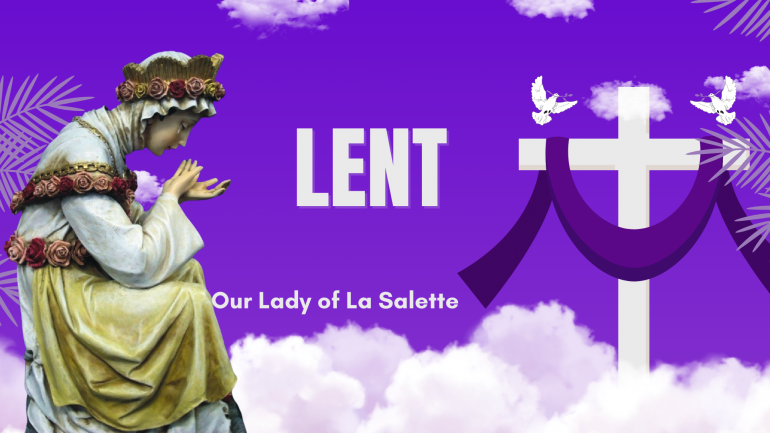
The statue of Our Lady in the Basilica of La Salette captures the mysterious beauty of the apparition. Mary is portrayed in radiant light, with a crucifix on her breast surrounded by a hammer and pincers, symbols recalling Christ’s Passion. Chains and roses also adorn her figure, reflecting both human sin and the hope of redemption. The image reminds the faithful that the sorrow of Mary is inseparable from the suffering of her Son and the salvation he brings.
At La Salette, Mary appeared as a mother deeply concerned for her children. She invited the world to reconciliation, with God and with one another. She called people to repentance, prayer, and a renewed commitment to faith.
According to the children’s testimony, one of Mary’s chief concerns was the neglect of Sunday as a day dedicated to God. She lamented that many people had abandoned worship and treated the Lord’s Day as an ordinary time. Her words echo the heart of Christian faith: Sunday is not merely a religious obligation but an encounter with Christ in the Eucharist and in the community of believers.
Even today, the temptation remains to reduce faith to convenience. It is easy to replace communal worship with private devotion or online participation when circumstances do not require it. Yet the Christian life is fundamentally communal. Gathering as the Body of Christ allows believers to share faith, strengthen one another, and encounter the living presence of the Lord in Word and Sacrament.
Mary also called the people to repentance and compassion. She urged them to replace harsh words and selfish attitudes with kindness and grace. Faith, she reminded them, cannot be limited to outward practices. True conversion requires a transformation of the heart.
Her message remains strikingly relevant today. Many people profess belief in God, yet hesitate to change their lives or confront injustice and selfishness. Lent challenges such as complacency. It invites believers to move beyond routine religion and embrace authentic discipleship.
The apparition also highlighted the importance of prayer in daily life. When Mary asked the children if they prayed regularly, they replied that they hardly prayed at all. The Lady gently urged them to at least say the Our Father and Hail Mary every morning and evening.
Her simple request reveals a profound truth: prayer anchors human life in God. In a world filled with distractions, prayer becomes the space where hearts are renewed and strengthened.
The message of La Salette also touches families and communities. Parents and elders carry the responsibility of passing on the faith to the next generation. In many societies today, children grow up surrounded by competing priorities, education, entertainment, and consumer culture. Without guidance and example, faith can easily fade from daily life.
Yet the story of Maximin’s father offers a hopeful reminder. At first, he dismissed his son’s account of the apparition. But when Maximin told him that the Lady had spoken about his struggles and worries, he was deeply moved. In that moment, he realized that God knew his burdens and cared for his family. The experience led him to rediscover faith.
This small episode illustrates a larger truth: God never abandons his people. Even when faith weakens, divine mercy continues to call humanity back to conversion.
During Lent, the Church invites believers to undertake precisely such a journey. The season asks each person to examine attitudes, habits, and choices that distance them from God and others. True repentance means making a real turn, what Scripture describes as conversion of heart.
The message of La Salette reminds us that Mary, the Mother of Jesus, continues to accompany the Church on this path. As a mother who weeps for her children, she calls them back to faith, prayer, and reconciliation.
Mary, Reconciler of sinners and Virgin of converts, pray for us and lead us closer to your Son.