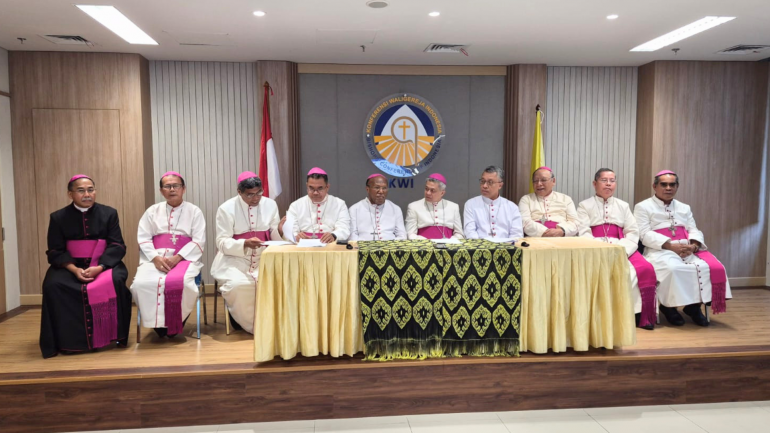
The Indonesian Bishops’ Conference (KWI) has called on citizens to strengthen national unity and renew hope amid growing social, economic, and environmental challenges as Indonesia marked its 118th National Awakening Day on May 20.
In a pastoral message titled “Rising Together in Hope,” the bishops said Indonesia faces increasing pressures from global economic uncertainty, geopolitical tensions, ecological degradation, rapid technological change, and domestic social concerns. National Awakening Day commemorates the rise of Indonesia’s modern nationalist movement and is observed annually across the country.
The bishops urged Indonesians to preserve solidarity and work together for the common good.
“Global economic uncertainty, geopolitical changes, rapid technological development, ecological crises, and various domestic social issues present enormous challenges to our shared life,” the statement said.
KWI highlighted growing social problems, including financial pressures on families, mental health struggles among young people, violence against women and children, and insufficient protection for vulnerable communities.
The bishops also drew attention to Papua, Indonesia’s easternmost region on the island of New Guinea, where long-standing tensions and conflict continue. They said security measures alone cannot resolve the situation and called for a more humane and participatory approach grounded in dialogue and respect for local communities, culture, history, and fundamental rights.
The conference also expressed concern about economic inequality, saying development gains have not been equally shared by ordinary citizens. Unemployment, rising living costs, and widening social gaps remain major concerns, according to the bishops.
KWI criticized corruption, abuse of power, and the influence of vested interests, warning that these weaken public trust and undermine justice. The bishops stressed that economic policies should prioritize poor communities, small farmers, fishers, laborers, Indigenous peoples, and marginalized groups.
“Politics and economics should serve the common good, not merely become arenas for competing interests and group profits,” the statement said.
On democracy, the bishops warned against shrinking civic space and restrictions on public criticism. They called for protecting democratic institutions through transparency, rule of law, and citizen participation, while rejecting authoritarian tendencies, militarism, and excessive centralization of power.
The bishops also renewed calls for environmental protection, citing concerns over deforestation, pollution, and unsustainable resource extraction. Referring to Laudato Si’, Pope Francis’ encyclical on care for creation, they urged greater accountability in development projects, including geothermal initiatives in Flores and food estate programs in Papua.
The message concluded with an appeal for dialogue, solidarity, and mutual cooperation to strengthen hope and national unity.
Radio Veritas Asia (RVA), a media platform of the Catholic Church, aims to share Christ. RVA started in 1969 as a continental Catholic radio station to serve Asian countries in their respective local language, thus earning the tag “the Voice of Asian Christianity.” Responding to the emerging context, RVA embraced media platforms to connect with the global Asian audience via its 21 language websites and various social media platforms.
Latest News