


In a quiet Catholic village in northern Bangladesh, a simple family home has become an unlikely gathering place, drawing hundreds of visitors and sparking conversations about culture, identity, and unity.
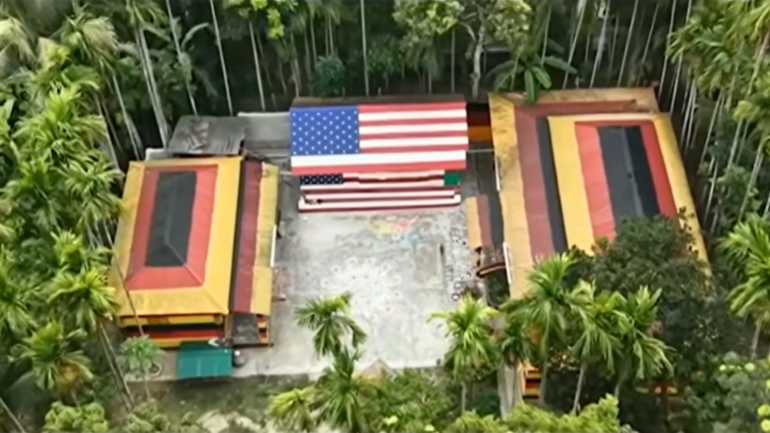
In Kalikapur village of Banpara parish in the Diocese of Rajshahi, a house painted in the black, red, and gold of the German flag now stands out against the rural landscape. Locally known as the “German House,” it reflects the passion of a migrant son whose love for his adopted country continues to shape his connection with home.
Sagor Kulentuno, a Catholic from the village, has been living in Germany for the past 13 years, serving there as a health worker. During that time, he witnessed Germany’s 2014 FIFA World Cup victory and developed a deep admiration not only for the country’s football but also for its people.
“After going there as an immigrant, I experienced a lot of kindness and cooperation,” Sagor shared through family members. “That made me respect and love Germany more.”
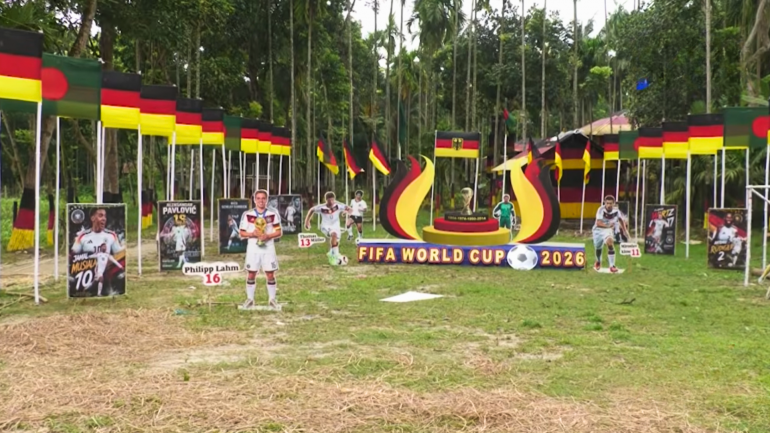
Although far from home, his presence is felt vividly in Kalikapur. Through video calls from Germany, Sagor directed relatives and workers to paint two of the family’s three buildings in German colors. A third building has been decorated with the colors of the United States, this year’s World Cup host. Trees in the compound have also been painted, while the adjacent field displays portraits of German players and records of the team’s World Cup achievements.
Yet amid this international display, national identity remains visible. Several Bangladeshi flags are placed throughout the compound, symbolizing what residents describe as a balance between global connections and local pride.
The transformation has attracted widespread attention across Bangladesh. News of the “German House” spread rapidly on social media and was picked up by national media outlets. Since then, visitors have been arriving daily, many traveling long distances out of curiosity and admiration.
Among them is Arif Hossain, who traveled from neighboring Sirajganj district. Although he supports Argentina, he said the house left a strong impression on him.
“I came after seeing it on social media,” he said. “Even though I support another team, I am amazed by the effort. It shows how deeply people here love football.”
Hossain also emphasized the importance of mutual respect. “We may support different teams, but we don’t want conflict. Football should bring harmony, not division,” he said.
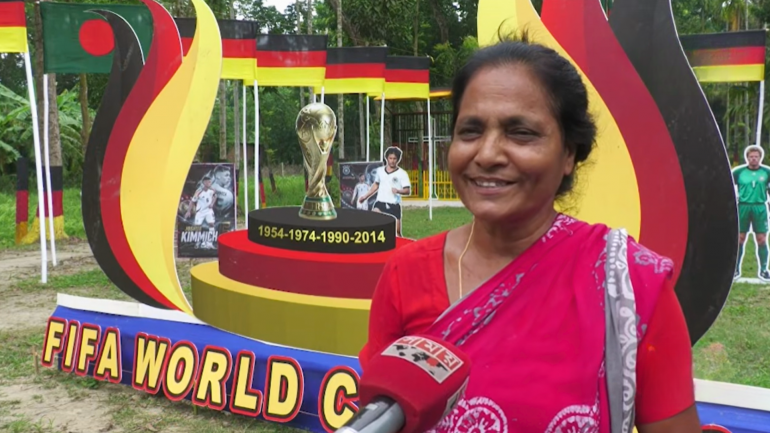
For many in this predominantly Catholic village, the phenomenon reflects something deeper than sporting enthusiasm. Local Catholic journalist Amor D’Costa sees it as a reminder of football’s power to unite people across differences.
“When you come here, you understand how important the World Cup is for people,” he told RVA News. “Football connects communities.”
According to D’Costa, the compound features 52 German flags alongside six Bangladeshi flags. A large screen has been set up to broadcast matches, especially Germany’s games, as well as all knockout-stage fixtures. A small coffee shop has also been opened, turning the space into a communal venue for gathering and celebration.
In Bangladesh, enthusiasm for the FIFA World Cup runs deep, even though the country does not participate in the tournament. During the competition, neighborhoods across the nation are often filled with the flags of popular teams such as Argentina, Brazil, Germany, Spain, and Portugal. Fans routinely wear jerseys of their favorite teams to work, school, and social gatherings.
In Kalikapur, however, this passion has taken on a distinct character. The “German House” has become more than a display of loyalty to a team; it has evolved into a shared social space where people from different backgrounds come together.
For Church leaders and local Catholics, such moments highlight the value of community life and peaceful coexistence in a diverse society. In a country where Christians are a small minority, the initiative has also drawn positive attention to a Catholic village, offering an example of openness and hospitality.
As visitors continue to arrive, the modest home stands as a testament not only to one man’s affection for a distant land, but also to the enduring ability of sport to build bridges across cultures, from a village in Bangladesh to the global stage.
Radio Veritas Asia (RVA), a media platform of the Catholic Church, aims to share Christ. RVA started in 1969 as a continental Catholic radio station to serve Asian countries in their respective local language, thus earning the tag “the Voice of Asian Christianity.” Responding to the emerging context, RVA embraced media platforms to connect with the global Asian audience via its 21 language websites and various social media platforms.
Latest News