




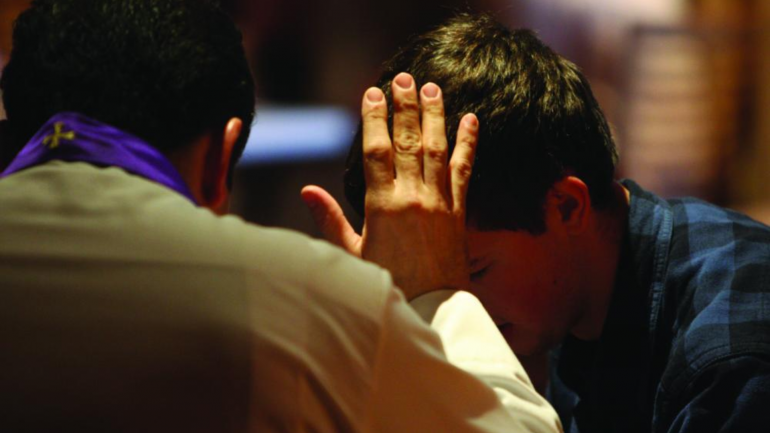
Maya stood in line at the counselling booth when she saw Mary stepping out of the church with a priest.
“Why do you go in there?” Maya asked.
“For confession,” Mary replied.
Maya laughed. “When clothes are dirty, we put coins in the machine at the laundromat and they come out clean. Similarly, when my soul feels heavy, I go to counseling.”
Mary smiled. “But in confession, I don’t need to put in coins. The stains of sin are washed away freely, even the ones I forget to mention.”
The priest, who overheard them, said: “Counselling may show you how to keep your clothes clean. Confession gives you a new garment, already paid for by grace.”
In many cities, there are shops lined with laundromats. It is a place where anyone can walk in with a bundle of dirty clothes, insert some coins, add soap, and watch the stains and odour slowly disappear. It exists because no one can wear the same clothes forever without washing them. Dirt accumulates, sweat seeps in, stains happen, and unless they are cleaned, clothes soon become unwearable.
Human life is similar. Our souls collect emotional and spiritual dirt, sometimes hidden from our awareness. Just as no one can go long without washing clothes, no one can truly live with an unwashed soul or heart.
We have two choices. The first is to attend counselling sessions, which are like laundromats: you pay and wash away your inner burdens, such as worries, anxieties, past wounds, and present-day struggles. The counsellor helps you “unpack” these burdens, sort them out, and slowly work through the process of healing. Just as a washing machine takes time to soak, rinse, and spin, so too the mind and heart need time, patience, and effort to be restored. Counselling focuses on psychological relief and personal growth through effort and guidance.
But for Catholics, there is another “laundromat”, a very different one: the confessional. When Jesus told His disciples, “Whose sins you forgive, they are forgiven; whose sins you retain, they are retained” (John 20:23), He gave the Church an eternal laundromat for the soul. Here, the cleansing is not only psychological but also spiritual. It reaches a deeper level. Sins are confessed, the blood of Christ is poured instead of water, the grace of detergent is added, and the passion of Christ is applied to make it clean. And the good news is “All is free.” The priest, the Alter Christus (another Christ), does not charge by the hour; the grace of God does not come with a fee.
Confession is not just therapeutic but sacramental. In the Sacrament of Reconciliation, sins are confessed, and through the priest, Christ Himself declares, “I absolve you.” This brings not only psychological relief but spiritual renewal. St. Augustine, having known the burden of sin, wrote, “The confession of evil works is the first beginning of good works” (Sermon 19). Counselling may lighten our burdens, but confession renews us entirely. As the prophet Isaiah wrote: Though your sins are like scarlet, they shall be white as snow; though they are red like crimson, they shall become like wool” (Isaiah 1:18).
Like children covered in mud from playing outside on a rainy day need their mother to scrub and wash them, we too fall, stumble, and get stained. If only, like the Prodigal Son (Luke 15:11–32), we come home dirty, hungry, and ashamed, God, like a father, is waiting to run, embrace, and clothe us with the finest robe. As Pope Francis said, “The Lord never tires of forgiving. It is we who tire of asking for forgiveness.” We do not earn or pay for forgiveness, but we receive it freely from the Father.
This brings us to an interesting paradox seen today: when the line for the confessional grows, the line at the counsellor’s chamber shrinks. Conversely, when confession is neglected, the counselling rooms overflow. These opposing trends reveal a striking contrast between the two approaches.
This is not to pit counselling against confession. They are not enemies but companions. Confession addresses spiritual and moral concerns, while counselling is essential for emotional health. There are burdens—such as trauma, depression, and mental illness—that require professional guidance, which confession alone does not address. Counselling has consequently become an essential service. We need counselors to listen patiently, ask questions, offer guidance, and help people find clarity where there was confusion.
Both counselling and confession are necessary and serve distinct roles. Counselling is the laundromat for the mind—processing emotions, challenges, and thoughts. Confession, however, is the laundromat for the soul—addressing spiritual stains that only absolution can cleanse. Neglecting confession leaves the deepest stains untouched. Therefore, the line outside the confessional tells the story of those who know that no human intervention can match the freedom found when Christ Himself, through His priest, declares: “Go in peace, your sins are forgiven.” In that moment, liberation comes not from human words but from Heaven itself.





- Reply
Permalink