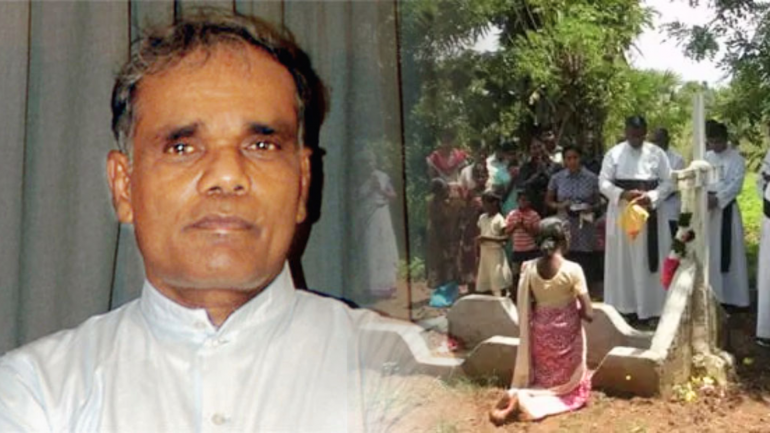
On the 18th death anniversary, the Church in Sri Lanka remembers Fr. Mariampillai Xavier Karunaratnam, affectionately known as “Father Kili,” a priest who dedicated his life to oppressed communities and worked tirelessly to bring unity and peace to a country scarred by war, fear, anger, and hatred.
After the assassination of his colleague at the North East Secretariat on Human Rights (NESHR), Member of Parliament Mr. Sivanesan, Fr. Kili spoke with his sister in Canada. When she expressed concern for his safety, he replied calmly:
“I am ready to meet death in the same way.”
By then, it was clear that he was being closely watched. Yet he chose not to leave the fate of the people he served.
Early Life and Education
Mariampillai Xavier Karunaratnam was born on April 20, 1951, in Karaveddy, Vadamarachchi, Jaffna. The fourth of ten children in a family of teachers, he studied at Karaveddy Vigneswara College, Nelliady Sacred Heart College, and St. Patrick’s College, Jaffna.
From his youth, he was deeply involved in community life. He participated in the student and youth wings of the Tamil United Liberation Front (TULF). During his Advanced Level studies, he became a popular English teacher, earning the nickname “Kili Vathiyar” (Teacher Kili).
He was also known as a village mediator, resolving family disputes and leading relief efforts during floods and other disasters.
The Divine Calling
By 1983, as armed conflict escalated and many Tamil youth turned to militancy or migration, Karunaratnam, then 32, discerned a different path. Guided by spiritual conviction, he left his banking career and entered the seminary.
On April 20, 1985, his 34th birthday, he narrowly escaped death. While walking in Urumapirai, Jaffna, he was shot by military forces. He was later placed in a truck, but a soldier noticed the rosary in his pocket. Realizing he would likely be killed if taken further, and being a fellow Christian, the soldier left him in a forested area. Villagers found him and rushed him to the hospital, where he survived.
A Priest in a Time of War
Fr. Karunaratnam was ordained on September 25, 1989, by Bishop Deogupillai. It was a period of intense violence: thousands of youths were killed in the south, while the north endured widespread destruction.
He remained deeply engaged with friends across communities and was known for reflecting critically on the suffering of both north and south. He was a nationalist, but never a chauvinist. He condemned injustice wherever it appeared, seeing all victims as caught in a cycle of systemic violence.
A Bridge Between Communities
Fr. Kili maintained strong relationships with Sinhalese activists, clergy, and intellectuals. He believed Sri Lanka’s healing depended on solidarity among all oppressed groups.
He frequently traveled south for dialogue. Fluent in Sinhala, he shared the realities of the north and listened to the suffering of civilians in the south. He also encouraged outsiders to visit the north and witness the situation firsthand.
For him, reconciliation was not an idea; it was a lived commitment.
Serving the Vanni
From 1996 to 2002, he served as parish priest in Mallavi and chaired the Vanni Citizens’ Committee. He worked tirelessly for civilians living under war conditions.
After the 2004 tsunami, he led relief operations with remarkable energy, assisting survivors across the north and east.
His advocacy for justice made him both respected and controversial. While many saw him as a saintly figure, others viewed him with suspicion due to his criticism of state policies.
Advocacy and Human Rights Work
Fr. Kili’s engagement with the LTTE is often viewed in complex terms. For him, dialogue with de facto authorities was a practical necessity to protect civilians and advocate for human rights.
He also took clear moral positions, including opposition to the recruitment of children under 17 into armed groups.
In 2002, he co-founded the North East Secretariat on Human Rights (NESHR), which documented disappearances and killings and brought international attention to human rights violations. He consistently maintained that his loyalty was to suffering people, not political actors.
The Final Sacrifice
By 2006, conditions worsened, and human rights defenders increasingly became targets. Despite opportunities to leave the country, Fr. Kili chose to remain in the Vanni.
On Sunday, April 20, 2008, after assisting at Mass in Mankulam, he was traveling to a counseling center in Vavunikkulam. At approximately 12:30 p.m., his vehicle struck a claymore mine on the Mallavi–Vavunikkulam road. It is widely believed in the north that the attack was carried out by the Deep Penetration Unit of the Sri Lankan military.
Legacy
Thousands of Christians and Hindus gathered at St. Theresa’s Church in Kilinochchi for his funeral. They came to honor a priest who lived and died with his people.
Fr. Karunaratnam did not only preach peace, but he also embodied it through courage, solidarity, and sacrifice. In life and death, he remains remembered as a priest of the people who showed that love is stronger than fear.