The voice did not merely shout. It rolled across the small cemetery from one end to the other.
“Sino?” (Who?)
It was loud enough to travel over tombstones and mausoleums, announcing my presence before I could explain it.
I had just asked a woman selling palamig (cold drinks) where the children who visit the nuns were.
She did not respond. Perhaps she did not hear me. Or perhaps she chose not to.
But someone else had.
Even here, daily routines exist. Books are carried. Lessons are learned. Futures are imagined.
If you had no prior knowledge that this was a cemetery now occupied by the homeless, you might mistake it for one of Manila’s congested informal settlements.
Inside, women sell cold drinks and small goods from makeshift sari-sari stalls. There is movement. There is commerce. There is life — in a place meant for the dead.
Only when you look closer do you see that mausoleums have become homes for the living.
Another woman gestured for me to follow her deeper into the cemetery. Perhaps her children were there. I took a few steps after her.
Then doubt settled in.
When she continued farther in, I stopped.
It was then that I asked the woman selling drinks about the children.
And the voice came.
“Sino?”
It rolled across the grounds, sharp and commanding. I turned and saw a tattooed, shirtless man staring at me. After a moment, he walked toward the inner rows of tombs.
Other men stood or sat on graves, watchful. Territory here is fragile. Vigilance is survival.
In that split second, a thought flashed through me — sudden and unfiltered: What if I get stabbed?
Fear overruled curiosity.
I did not follow the woman.
I stepped back instead.
And yet, the woman selling palamig smiled — even chuckled softly. Perhaps it was her way of reassuring me. Or perhaps of easing the tension.
I did not take out my phone. Taking photos would have made things worse.
When I stepped out of the gate, another tattooed, shirtless man approached me — this time smiling — and asked who I was looking for.
I told him.
“They’re at school,” he said. “They’ll return in the afternoon.”
The tension I had carried began to loosen. The voice that rolled across the cemetery had not been the whole story.
As I walked away, the fear slowly faded. What remained was a painful contrast — between a life with a roof and regular meals, and a life carved out among the dead.
The women selling drinks.
The men guarding space.
The children who would return from school to pathways lined with marble and concrete slabs.
This is not spectacle. It is adaptation. It is life pressing forward wherever it can.
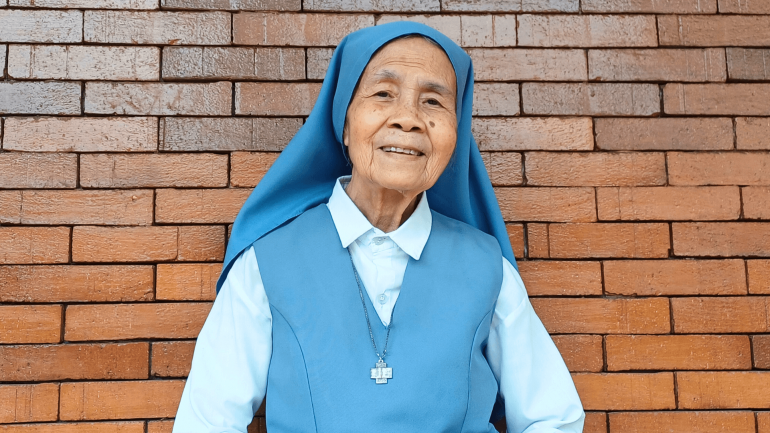
I had gone there to understand the ministry of Sr. Evangelina Canag, now 85, who first entered this community in 2008. Long before that, she served as provincial superior of the Daughters of St. Paul for nine years — leading during the Marcos years, through the 1986 EDSA Revolution, and into the presidency of Corazon Aquino.
She witnessed national upheaval. Yet she chose to return here, again and again.
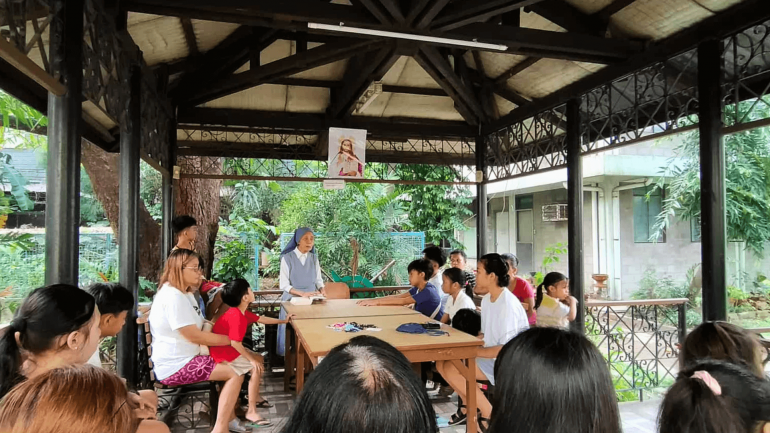
Today, she no longer walks regularly through the cemetery. Instead, once a month, some of the children — accompanied by parents or guardians — go to the convent. There, they gather for Bible study, simple meals, games, and reading sessions.
The Sisters quietly provide school baon (money or food brought for school), sourced from sponsors who may never see the narrow paths between the graves but choose to support the children who walk them daily.
The movement goes both ways.
From convent to cemetery.
From cemetery to convent.
If one morning unsettled me, what did it require of her to remain present for years?
Before I went, she told me simply, “I stopped going because I’m old.”
After hearing that voice roll across the cemetery, I began to understand that age was only part of the story.
When I messaged Sr. Evangelina after I got home and asked whether she had felt fear when she first set foot in the cemetery, she replied:
“No. My heart was pained by their condition.”
Her answer stayed with me.
The shout echoed briefly.
But what lingers longer is this: even among the dead, children go to school. Women sell cold drinks and food. Dreams continue. An elderly Sister built a bridge — constant, patient, almost invisible — between a guarded cemetery and a convent where the children laugh and are known by name.