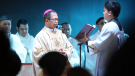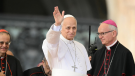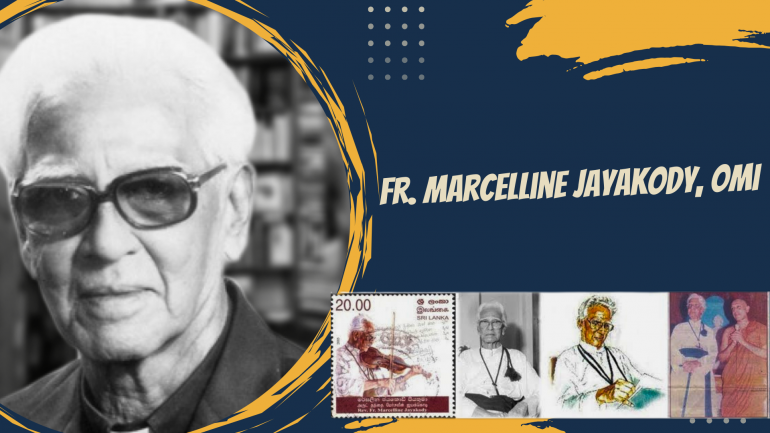
In a country where Catholics make up barely 5.6 percent of the population, one name is repeatedly quoted across Sri Lankan media, Christian and non-Christian alike, whenever Christmas approaches: Rev. Fr. Marcelline Jayakody, OMI.
The reason is simple yet profound. The Christmas carols and poems he composed in the Sinhala language have become part of the nation’s cultural and spiritual memory, sung and recited far beyond church walls. Through his words, Christmas ceased to belong to one community alone and became a shared human longing for peace, dignity, and compassion.
In 1983, Fr. Marcelline Jayakody received the Ramon Magsaysay Award in the Philippines, often described as Asia’s Nobel Prize. What he said and did during that visit revealed his deeply human, inclusive, and prophetic vision of coexistence.
It was the evening of August 31, 1983, in Manila. As was customary, the Magsaysay Awards Committee held a brief conversation with the awardees before the ceremony. During the exchange, one committee member asked Fr. Jayakody a pointed question:
“Through your long years of literary service, how many people have you converted to the Catholic faith?”
“None,” he replied, directly and without hesitation.
Then he added quietly,
“I never wanted to convert anyone to my religion. What I wanted was to light the lamp, the light that exists in the heart of every person I meet.”
A silence filled the room.
Later that evening, as Fr. Jayakody stepped onto the stage to receive the award, the announcer asked him another question:
“What have you done to deserve this award?”
“I haven’t done very much,” he said humbly.
“I have written a few poems for the peace and brotherhood of the people of our country.”
Once again, the simplicity of his words stilled the audience. Fr. Marcelline Jayakody was a man who perceived reconciliation not sentimentally, but critically and courageously, engaging with it through conscience and creativity.
This vision finds powerful expression in one of his poems titled “Why Religion, If It Kills Human Beings?”
Why the church, why the temple,
Why the kovil,
If human beings are being killed?
If villages are destroyed,
If hearts are shattered,
If homes and shelters are reduced to rubble;
If human rights are stripped away,
if light and warmth are extinguished;
If there is nothing to eat,
If there is nowhere to live;
If even passing vehicles
are set ablaze in hate.
Fr. Jayakody was often called “the priest of the temple.” When asked why he showed such deep respect for Buddhist places of worship, his response was as disarming as it was revealing: “I respect the temple because I respect the Church.”
Born on June 3, 1902, Fr. Marcelline Jayakody completed his earthly journey on January 15, 1998. Yet, 27 years after his death, his name continues to be spoken, sung, and read during every Christmas season in Sri Lanka, a living testament to his literary mission of coexistence and human solidarity.
His life and legacy so deeply moved Sri Lankan society that Most Venerable Ittapane Dhammalankara Thero, a senior Buddhist monk renowned for his leadership in education and interreligious dialogue, authored a book on Fr. Jayakody titled Malpale Upan Pansele Piyathuma (Priest of the Temple). It is considered the first book in the world written by a Buddhist prelate on a Catholic priest.
On Sri Lanka’s first Independence Day, Fr. Marcelline Jayakody was entrusted with training children to sing the National Anthem, a symbolic recognition of his place in the nation’s cultural life. Poet, musician, author, journalist, and peacemaker, he received numerous national and international honors.
Above all, he remains the priest who wished Christmas not only for Christians, but for the poor, the forgotten, and all of humanity.