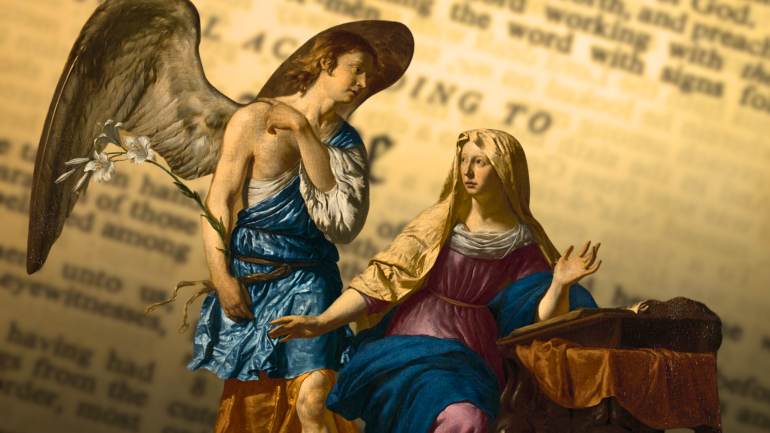
Today, March 25, the Church celebrates the Annunciation of the Lord.
Mary’s fiat to God continues to echo across the centuries: “Be it done unto me according to your word” (Luke 1:38).
In that single line, Mary consents - not to a plan she fully understands, but to a God she chooses to trust. In that consent lies the heart of every Christian vocation.
The Pattern of a Call
Mary’s “yes” belongs to a long tradition of divine calling that runs through Scripture.
When Moses encounters God in the burning bush, his instinct is hesitation. “Who am I that I should go to Pharaoh?” (Exodus 3:11). He protests his weakness, his lack of eloquence, his fear. Yet God does not withdraw the call. Instead, He offers His presence: “I will be with you.”
The young Samuel, awakened in the night, does not even recognize the voice calling him. But when he understands, his response is simple: “Speak, Lord, for your servant is listening.” (1 Samuel 3:10).
Isaiah, confronted with divine holiness, is painfully aware of his own unworthiness. Yet when the call comes, he answers boldly: “Here am I. Send me!” (Isaiah 6:8).
In each encounter, the pattern is clear: God calls, the human hesitates, and grace bridges the distance. Mary stands within this tradition - but also brings it to fulfilment.
A Yes Without Guarantees
What makes Mary’s “yes” extraordinary is its risk.
In her cultural setting, an unexplained pregnancy could bring shame, rejection, or even danger. Joseph’s righteousness would later protect her, but that assurance was not present when she spoke her consent.
Mary steps into uncertainty without demanding control. Her words are neither passive nor naïve. They are deliberate: “Be it done unto me according to your word.”
Beginning of a Movement
The New Testament continues this pattern - but with a striking immediacy.
When Jesus calls Matthew, the tax collector does not hesitate. “He got up and followed him.” (Matthew 9:9) A life built on profit and compromise is abandoned in a single decisive act.
The fishermen - Peter, Andrew, James, and John - leave their nets “immediately” (Matthew 4:20–22). No delay, no negotiation.
The call of Christ does not merely adjust lives. It reorients them. Mary’s “yes” begins this movement. The disciples’ responses extend it.
When ‘Yes’ Becomes Witness
If Scripture gives the pattern, history reveals its cost.
Across centuries, men and women have taken Mary’s words seriously - not as devotion, but as a decision.
In Asia, this “yes” has often been tested in fire.
The Korean martyrs consisted of many laypeople who embraced the faith in a society where Christianity was neither inherited nor socially convenient. Their “yes” was born of conviction, not comfort.
The Vietnamese martyrs, including priests, catechists, and lay faithful, endured imprisonment, torture, and death rather than deny Christ. Among them stand figures with special resonance - St. Philip Minh and his companions of the College General, in Penang. Formed for mission, they did not merely study the priesthood; they lived it to its ultimate conclusion. Their journey from formation to martyrdom is a stark reminder that the priestly “yes” is never merely institutional - it is total.
Further afield, the Uganda martyrs, young and resolute, chose faith over royal favour, sealing their witness in blood. And in more recent memory, the Cambodian martyrs stand as quiet yet powerful witnesses from a time of unspeakable brutality. Amid the darkness of the Khmer Rouge era, their fidelity became an act of resistance - an unspoken but unyielding “yes” to God.
These are not distant figures. They are the living echo of Mary’s fiat - carried through history, often at great cost.
Saints of the Everyday ‘Yes’
Not every “yes” leads to martyrdom. But every vocation demands fidelity.
St. Damien of Molokai said “yes” to a mission few would accept, living among leprosy patients and eventually dying as one of them. His was a daily surrender.
St. Teresa of Calcutta, responding to a “call within a call,” stepped into the slums of Kolkata to serve the poorest of the poor. Her “yes” unfolded over decades, in small, persistent acts of love.
These lives remind us that sanctity is not always dramatic. More often, it is consistent.
Making Space for God
Mary’s “yes” did one simple but profound thing: it made space for God.
That remains the heart of every vocation.
Do we make space for truth, even when it disrupts us? For justice, even when it costs us? For compassion, even when it is inconvenient?
Mary did not change the world through power or position, but through availability.
The Unfinished ‘Yes’
The Annunciation is not a closed chapter. It is an ongoing invitation.
Mary’s “yes” did not end in Nazareth. It led her to Bethlehem - and eventually to Calvary. It was tested, deepened, and lived.
So too with us.
The question is not whether God calls, but how we respond. Do we delay? Do we negotiate? Or do we trust?
Her words remain as unsettling today as they were then: “Be it done unto me according to your word.”
In a world that seeks control, that kind of surrender can seem almost reckless.
And yet, it is precisely there - in that surrender - that grace begins.