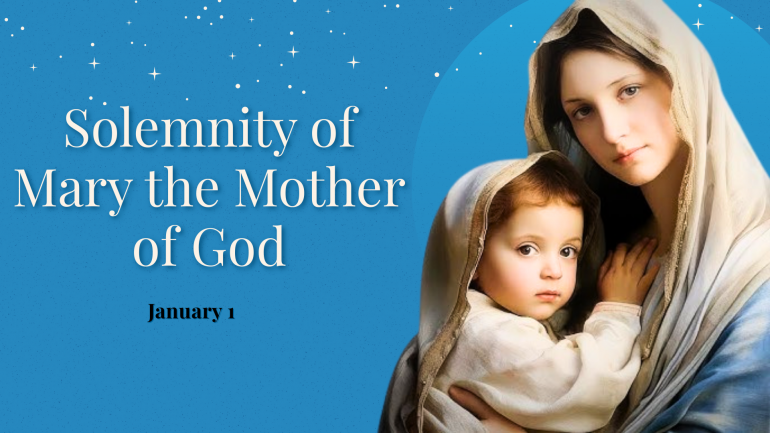
On January 1, the Church celebrates the Solemnity of Mary, the Mother of God, a feast that draws our attention to Mary’s unique place in the mystery of salvation. In the Church’s liturgical rhythm, the feasts of Jesus are often followed by a feast of Mary, sometimes the very next day, or within a week, highlighting her inseparable role in the life and mission of her Son.
Mary’s honored place is prefigured in Scripture. King Solomon, for instance, showed profound reverence for his mother Bathsheba by providing a throne for her at his right hand (1 Kings 2:19). How much more, then, would Jesus honor Mary, His own mother? How exalted must be the woman who bore the Son of God in her womb. Just as Solomon readily listened to his mother’s petitions, Christians believe that Jesus responds lovingly to Mary’s intercessions.
Mary’s exalted role among the saints presents her as a supreme model of faith and discipleship. In the Book of Revelation (Rev 12:1,5), St. John describes a vision of a woman clothed with the sun, crowned with twelve stars, and bearing a child destined to rule the nations. It is little wonder that Catholics, contemplating this vivid image, see in it a reflection of Mary as Queen of Heaven.
The Church’s belief in Mary’s Assumption has ancient roots. According to early Christian accounts, including traditions associated with St. Theodosius, the Assumption was already being celebrated in Palestine in the 4th and 5th centuries. This suggests that devotion to the Assumption was well established among the early followers of Christ, especially in the land where Jesus and His mother lived.
The Assumption is deeply consistent with Mary’s identity as Theotokos, the “God-bearer.” This title expresses the singular grace granted to Mary: that she bore God Himself in her body. The very concept of holiness, rooted in the Hebrew words qadosh and kodesh, and the Greek hagios, implies being consecrated and set apart for God. Mary’s holiness flows entirely from God’s initiative and grace.
From the beginning, Christians recognized the divine identity of Jesus Christ. Isaiah’s prophecy (Isaiah 9:6) is understood by Christians as pointing to the Messiah’s divinity, a truth later affirmed by St. Thomas the Apostle when he proclaimed, “My Lord and my God.” The reality of the Incarnation, God becoming flesh, stands at the very heart of Christian faith.
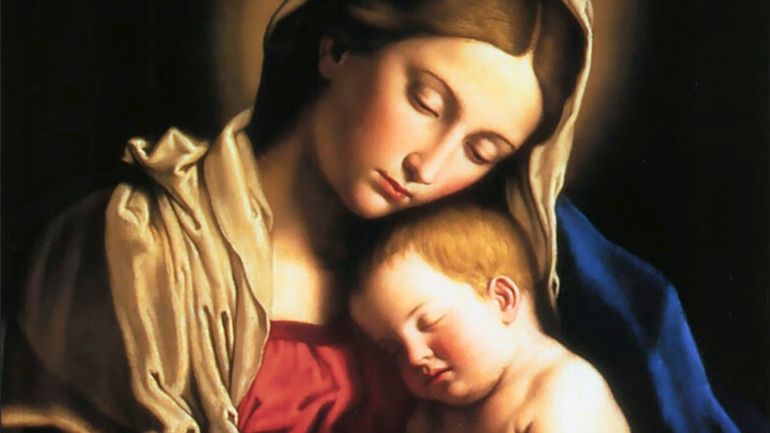
Yet this mystery raised profound questions among early Christians. How could Christ be both fully human and fully divine? Was He merely God appearing as a man? Or a human being specially united to God? These questions came to a head at the Council of Ephesus in AD 431, prompted by the teachings of Nestorius, Patriarch of Constantinople. Nestorius rejected the title Mother of God, arguing that Mary was the mother only of Christ’s human person, not His divine person, because he claimed Christ consisted of two separate persons.
The Church firmly rejected this view. It proclaimed that Christ is one divine Person, the Second Person of the Trinity, possessing two natures, divine and human, united without confusion or separation. As a result, the Church affirmed that Mary is truly the Mother of God, because she is the mother of the one Person, Jesus Christ, who is God incarnate. The title Theotokos thus became a touchstone of authentic Christian faith.
To deny Mary the title Mother of God would ultimately be to deny the truth of the Incarnation itself. As St. Paul wrote, “When the fullness of time had come, God sent His Son, born of a woman” (Galatians 4:4). Because Mary is the Mother of God, she is also, by grace, the mother of all those redeemed by her Son.
In Luke 1:28, the angel Gabriel addresses Mary as Kecharitomene, a Greek term meaning “full of grace” or “highly favored.” This unique form of address, used of no other human being in Scripture, points to the extraordinary grace God bestowed upon her. Catholic faith holds that Mary was conceived without original sin and, by God’s sustaining grace, preserved from personal sin throughout her life.
Why would God grant Mary such a singular privilege? When the Eternal Word became flesh (John 1:14), God willed that His sinless Son receive His human nature from a mother uniquely prepared by grace—one who would nurture Him until the time came for His divine mission to be revealed.
Mary is inseparable from Jesus. As Venerable Archbishop Fulton J. Sheen beautifully wrote in The World’s First Love: Mary, Mother of God: “The less we think of Mary, the less we think of Jesus. The more we adore His divinity, the more we venerate her motherhood.” Mary, he says, is like a window through which humanity glimpses divinity, or a magnifying glass that intensifies our love for her Son and enkindles our prayer.