



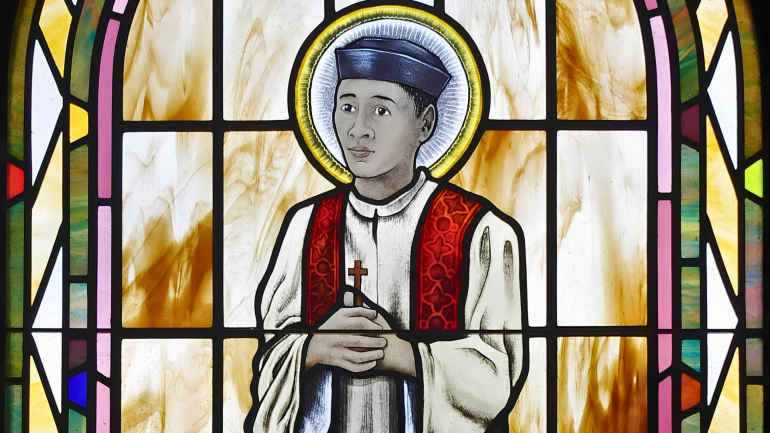
When we think of martyrdom, we tend to think of one great act of heroism. The story of St Andrew Dung-Lac, the Vietnamese priest who was beheaded in Hanoi on 21st December 1839, is a case in point. It was a long process of faithful living which culminated in that one final act. We celebrate their feast on November 24.
A Life Before the Sword
Andrew was born Trần An Dũng in 1795 in northern Vietnam into a poor family. He had no special standing or position. Like so many Vietnamese Catholics at that time, he was taught by catechists (laymen who taught the faith) as there were very few missionaries around and they were often in short supply or even driven out. He became a catechist himself, studied Latin and was ordained in 1823. For some 16 years he worked in the countryside, often in secret, moving from village to village and lodging with the families he served. Of the 117 martyrs canonised by Pope John Paul II in 1988, some were bishops and priests, but the majority were laymen (farmers, soldiers, catechists, mothers, etc.). Eleven were Spanish Dominicans, and ten were French missionaries. Most were Vietnamese, and they are only a small part of the many thousands (if not many thousands more) who perished during the persecutions of the Nguyễn emperors from the 17th to the 19th centuries.
The Lesser-Known Detail: He Was Ransomed, Then Chose to Stay
One thing that is frequently overlooked is that Andrew was arrested in 1839 with Fr. Peter Thi and a ransom was raised by the local Christians to secure his release. He was not free however. He was captured again and executed. This is significant because it demonstrates that his faith was not purely his own. The community had paid for his life and he was very much aware of that, yet he still chose to remain with his people.
Another aspect of this history which is frequently ignored is the role of the lay communities. There were groups such as the Lovers of the Cross (founded in the 17th century) who developed networks of prayer and mutual support which continued right through to the point when their priests were arrested. The martyrs were not simply individual heroes, they were men and women from communities which were themselves deeply committed and supportive.
A Psychological Reading
The sources on Andrew's inner life are very thin and hagiography in general is very good at smoothing over doubt so any psychological analysis has to be very cautious. That said modern psychology does provide us with some useful frameworks.
Meaning and endurance. Viktor Frankl observed that people who can find meaning in suffering will endure the most horrific of experiences. Andrew's years of secret ministry were a perfect illustration of this principle. It was a life of chronic uncertainty, of constant alertness and of the ever-present threat of betrayal all for the sake of a purpose which was greater than his own personal safety.
Identity under coercion. Imperial edicts required Christians to trample the cross as a public demonstration of renunciation. It was less a test of faith and more an attempt to force a public rupture between what you believed and what you did. That's the very essence of cognitive dissonance and the damage it can do. Many Christians did in fact yield to the torture and later repented. The Church has always had respect for the steadfast and has never had contempt for the fearful. That same compassion has a parallel in what we now call moral injury (the injury that results from acting against your values under duress). A faith which allows for return and forgiveness is a faith which is good for the human psyche as well as the soul.
Social support as protection. There's a huge body of contemporary research which shows belonging to be one of the very strongest predictors of resilience. The ransom, the hidden homes, the catechists who taught the kids by night all point to this. Andrew's courage was in no way his own. It was entirely the product of him being known and held by a community.
Self-efficacy and gradual courage. Bandura showed that confidence is developed through repeated experiences of overcoming difficulty. Andrew didn't become brave at the scaffold. It was years of small daily acts of fidelity that built up the capacity for the final act.
Why He Matters Today
We won't all be facing an executioner, but many of us will face the quieter version of Andrew's quandary. We'll be under pressure to suppress our views, to keep the peace by remaining silent, or to go along with the crowd and let that erode our inner sense of integrity. Andrew's example points to the idea that integrity isn't some grand gesture but rather a habit, one that is cultivated long before it is ever put to the test.
He's also speaking to a society in which isolation is a major issue. His story is a reminder that resilience is a communal thing and that the most practical form of courage may simply be to look after one another.
Finally, he speaks to the Vietnamese community and to all communities that have inherited the memory of persecution. We now have the concept of intergenerational trauma but also of intergenerational meaning. The memory of the martyrs can be a memory of gratitude rather than one of grievance and in that way it can become a source of identity and strength rather than a wound that is simply passed on unhealed.
Andrew Dung-Lac's feast is on 24th November along with his companions. It is worth remembering a priest who was poor at the start, who remained with his people and who lived faithfully long before he was called upon to die for it.