When the Church remembers St. John Vianney, the Curé of Ars, on August 4, it usually recalls a familiar image: the tireless confessor who heard sins for up to sixteen hours a day, the patron saint of parish priests, the man who "converted a whole town." That story is true but incomplete. Behind the plaster-statue version of Vianney is a stranger and more human figure. He was a man who, by every conventional measure, should have failed and whose interior struggles resemble conditions we now describe in clinical language.
The Boy Who Couldn't Pass the Test
Born in 1786 near Lyon, France, Jean-Marie-Baptiste Vianney grew up during the Revolution when priests were hunted, and Mass was said in secret barns. His early education was almost non-existent. He did not begin serious studies until his late teens, and Latin, the language of seminary formation, never came easily to him. He failed his exams repeatedly. Seminary officials nearly dismissed him. He was ultimately ordained less on his academic record than because his examiners judged his personal holiness and moral seriousness to be extraordinary. People know that Vianney was also briefly a fugitive. Conscripted into Napoleon's army in 1809, he fell ill, missed his unit's departure, and was informally classified a deserter. He spent over a year hiding in the mountains and working under a false identity before an imperial amnesty cleared his name. This period of enforced concealment, living with a constant undercurrent of fear and shame, shaped a personality already prone to self-doubt.
A Mind at War With Itself
Vianney's biographers describe, almost in passing, a lifelong condition that today would likely be called religious scrupulosity, a subtype of obsessive-compulsive disorder where a person experiences relentless, intrusive guilt over perceived moral or spiritual failure, regardless of the facts. Vianney fasted to the point of endangering his health, slept only a few hours on bare boards, and repeatedly petitioned his bishop to let him resign his parish and retreat into monastic anonymity, convinced he was unfit for ministry.
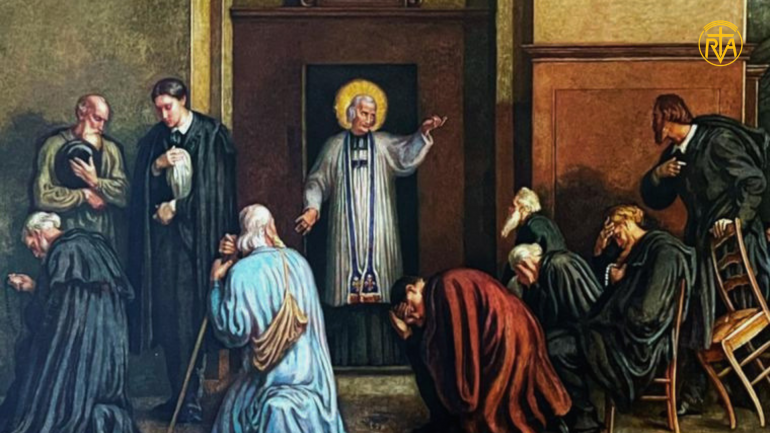
What makes Vianney psychologically interesting is not that he suffered this way but what he did with it. Rather than projecting his harsh inner voice onto those who came to him, he became famous for the opposite: an almost disarming gentleness in the confessional. Penitents from across France travelled to Ars because Vianney listened without the condemnation they expected and seemed to intuit the specific burden a person carried before they finished speaking. In modern therapeutic language, he offered something close to unconditional positive regard, full acceptance of the person independent of their disclosed failures, paired with an unusual gift for what we might now call attuned listening. He built a compassionate practice out of his own most painful material, refusing to let his private torment harden into judgment of others.
Why This Matters Now
Vianney's relevance today has less to do with confession as a ritual and more with the shape of his interior life. He is a case study in what psychologists call post-traumatic growth: someone whose early instability, self-doubt, and intrusive guilt did not produce cruelty or withdrawal but over decades produced an extraordinary capacity for presence with other people's pain. In a culture saturated with burnout, credential anxiety, and a nagging sense of not measuring up, Vianney is oddly contemporary, a man who never resolved his imposter syndrome, who wanted to quit his job more than once, and who nonetheless became the very thing his self-doubt insisted he could never be.
He also offers a quiet challenge to workaholism dressed as virtue. Modern readers should resist romanticising his marathon confessional hours or extreme austerities as a model to imitate literally; the Church has grown more cautious about celebrating self-punishment as spiritual heroism. The more durable lesson is different: unresolved pain, honestly carried rather than projected onto others, can become the material of compassion. In an era preoccupied with self-optimisation, Vianney suggests a less tidy but more human path, not the elimination of struggle but its transformation into attention for someone else's.