



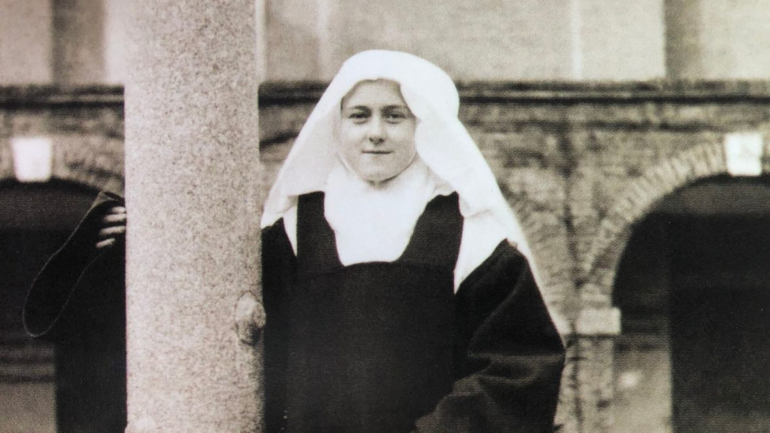
Thérèse Martin died on 30 September 1897 at the age of twenty-four in a rather unnoticeable Carmelite convent in Normandy; although she had never gone as a missionary, had not founded an order, nor had she written a theological treatise, she is still recognised as a Doctor of the Church, is co-patron of the missions, and is one of the most widely read spiritual writers of our time. The common portrayal of her as a sweet girl who used to scatter roses conceals the fact that she was in fact a far more interesting and psychologically perceptive individual. We celebrate her feast on October 1.
Beneath the Roses
Loss played a significant role in her early years. When Thérèse was four, her mother, Zélie, died from breast cancer, and then her sister Pauline, who had become her chosen 'second mother', went into Carmel; at the age of ten Thérèse fell ill with a peculiar sickness involving tremors, hallucinations, and fear. The recovery she credited to the smile of a statue of the Virgin, in today's terms, amounted to working through a grief that had never been expressed.
Attachment theory would pick up on this pattern: she had been a very sensitive child, prone to crying and troubled by what she referred to as scruples, a severe self-doubt which nowadays could be understood as involving obsessive-compulsive tendencies. The way she 'converted' on the night of Christmas 1886, by managing not to cry when her father made a careless remark, was not a sign of a pious miracle but rather a change in her method of emotional regulation, shifting from being controlled by her emotions to learning to keep them in check.
When she was fourteen, Thérèse asked to join the Carmelite order early, going against the established rules and regulations. This decision showed that she was determined, even though she was also very fragile. Her father, Louis, suffered a severe decline in his mental health and was sent to an institution for three years. Thérèse witnessed a dearly loved parent losing his mind and referred to this as 'a great humiliation'. She did not ignore or spiritualise away the pain.
The Hidden Darkness
The most remarkable, though less well-known, aspect of her life was the last 18 months. Since she was suffering from tuberculosis, she went through a period which she called a "night", during which it seemed as if heaven had disappeared and the idea of nothingness affected her. She stated that she sat at the table of sinners and unbelievers and shared their doubt rather than condemning it; she did not arrive at a certain resolution and simply continued to love within it.
Her sister Pauline edited her writings very extensively after her death, smoothing out her harsher features. It was not until the 1950s, when the original manuscripts were published, that readers encountered the true Thérèse: she was then found to be sharper, funnier, and more theologically assertive. In addition, she composed poetry and put on plays for her community, taking on the role of Joan of Arc herself, and she had a talent for satire and role-play.
A Psychology of the "Little Way"
Thérèse's "Little Way" is frequently treated in a sentimental way and is more accurately seen as a therapeutic realization; she came to the conclusion that she would never reach the state of heroic sanctity and, rather than becoming despairing, gave up the idea of perfection. She would be like a small child carried up the stairs by a parent, without having to earn the privilege of the ascent.
Modern psychologists would be able to identify a number of these ideas. First, there is self-compassion: instead of punishing herself, she responded to her weaknesses with gentleness. Secondly, there is what Winnicott referred to as the 'good enough' parent; she imagined God as someone who does not require flawless performance. A third idea is post-traumatic growth, the way in which early loss can lead to an increase in empathy rather than merely causing harm. She also engaged in a form of mindfulness by finding meaning in the dishes, in her difficult sister, and in small irritations. The fact that she showed consistent kindness towards a sister whom she found irritating, rather than expressing warm feelings, illustrates that behaviour can change before emotion does, a principle which is at the heart of contemporary cognitive-behavioural approaches.
There is one point to bear in mind: if she is regarded merely as an example for study, then her argument is overlooked, namely that these psychological patterns made her susceptible to something that went beyond herself. While psychology can explain how she coped, it cannot determine whether her trust was justified; that issue remains for the reader to decide.
Why She Matters Now
We nowadays live in an age that is full of anxiety, motivated by comparison, and worn out by the pressure to be exceptional. Thérèse provides an option that is not based on self-help optimism nor on resignation. Her "little way" shows exhausted professionals, to perfectionist students, and to caregivers that simple faithfulness is worthwhile. The fact that she doubts at night speaks to a generation that finds it hard to attain certainty, and by standing alongside the unbelievers, she demonstrates a way to maintain faith without holding those who don't believe in it in contempt. The way in which she admits her suffering can be identified by anyone who is going through grief, illness, or has a family member who is experiencing a mental decline.
She said she would "spend my heaven doing good on earth". More than 130 years later, her most radical idea remains that one need not be visible to be significant. A life lived in the background with love is sufficient.