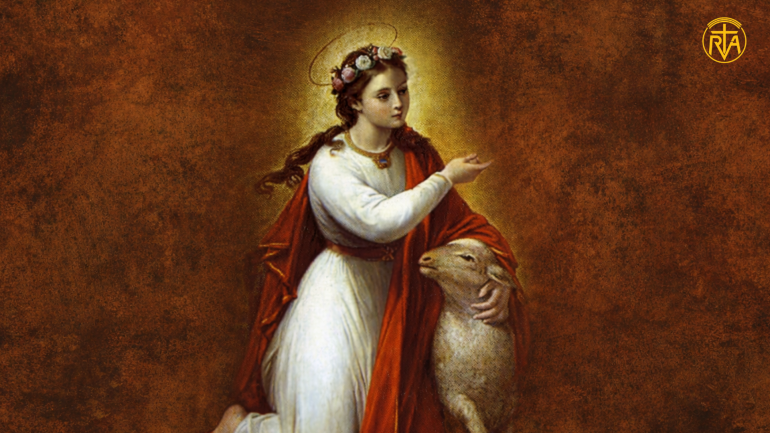
St. Agnes of Rome was barely a teenager when she was killed for her faith. Born around AD 291 and martyred during the Diocletian persecution in AD 304, she was only about 12 or 13 years old.
In the Rome of her time, she was powerless by every social measure — young, female, without political standing or legal protection. Yet centuries later, her witness continues to unsettle empires, cultures, and assumptions about what freedom really means.
Agnes did not die because she was passive. She died because she refused.
When pressured to renounce her Christian faith and marry a Roman nobleman, she declared herself already betrothed — not to a man of status, but to Christ. In a society where women were exchanged through marriage and the female body was treated as property, this was an act of extraordinary defiance. Her resistance was quiet, interior, and unyielding. She did not demand rights; she lived her dignity as a fact.
According to early Christian tradition, attempts were made to humiliate and break her resolve. They failed. Agnes remained steadfast, and she was eventually executed, most commonly believed to be by the sword. Her death sealed her place as one of the Church’s earliest virgin martyrs — a young girl whose courage embarrassed power.
Today, she is venerated as virgin and martyr, child saint, patron saint of young girls, virgins, and victims of sexual violence, and remembered symbolically as the innocent lamb, a living testament to courage, purity, and moral integrity.

Honoured Across Churches and Continents
This is why St Agnes continues to be honoured across the breadth of Christianity, far beyond any single denomination. In the Roman Catholic Church, her name is spoken in the Roman Canon of the Mass, placing her among the saints closest to the altar.
A basilica stands over her tomb in Rome, and her feast day on 21 January is marked with the blessing of lambs — their wool later woven into the pallium worn by metropolitan archbishops, a reminder that authority in the Church must be gentle, sacrificial, and accountable to the vulnerable.
The Eastern Orthodox Church venerates her as a great virgin martyr, praising her courage and steadfast faith in its hymns and liturgical texts. The Oriental Orthodox Churches — Coptic, Armenian, Syriac, Ethiopian, and others — also remember her among the early martyrs of Rome, holding her up as a model of resistance to oppression and fidelity under persecution.
In the Anglican Communion, particularly within High-Church traditions, Agnes is commemorated for her moral courage and integrity of conscience. Even in some Lutheran and mainline Protestant communities, she is remembered not for intercession but as a historic witness to faith lived without compromise.
Her presence in Asia, while smaller than in Europe, is still significant. In the Philippines, she is honoured with parishes and chapels, particularly in Quezon City, where her feast inspires youth devotion. In India, Catholic communities in Kerala, Goa, and other regions dedicate chapels and schools to her, often encouraging girls to model her courage and moral integrity.
In Malaysia, Singapore, and Indonesia, her name is less widespread but revered in schools, small chapels, and youth programs — a quiet but enduring witness to her influence across continents. Across Asia, her devotion may be niche, but it carries the same message: integrity, courage, and freedom of conscience know no boundaries.
Freedom of Conscience for Modern Women
This is also why St. Agnes remains strikingly relevant in conversations about feminism and women’s liberation today.
Modern feminism, at its best, insists that women have agency over their bodies, voices, and futures. Agnes lived that truth long before the language existed. Her martyrdom was not about repression or submission, but about bodily integrity as dignity. She refused to let her body be owned, traded, threatened, or used as leverage.
In an age that celebrates choice, Agnes forces a deeper question — what is choice for? She reminds us that freedom is not simply the ability to say yes, but the courage to say no when conscience is at stake. Her resistance was not against men as such, but against coercion, violence, and the stripping away of moral agency.
This is where Agnes challenges not only patriarchy, but also contemporary culture. Today’s girls grow up in a world that speaks the language of empowerment, yet often measures worth through appearance, approval, performance, and compliance. They are told they are free — but only if they are desirable, flexible, and endlessly accommodating. Agnes stands in quiet contradiction to this logic.
She was free because she knew who she belonged to.
For the Church today, Agnes is also a mirror. Her story warns against confusing authority with control, obedience with silence, or pastoral care with coercion. She reminds leaders that conscience is sacred, and that faith imposed by force ceases to be faith at all.
St Agnes did not live long. But she lived undivided.
And for young women navigating feminism, faith, and a culture that demands everything while promising little, her witness remains quietly revolutionary. She tells them this: You do not need permission to be whole. You are not free because you are wanted. You are free because you know where you stand.
That truth — honoured across churches, centuries, continents, and cultures — still has the power to disturb the powerful.