Along the coast of the Bay of Bengal in Santhome, Mylapore, a neighborhood in Chennai, the capital of the southern Indian state of Tamil Nadu, stands the National Shrine of St. Thomas Cathedral Basilica. The tomb of St. Thomas is at the center of this beautiful Gothic church, an architectural treasure.
St. Thomas, referred to as Didymus (Greek for "twin"), was one of the Twelve Apostles chosen by Jesus. Thomas experienced firsthand the company of Jesus, following Him closely throughout His ministry. On one occasion, after the death of Lazarus, the Gospel of St. John records that although the other apostles were reluctant to return with Jesus to Judea, Thomas' profound trust and courage inspired them when he said, "Let us also go, that we may die with him."
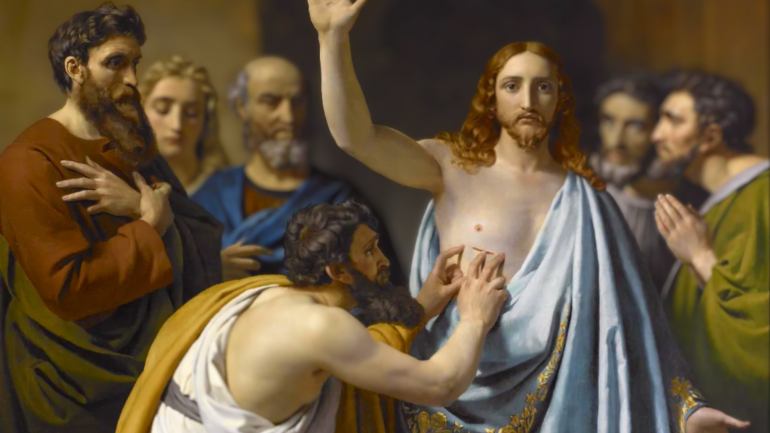
After the Resurrection, however, Thomas gave in to doubt and skepticism when the risen Jesus appeared to the other ten apostles while Thomas was absent. Thomas said his belief in Jesus was conditional until he could see and touch the wounds of the Crucifixion himself. Although he had witnessed Jesus' crucifixion and death, he insisted on seeing the marks of the Crucifixion on the risen Lord before believing. That moment came when Jesus appeared again and invited Thomas to put his finger into the nail marks and his hand into His wounded side.
Pope Francis illuminates our understanding: "Jesus does not give up, he does not get tired of us, he is not afraid of our crises, our weaknesses. He always comes back: when the doors are closed, he comes back; when we are in doubt, he comes back; when, like Thomas, we need to encounter him and touch him up close, he comes back."
The Lord comes to us with His reassuring presence, saying, "Doubt no longer but believe."
Pope Francis continues: "By telling us the story of St. Thomas' doubt, John's Gospel wants to tell us that God is not looking for perfect Christians. It is better to have an imperfect but humble faith that always returns to Jesus."
Thomas was absent when the risen Jesus first appeared to the apostles. For his sake, the merciful Lord came again. Pope Francis encourages us: "Jesus is the God of second chances"—opportunities we should never overlook, for He comes to show us His wounds so that He may heal ours.
After encountering the risen Lord and touching His wounds, Thomas rose above his weakness and doubt and proclaimed, "My Lord and my God." According to tradition, his journey of faith brought him to India in A.D. 52, where he arrived on the Malabar Coast in present-day Kerala, southwestern India. He traveled extensively for the next 17 years, preaching the Gospel and performing many miracles.
Tradition holds that a huge log of wood washed ashore near Santhome but could not be moved, even by elephants. St. Thomas used his girdle to pull it ashore. The king of Mylapore, impressed by the miracle, donated the log to Thomas, who used it to build a small chapel.
As persecution intensified, St. Thomas took refuge in a cave at Little Mount, about four miles from Santhome. He was martyred in A.D. 72 after being pierced with a spear while praying before a cross. Pilgrims continue to venerate the Bleeding Cross, which tradition holds was carved by the apostle himself.
After his death, his body was buried in the church he had built. A vessel containing earth believed to have been soaked with his blood, along with the spear that pierced him, was placed in his tomb. In the 10th century, Christians from Persia built a church over the burial site. The tomb has been opened four times, and tradition records that during the first opening, the son of Raja Mahadevan was healed of his illness.
St. Thomas Cathedral Basilica in Chennai, together with its adjacent museum where the spear believed to have killed the apostle is displayed, invites pilgrims to pray for the courage and zeal that marked his life and ministry. His faith and perseverance continue to inspire thousands of pilgrims who visit Santhome throughout the year to seek his intercession.
The Feast of St. Thomas is celebrated on July 3 and is observed as Faith Formation Day in some places.