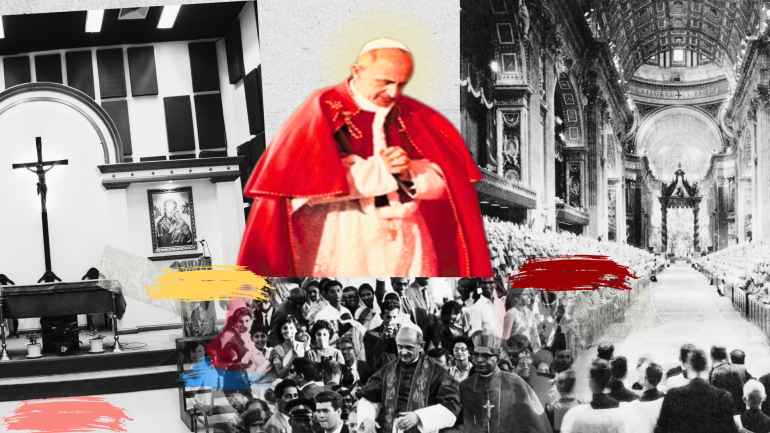
(The RVA Central Office in Quezon City, Philippines, has been blessed by visits from three saints of the Catholic Church — St. Paul VI, St. John Paul II, and St. Teresa of Calcutta. Their presence remains a lasting inspiration for RVA’s mission to proclaim the Gospel across Asia. As we prepare to rename our chapel the Three Saints Chapel in their honor, RVA launches a special series reflecting on their lives, their contribution to the Church’s mission in Asia, and their memorable visits to our broadcast center. Their witness continues to guide our work of faith and communication. – Editor)
On 14 November 2018, Pope Francis canonized Pope Paul VI (together with Oscar Romero and some others). In his homily, during the Eucharistic Celebration, Pope Francis said: “Paul VI spent his life for Christ’s Gospel, crossing new boundaries and becoming its witness in proclamation and in dialogue, a prophet of a Church turned outwards, looking to those far away and taking care of the poor. Even in the midst of tiredness and misunderstanding, Paul VI bore witness in a passionate way to the beauty and the joy of following Christ totally. Today he still urges us, together with the Council whose wise helmsman he was, to live our common vocation: the universal call to holiness. Not to half measures, but to holiness.”
In many ways, these beautiful words sum up and epitomise Pope Paul VI: man, message and mission!
Four significant dimensions defined Pope Paul VI and his Pontificate.
Mainstreaming Vatican II
While Pope John XXIII initiated and opened the council in 1962, he passed away in 1963, and Pope Paul VI took over, concluding the council in 1965. He signed and promulgated all 16 documents of the Second Vatican Council. These have become today the way of proceeding for the Church, not merely signposts or directions – but the spirit and letter, which need to be internalized and actualized. The Vatican II documents have had ramifications in the Church and helped in the reforms-, which was essentially the vision of the Council.
Synod of Bishops
The experience of the Church gathered in the Second Vatican Ecumenical Council (1962-5) motivated Pope Paul VI to “permanently establish a special Council of bishops, with the aim of providing for the continuance after the Council of the great abundance of benefits that We have been so happy to see flow to the Christian people during the time of the Council as a result of Our close collaboration with the bishops” (Apostolic Letter ‘Apostolica Sollicitudo’). Thus, the modern Synod of Bishops was born in 1965. That Synod was the logical outcome of a very special period in the history of the Church.
Development of Peoples
In his Encyclical dated 26 March 1967, ‘Populorum Progressio’ (On the development of peoples), Pope Paul VI focused on the "development of peoples" to address global poverty, inequality, and social injustice. The encyclical argues that the world economy should serve all of humanity, not just a few, by promoting solidarity, social justice, and a more equitable distribution of the Earth's resources. It emphasizes the need for wealthier nations to aid developing countries, the importance of workers' rights, and the idea that true development is a holistic process that includes spiritual and moral growth. Pope Paul VI also stressed that true development goes beyond economics to include social, political, and spiritual growth. The encyclical called for wealthy nations to provide aid to poorer nations, emphasizing that the world's resources should be shared for the common good. It advocated for fair wages, secure employment, safe working conditions, and the right to join a union.
Social Justice
In 1971, when Paul VI convoked the Synod of Bishops, it focused on ‘Justice in the World’. That was a watershed moment for the Church. In the section ‘The Gospel Message and the Mission of the Church’, the Synodal document offered a new understanding of sin "In the face of the present-day situation of the world, marked as it is by the grave sin of injustice, we recognize both our responsibility and our inability to overcome it by our own strength. Such a situation urges us to listen with a humble and open heart to the word of God, as he shows us new paths toward action in the cause of justice in the world." The Synod document’s message can be summed up in one well-known sentence, “Action on behalf of justice and participation in the transformation of the world fully appear to us as a constitutive dimension of the preaching of the Gospel, or, in other words, of the church’s mission for the redemption of the human race and its liberation from every oppressive situation”. The promotion of justice is a necessary feature in the task of evangelization. Paul VI was unequivocal about this!
There is certainly much more that can be said about Paul VI: man, message, and mission. If he were alive today, he would have reiterated those words from his address to the UN General Assembly in 1965, "No more war, and war never again! Peace, it is peace which must guide the destinies of people and of all mankind."
Pray for us, Saint Paul VI!