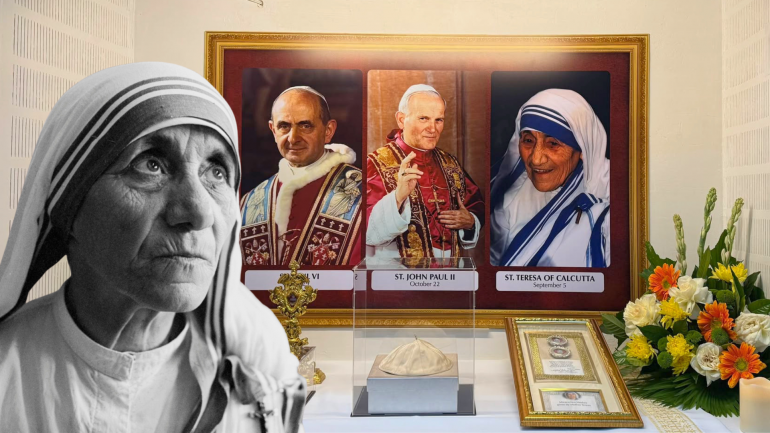
(On April 12, Divine Mercy Sunday, in a moving ceremony witnessed by over 200 faithful, the renovated RVA chapel in Quezon city, Philippines, was dedicated as the Three Saints Chapel, honoring St. Paul VI, St. John Paul II, and Mother Teresa of Calcutta. In this reflection, Sr. K. J. Belji, a Sister of Charity of Nazareth and an RVA freelancer based in Patna, India, invites readers to look beyond grand monuments and encounter the quiet power of a simple room that shaped Mother Teresa’s mission. – Editor)
Our society often cherishes and preserves monuments of grandeur. Yet, one of the most powerful memorials to Mother Teresa is not a towering structure but a small, unassuming room. Situated on the campus of the Missionaries of Charity in Patna City, Bihar. Here, simplicity becomes proclamation, and memory transforms into mission.
Patna, the capital of the eastern Indian state of Bihar, holds a special place in the life of Mother. At that time, the current Kurji Holy Family Hospital was known as Holy Family Hospital and functioned on the premises of Padri Ki Haveli in Patna City, eastern India. It was here that Mother Teresa stayed for about three months in 1948. She received nursing training and virtually commenced her service for the poor. This room is preserved with devotion by the sisters. At first sight, the setting appears plain. Yet, in that very plainness lies a profound testimony.
The walls carry a carefully curated collection of photographs that narrate the unfolding of her vocation. These are not mere images; they are windows into a life consumed by love. One sees her among the poor, holding the abandoned, tending to the sick, and offering dignity to those left on the margins of society. Each photograph reflects her unwavering conviction that every human person is worthy of love and care. These images together form more than a visual record; they echo a spiritual vision. They present a Gospel lived in action, that charity is not an abstract ideal but a daily, deliberate choice. In this sense, the walls themselves become a form of silent preaching, inviting every visitor to move beyond admiration into participation in this mission of love. Her vision was clear and compelling: to see Christ in the poor and to serve Him with wholehearted devotion.
Moving into the room, we find her bed, simple and unadorned. It reflects a life that consciously rejected comfort in favour of solidarity with the poor. Isn't it a contrast to the nature of human beings' tendency to accumulate luxury? She taught us that true richness lies not in possession, but in self-giving. Nearby, a modest table and chair are preserved with great reverence. These ordinary objects speak volumes. One can imagine her seated there, reflecting, praying, or preparing for the work that lay ahead. There is no trace of grandeur, no sign of status, only a simplicity that reveals the depth of her interior life. The woman who would one day touch the hearts of millions once occupied this very space, embracing each moment with faith and purpose.
Visitors entering the room experience a deep sense of reflection. The atmosphere encourages stillness, not through instruction, but through its very presence. The room does not overwhelm; it invites. It does not display; it reveals. It becomes a place where one encounters not only the memory of a saint, but also the call to live with greater compassion.
The sisters of the Missionaries of Charity have maintained this space not as a museum, but as a living testimony. Its simplicity mirrors the spirit of their foundress; unpretentious, focused, and deeply rooted in love.
Close to this sacred space stands the historic Padri Ki Haveli, the oldest church in Bihar, built in 1713 originally and redesigned in 1772. It stands as a landmark of steadfast faith. Together, the church and this preserved room create a powerful harmony of prayer and service. If the church proclaims the Word of God, this room demonstrates how that Word is lived out in concrete acts of love.
Today, the spirit of Mother Teresa lives on through the dedicated service of the Missionaries of Charity in Patna. Their house in the city stands as a humble yet powerful centre of compassion and selfless service. The sisters are actively engaged in caring for the most vulnerable sections of society. The abandoned, elderly, destitute women, orphaned children, and those suffering from chronic illness have a special place in their hearts. One of the most touching aspects of their ministry in Patna is their personal approach to care. The sisters do not merely provide material assistance; they offer presence, compassion, and a sense of belonging.
Within the sacred chapel of the Mother House in Kolkata, the statue of Mother Teresa continues to inspire me. Depicted in her familiar white sari with blue borders, she is shown in deep devotion, her hands gently folded and her head slightly bowed. The posture reveals not grandeur, but surrender, a soul entirely turned towards God. Her focus rests on her interior life; her expression conveys peace and humility. No wonder she was able to accomplish so much!
May the life and vision of Mother Teresa inspire us, affirming that love in action transforms the world.