


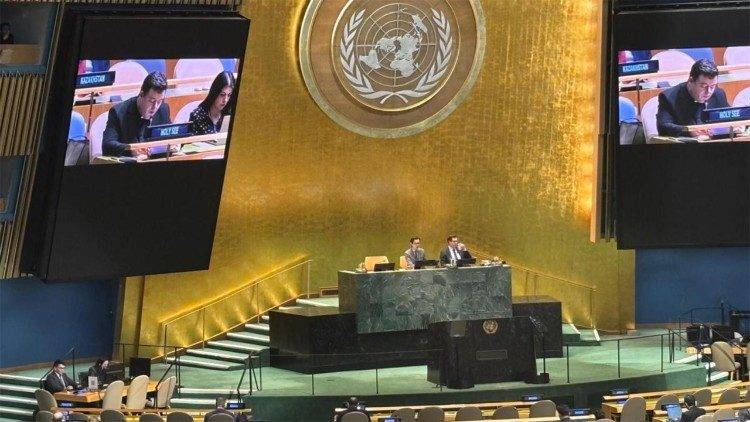
The Holy See has warned that renewed reliance on nuclear deterrence, the modernization of arsenals, and the growing integration of artificial intelligence (AI) into military systems are driving the world toward a more fragile and dangerous security environment.
Speaking at the General Debate of the Eleventh Review Conference of the Treaty on the Non-Proliferation of Nuclear Weapons (NPT) at the United Nations in New York on April 29, the Holy See’s Permanent Observer Mission described the current moment as one of “profound gravity,” according to Vatican News.
Amid rising geopolitical tensions and weakening arms control regimes, the delegation expressed concern over a renewed normalization of nuclear rhetoric, including threats involving possible use and testing of nuclear weapons. It also pointed to recent attacks on nuclear facilities as evidence of the erosion of long-standing international safeguards, as reported by Vatican News.
Quoting Pope Leo XIV, the Holy See warned of a troubling shift away from multilateral diplomacy rooted in dialogue and consensus toward approaches increasingly “based on force,” Vatican News reported.
A central concern was the increasing role of artificial intelligence in nuclear decision-making systems. The Holy See cautioned that AI compresses critical human decision time during crises, heightening “the risk of miscalculation” and weakening moral responsibility in life-and-death judgments, according to Vatican News.
Reaffirming the importance of the NPT, the Holy See stressed its three pillars, disarmament, non-proliferation, and peaceful use of nuclear energy, as indispensable to global stability. It emphasized that Article VI imposes a binding obligation on nuclear-armed states to pursue good-faith negotiations toward complete disarmament, an obligation it said is increasingly urgent as arsenals are modernized and deterrence doctrines expanded .
The mission warned that such trends risk entrenching “a paradigm that is already strategically and morally questionable,” noting that reliance on deterrence reflects “mutual vulnerability sustained by the threat of force rather than law and trust,” as highlighted by Vatican News.
On peaceful nuclear use, it reaffirmed states’ rights to develop nuclear technology for medicine, agriculture, food security, and environmental protection, within strict international compliance.
Concluding, the Holy See echoed Pope Leo XIV’s call for “a peace that is disarmed and disarming,” emphasizing that authentic peace must be built not on fear, but on “trust, dialogue, and the recognition of our shared humanity,” according to Vatican News.
Radio Veritas Asia (RVA), a media platform of the Catholic Church, aims to share Christ. RVA started in 1969 as a continental Catholic radio station to serve Asian countries in their respective local language, thus earning the tag “the Voice of Asian Christianity.” Responding to the emerging context, RVA embraced media platforms to connect with the global Asian audience via its 21 language websites and various social media platforms.
Latest News