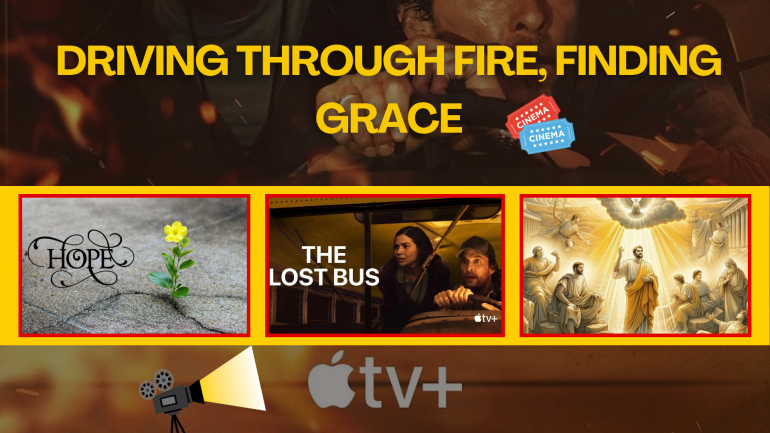
There are films that entertain, and then there are films that burn their way into your conscience. The Lost Bus does both.
Directed by Paul Greengrass, this Apple TV+ original roars through terror, tenderness, and transcendence in equal measure. Inspired by true events from the 2018 Camp Fire, California's deadliest wildfire, this is the story of an ordinary school bus driver and a courageous teacher. Kevin McKay (Matthew McConaughey) and Mary Ludwig (America Ferrera) drove their bus through an inferno to save 22 children.
The plot sounds simple, but the director turns it into something visceral. The fire, the fear, the choking smoke, all are rendered with the intensity of a war film. The first act lingers a bit too long on Kevin’s personal tragedies: a broken marriage, a sick son, a dying dog, pain layered upon pain. Yet, once the wheels of the yellow bus start rolling into chaos, the movie grips you like a prayer said in panic.
Greengrass, co-writing with Brad Ingelsby (Mare of Easttown), adapts a small chapter from Lizzie Johnson’s Paradise: One Town’s Struggle to Survive an American Wildfire. The result is a cinematic hymn to ordinary heroism. Ferrera delivers one of her finest performances yet, balancing maternal warmth and raw fear. McConaughey, meanwhile, is at his earthy best, less movie star, more every man saint.
One standout moment is when Mary steps off the bus to find water for the suffocating children. The silence, broken only by the roar of flames, feels almost sacramental. Another is when Kevin tears his shirt into strips, wets them, and hands them to the children to breathe through, “baptising” them in sweat and smoke. They hold those strips to their faces like relics of survival. When one teacher whispers, “Just pray, honey, just pray,” the moment transcends cinema; it becomes a communal liturgy of fear and faith.
And that’s where theology sneaks in, not as sermon, but as subtext. The entire film could be read through the lens of Pauline theology of hope and perseverance. In Romans 5:3-5, Paul writes: “We also glory in our sufferings, because we know that suffering produces perseverance; perseverance, character; and character, hope.” The journey of that lost bus mirrors this divine logic. Every turn through the burning town feels like a purgatorial passage, human fragility refined by fire.
McKay, like Paul’s weary traveller, drives not out of certainty, but of stubborn hope. Hope that there’s still a road ahead. Hope that no child will be left behind. Hope that even in a world ablaze, grace can still be found behind the wheel. His line, “We don’t leave till every kid’s home,” could have been lifted from the Gospel itself, a modern echo of the Good Shepherd who leaves none of his flock behind.
In a way, The Lost Bus becomes a cinematic parable about salvation. The flames could stand for sin, despair, or the apocalyptic chaos of our age, climate change, war, indifference. The bus, with its frightened passengers, becomes the Church: imperfect, frightened, often stuck in traffic, yet still moving toward life. Kevin and Mary become unlikely apostles, flawed yet faithful, trusting that movement itself is grace.
There’s an almost wacky holiness in Greengrass’s realism. It’s as though he baptises the action genre in theology. The road, wrapped in fire, looks like the narrow path Jesus spoke of: “For the gate is small and the way is narrow that leads to life.” Watching Kevin steer through hell feels like watching faith itself, sweaty, trembling, yet steady on the gas.
By the end, when they emerge from the smoke, we are left with no choir, no sermon, just breath, tears, and a sky clearing. Salvation, it turns out, is quiet. Sometimes grace doesn’t descend from heaven; it’s driven through the fire by a bus driver who refused to turn back.
There’s also a subtle critique tucked in the flames. The fire was caused by corporate neglect, an electric company’s faulty line. Greengrass doesn’t linger there, but the theology of The Lost Bus brings out the aspect of justice: creation burns because of human greed. Yet amid the ashes, human goodness still flickers. In every crisis, there are McKays and Marys, ordinary saints steering through catastrophe.
Pauline hope doesn’t deny the fire; it drives through it. That’s what The Lost Bus teaches us. In the end, the movie isn’t about disaster; it’s about direction. Not about the loss, but the lost who are found.
Maybe our lives are all burning towns in some way, jobs collapsing, relationships smoking, faith choking in the fumes of modern anxiety. But perhaps the Gospel calls us, like Kevin, to get behind the wheel anyway. To keep moving, trusting that the road ahead, however scorched, still leads to resurrection.
When the road ahead of us blazes with fear and loss, do we, like Kevin McKay, still dare to drive through, trusting that hope, like grace, is often found only in the fire?