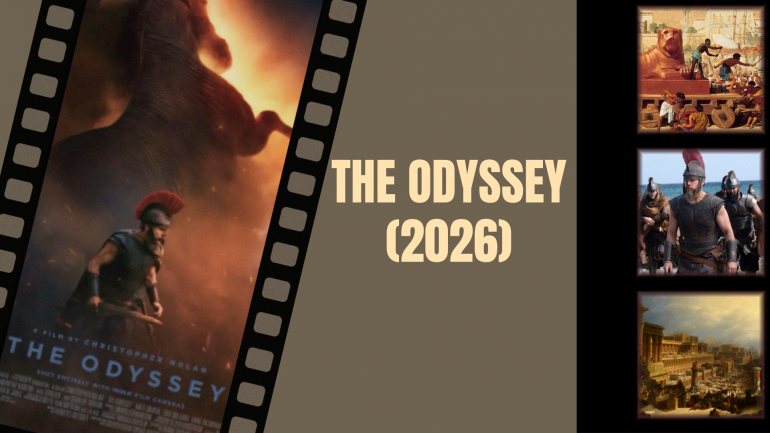
Christopher Nolan’s $250 million IMAX spectacle, The Odyssey, takes on Homer’s ancient Greek epic through grand cinematic scale and a layered, non-linear narrative. At its center is a grizzled and war-weary Odysseus, played by Matt Damon, whose triumphant departure from Troy becomes a desperate ten-year struggle to return home.
Waiting for him in Ithaca are his faithful wife, Penelope, played by Anne Hathaway, and their son, Telemachus, played by Tom Holland. Their home has been overrun by predatory suitors, led by the smug and calculating Antinous, played by Robert Pattinson. As Odysseus fights monsters, temptations and gods across the sea, Penelope and Telemachus face another kind of battle: preserving a household slowly being consumed from within.
Nolan rearranges time like a deck of cards, allowing memory, guilt and prophecy to bleed into one another. Working alongside editor Jennifer Lame and composer Ludwig Göransson, he creates an immersive audiovisual experience. Shot entirely using IMAX 70mm cameras, the film moves between enormous spectacle and suffocating dread, from the darkness of the Cyclops’ cave to the hypnotic terror of Circe’s island.
At its deepest level, Nolan’s The Odyssey raises a theological question: What happens when we violate what is sacred, lose our faith and turn our spiritual home into a ruin? Odysseus’ crisis is not merely geographical. He is not simply a man trying to cross an ocean. His exile is spiritual.
Odysseus comes to recognize that his greatest achievement, the Trojan Horse, was also a profound violation of xenia, the sacred law of hospitality, human dignity and mutual obligation. The Greeks won the war, but in doing so, they became the very lawless people they had once feared.
As Penelope tells her disguised husband, the Greeks themselves became the “people from the sea,” carrying violence and disorder wherever they went. Their victory over Troy did not restore civilization. It helped destroy the moral order they claimed to defend. This offers a striking parallel with the Old Testament account of the Exodus.
The Israelites were freed from slavery in Egypt by the mighty hand of God. Yet in the wilderness, they repeatedly doubted His providence. They complained against Moses, created a golden calf, and longed for the false security of their former captivity. The desert exposed what remained unhealed within them.
Odysseus’ journey functions in much the same way. Like Israel, he has been delivered from an enemy but remains imprisoned by distrust, pride, and fear. He condemns the gods while lamenting the consequences of his own choices. Speaking to the Sirens, he says:
“What you most want is what you most cannot have. And what you most cannot have is what you already had, and lost.”
The Israelites failed to enter the Promised Land immediately, not because the desert was impossible to cross, but because their hearts were not yet ready to trust the God who had saved them. Odysseus also prolongs his exile. His greatest fear is not Poseidon’s ocean or the monsters hidden within it. It is the fear of returning home and confronting what he has become. He must face the possibility that his actions at Troy destroyed the very moral world to which he now longs to return.
Both journeys reveal the same spiritual truth: the wilderness is not only a place of punishment. It is also a place of revelation. It reveals what power, success and self-confidence often conceal. It strips away illusions of control and forces the wanderer to confront the truth about himself.
At one point, Odysseus cries, “Why can’t the gods speak in a way we can understand? Who does not understand pain?” His lament echoes the cries of Israel in the desert. It is the cry of a person who wants God to explain suffering before he is willing to trust.
Yet redemption begins when Odysseus understands that sacrifice cannot be reduced to strategy. As the film observes, “the power of sacrifice is in the cost to the person making it.” Moses had to surrender his self-reliance in order to lead Israel. Odysseus must likewise abandon his dependence on polymēchania, his celebrated ability to escape every problem through schemes, disguises and cleverness.
The very quality that once made him heroic has become the obstacle to his healing. He cannot trick his way into redemption. He cannot conquer his way back into innocence. He cannot manipulate the gods into giving him peace. Home cannot finally be reached through force, deception or conquest. It must be received as grace.
Odysseus can return only when he accepts his limits, acknowledges the harm he has caused and relinquishes the illusion that intelligence alone can save him. Ithaca is therefore more than a destination. It becomes an image of reconciliation, a home made possible not through the hero’s strength, but through surrender.
We often create wildernesses of our own. Through pride, anger, ambition or fear, we damage relationships and betray sacred trusts. We burn walls that once protected something precious. Then, ashamed of what we have done, we convince ourselves that the road home has disappeared.
But the Christian hope is that no wilderness is beyond the reach of grace.
The journey home may require truth, repentance and sacrifice. It may demand that we surrender the clever stories we tell to justify ourselves. Yet the door is never completely closed to the heart willing to abandon its illusions of control.
Perhaps the greatest danger is not that we have wandered too far, but that we remain attached to the pride that keeps us wandering.