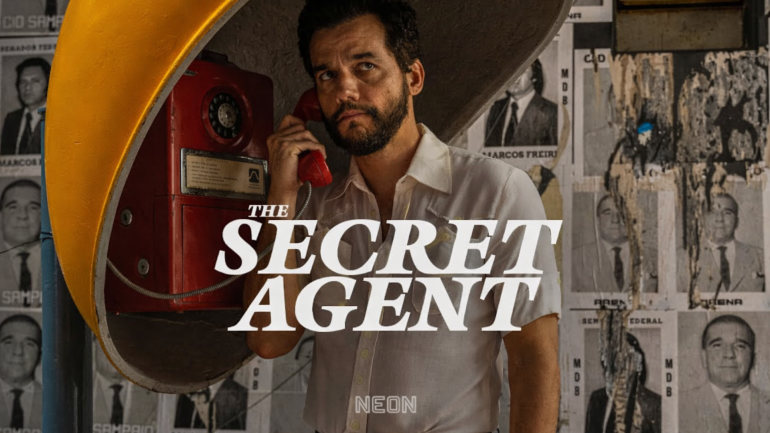
Set in 1977 Brazil during a tense military dictatorship, The Secret Agent follows Marcelo, a quiet and thoughtful man who arrives in the coastal city of Recife in a bright yellow Volkswagen Beetle. He seems ordinary at first, just another traveller stopping at a dusty gas station, but something about him feels hidden. Slowly we realise that Marcelo is living under another identity. A former researcher and widower, he is a man pursued by danger, haunted by memories, and quietly searching for something lost, perhaps truth, perhaps family, perhaps himself.
What follows is a mysterious, sometimes surreal journey through fear, memory, and moral courage.
Directed by the brilliant Brazilian filmmaker Kleber Mendonça Filho, the film carries the unique storytelling style that marked his earlier films Aquarius and Bacurau. Not rushing his audience, Mendonça Filho does lets the atmosphere of dictatorship-era Brazil to slowly seep into the viewer’s mind.
The lead role is played by Wagner Moura, whose performance is deeply restrained yet emotionally powerful. Moura’s Marcelo speaks little, but his eyes carry the weight of an entire life. At times, a single glance tells more than a page of dialogue.
The movie opens with an unforgettable scene. Marcelo stops at a lonely gas station where a dead body lies half-covered with cardboard. The police arrive, but instead of caring about the corpse, they inspect Marcelo’s car and casually ask for a “donation” to the police carnival fund. Corruption is so normal that no one seems shocked. Marcelo quietly hands over a few cigarettes and drives away while the soft melody of Chicago’s “If You Leave Me Now” plays in the background.
Watching this film through a faith and liberative lens, one theme quietly stands out: truth hidden under fear.
In the Gospel of John, Jesus says:“You will know the truth, and the truth will set you free.” (John 8:32)
But in The Secret Agent, truth is dangerous.
People speak in codes. Records are altered. Police manipulate the law. Even identities are changed. Marcelo lives under a false name simply to stay alive. In a world like this, truth becomes something fragile, almost sacred.
One small scene captures this beautifully. Marcelo secretly searches government archives for traces of his disappeared mother, digging through files, forgotten records, fading documents.
It reminded me of something deeply theological: God’s truth is never fully erased, even when buried under systems of power.
Just as prophets in the Bible spoke the truth during oppressive times, Marcelo’s quiet resistance becomes its own kind of testimony. He does not shout slogans or lead revolutions. Instead, he performs small acts of courage: protecting people, caring for his son, refusing to become cruel in a cruel world.
In the Bible, Elijah did not encounter God in the earthquake or the fire, but in the gentle whisper (1 Kings 19:12).
Marcelo feels like that whisper. Another touching moment comes when his young son asks about his mother who has died. The innocence of the child contrasts sharply with the violent world around them. In that moment, the film reminds us that love, especially parental love, remains one of the last refuges of humanity.
Even under dictatorship, a father still worries about his son. Perhaps that is where the Gospel quietly lives in the film.
Despite its serious themes, the movie occasionally slips in subtle humour. One elderly woman running a safe-house for dissidents speaks with such dry sarcasm that you almost expect her to offer tea to assassins if they knock politely enough.
And the criminals themselves sometimes behave like bored office workers discussing routine tasks, except their “office work” involves murder. It’s darkly funny in a way that makes you shake your head and mutter, “Human beings are strange creatures.”
By the end, The Secret Agent leaves us with a haunting realisation: systems of power may silence people, erase records, and rewrite history, but memory and conscience keep whispering the truth.
And that brings us back to faith.
Christian theology reminds us that God’s kingdom often grows quietly, like a mustard seed, unnoticed at first. Courage is not always loud. Sometimes it looks like a tired man driving a yellow Beetle down a dusty road, trying to protect what little goodness he still can.
So perhaps the real question this film asks is not about spies or dictators.
It is about us.
When the world around us becomes comfortable with silence, will we still choose to live in truth?