



The most effective speech is not a sermon but a witness.
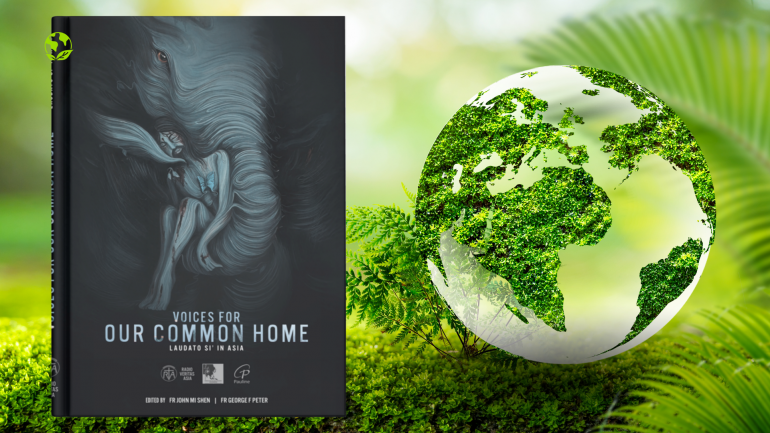
Voices for Our Common Home, a commemorative book released by Radio Veritas Asia on the occasion of Laudato Si’ completing a decade, is exactly that. The book showcases how countries and communities in Asia have been living out Pope Francis’ vision as articulated in his encyclical. Here is a foresight-driven summons for us to recognize the interrelationship between caring for Creation, social justice, and moral responsibility as stewards of God’s masterpiece.
Laudato Si’ spurred a revolution of ecological conversion in the Catholic Church, which over the years has demonstrated courage, creativity, and pastoral commitment in different parts of the world. As a directive, it inspired a journey of introspection, leading to a proactive orientation toward harmony with creation, solidarity with the poor, the promotion of simpler and more sustainable lifestyles, and the nurturing of a spirituality that deepens our relationship with God and all of His creation. Thus, it embodies the encyclical’s insight that “the cry of the earth and the cry of the poor” are inseparable (LS 49).
I have read the book cover to cover. If you haven’t, I suggest you purchase a copy now.
Psalm 24:1 echoes the Pope’s reminder that “everything is connected” (LS 91). Every creature and ecosystem in the cosmos, no matter its size or position, has a purpose. Caring for creation is not an isolated act but is intrinsically linked with faith, spirituality, and justice. When we look upon ecological conservation as a vocation, we deepen our awareness of the sacred bond we share with all creation. Only then will our efforts to obtain justice for all causes be renewed, and our endeavors to save our common home become fruitful.
Laudato Si’ (LS 12) maintains that none is superfluous. The entire material universe speaks of God’s love and His boundless affection for us. We cannot turn a blind eye to realities where environmental degradation and ecological crises are not abstract concerns but harsh realities affecting daily life, livelihoods, and landscapes. There are a minuscule number of courageous people raising their voices against the injustices suffered by the most vulnerable in society, filling the world with reasons for hope. And the role of the vast majority? Sadly, to sit back recounting horrifying statistics on social media.
As the World Environment Day Conclave unfolds in Baku, the capital of the Republic of Azerbaijan, millions of people across the world will participate in online and in-person activities and events aimed at accelerating responsible environmental progress for the planet and its creatures. The cry of God’s handiwork, suffering through climate change, the loss of natural flora and fauna, and uncontrolled pollution of resources, has thankfully in recent times prompted countries to work more closely than ever before to address these challenges and commit themselves to creating a healthier environment and a greener world.
Some such initiatives I have observed and been involved in are at my parish of St. Michael, the parish of Our Lady of Victories, and Canossa High School, all located in Mahim, Mumbai, western India. Able leadership amplified the call for an integrated ecological and social conversion, encouraging believers and students, the future of the world, to translate their faith into concrete transformative action. Understanding ecology is not merely about addressing an issue; it is about being a synodal Church, one that listens, witnesses, and acts with compassion.
There are still many Indigenous communities that continue to demonstrate ecological responsibility through native wisdom, community-based living, and resistance to exploitation, despite facing significant threats. We may have a long way to go before we, as a Church, succeed in awakening those still untouched by these human realities, fostering fearless engagement and a renewed commitment to safeguard God’s gift for this generation and those to follow. But hope endures.
Laudato Si’ emphasizes the fact that every living thing is part of a larger system, where its existence depends on the existence of other creatures. Any disruption in this mutuality can have cascading effects, something humans often adopt an ostrich-like attitude toward. Cloudbursts once considered a distant reality have wreaked havoc on the geosystem of the Western Himalayas, causing extensive loss of life and widespread destruction. Laudato Si’ calls those who believe in an all-powerful Creator, especially Christians, to a paradigm shift in our treatment of the environment.
In Genesis 1:28, God called us to “subdue” the earth. Yet a throwaway culture, rising carbon footprints, inequity that curtails basic human rights, and weak-willed political leadership continue to wreak havoc on the Earth, with its vulnerable atmosphere and limited resources. We have searched the universe for an alternative residence for years, to no avail. Hence, instead of acting as though we own the world, we need to act as caretakers accountable to God, who is the ultimate Creator and owner of the world, bearing in mind that all our choices have eternal consequences.
The paradox of our time is that we have used technology to make deserts bloom while also misusing it to harm our common home. The measure of our intelligence is our ability to change and adapt. The faster, the better.
Our reward may not be one of this world, but we can look forward to hearing the Master's voice echo the words of Matthew 25:21: “Well done, good and faithful servant.”