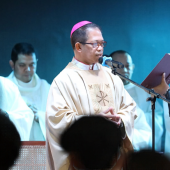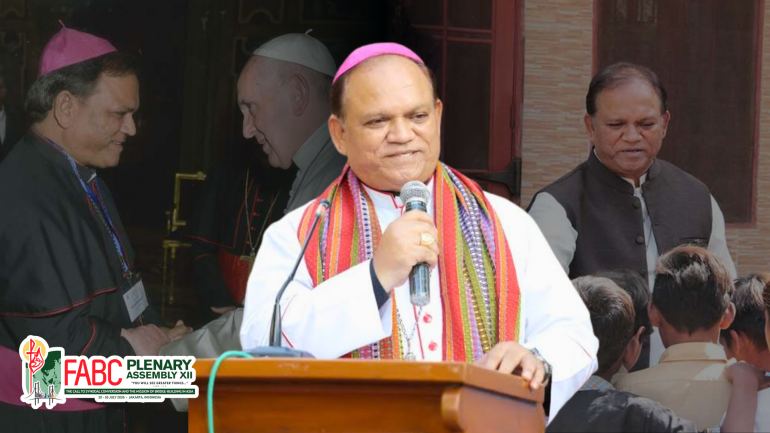
A leading voice for religious freedom, human rights, and social justice in Pakistan, Bishop Samson Shukardin has served as bishop of the Diocese of Hyderabad since 2015. He also serves as president of the Pakistan Catholic Bishops' Conference.
As Catholic leaders from across the continent prepare for the upcoming 12th Federation of Asian Bishops' Conferences (FABC) Plenary Assembly in Jakarta, RVA spoke with Bishop Samson about his expectations for the assembly, the importance of interreligious dialogue, and the experiences and contributions of the Church in Pakistan to the wider Asian Church.
Excerpts:
RVA: Your Excellency, what are your primary expectations for the upcoming FABC Plenary Assembly in Jakarta?
Bishop Samson: My core expectation is that the Assembly will serve as a profound moment of global solidarity and mutual listening. For a minority Church like ours in Pakistan, the FABC is a vital platform to connect with the larger Asian Catholic body. I expect it to strengthen the bonds between different regional conferences, allowing us to share pastoral challenges and renew our collective commitment to the Gospel in an increasingly complex socio-political Asian landscape.
RVA: What major issues do you hope the Assembly will address during its sessions?
Bishop Samson: I deeply hope the Assembly addresses the rising challenges of religious intolerance, the protection of marginalized minority communities, and youth empowerment across Asia. Additionally, the economic vulnerabilities of our people and the impact of climate change, which heavily affects countries like Pakistan, are urgent pastoral matters.
We must also confront the rapid, profound impact of the digital revolution; as Pope Leo XIV highlighted in his new social encyclical, Magnifica Humanitas, the rise of Artificial Intelligence poses a severe risk of further dehumanization and economic displacement for the most vulnerable if it lacks moral guardrails.
The Assembly must look at how the Church can practically safeguard human dignity against both traditional social inequalities and these new technological shifts, offering concrete hope to families facing structural discrimination and poverty.
RVA: What specific contribution can the Church in Pakistan make to the wider Asian Church?
Bishop Samson: The Church in Pakistan brings a profound message of resilience and unique expertise in navigating what we call the "dialogue of life." Despite being a small minority, our vibrant faith, our extensive service in education and healthcare to all citizens, and our active grassroots engagement with progressive Muslim scholars show how a minority Church can be a powerful force for peace. We offer the wider Asian Church a testimony of steadfast faith and a model for courageous interfaith coexistence under challenging circumstances.
RVA: The assembly will especially focus on "synodal conversion" and "bridge building." How do these themes relate directly to the reality of the Church in Pakistan?
Bishop Samson: In Pakistan, these themes are not abstract concepts; they are daily pastoral necessities. Synodal conversion means our clergy, religious, and laity walking hand-in-hand to support families facing economic hardship and social vulnerability, particularly in rural areas like Sindh. Bridge-building is our default mode of operation. We build bridges every day through our institutions and human rights networks, countering biases by encountering others in our shared humanity.
RVA: Looking ahead, what concrete outcomes do you hope the Assembly will achieve for the Church across Asia?
Bishop Samson: I hope the Assembly achieves a unified, actionable pastoral roadmap for Asia, one that moves beyond statements and translates into grassroots initiatives. Specifically, I hope to see stronger inter-conference support networks, enhanced regional programs for youth and leadership development, and a loud, clear, collective Asian Catholic voice that champions human rights and religious freedom globally.
Radio Veritas Asia (RVA), a media platform of the Catholic Church, aims to share Christ. RVA started in 1969 as a continental Catholic radio station to serve Asian countries in their respective local language, thus earning the tag “the Voice of Asian Christianity.” Responding to the emerging context, RVA embraced media platforms to connect with the global Asian audience via its 21 language websites and various social media platforms.
Latest News