



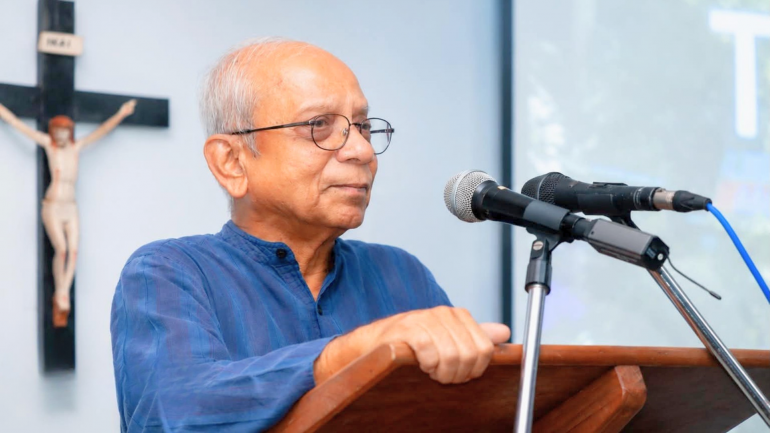
As the Catholic Church in India prepares to observe Justice Sunday on August 23, Jesuit human rights, reconciliation and peace activist Fr. Cedric Prakash, SJ has challenged Church leaders, clergy, religious and faithful to recover their prophetic voice and stand publicly with victims of injustice.
In a reflection shared with Radio Veritas Asia, Fr. Cedric Prakash, SJ, said Justice Sunday should be an opportunity for the Church to respond “authentically and proactively, visibly and vocally” to people who suffer injustice.
The theme for this year’s observance is “Justice Begins with Us,” drawn from Isaiah 1:17. Archbishop Peter Machado of Bangalore, chairman of the CBCI Office for Justice, Peace and Development, said in a July 22 communique that true worship of God is inseparable from the practice of justice.
“God calls us not merely to avoid wrongdoing, but to actively seek justice, protect the vulnerable, and uphold the dignity of every person,” Archbishop Machado wrote.
The Catholic Bishops’ Conference of India (CBCI) resolved in 1989 to observe the Sunday after Independence Day as Justice Sunday. The first observance was held on August 20 that year, focusing particularly on caste discrimination and social inequality.
Fr. Cedric said this year’s observance comes amid widespread concerns over discrimination against religious minorities, denial of rights to Dalit Christians and Muslims, displacement of Indigenous communities, economic inequality, unemployment, exploitation of workers and environmental degradation.
“The ‘water, forests and land’ of Indigenous communities is being systematically snatched away from them,” he said, referring to concerns over the loss of traditional lands and resources.
Fr. Cedric reflected on what he sees as a weakening of the Church’s prophetic role in recent years and called for a renewed commitment to this responsibility.
“It is public knowledge that, of late, the Church in India, in general, with the notable exception of a minuscule minority, has abdicated the prophetic role it needs to play in these challenging times,” Fr. Cedric said.
He noted that some Church leaders have chosen accommodation with the prevailing political environment, while others remain constrained by fear or self-interest, making it difficult to respond boldly to situations of injustice.
“Many are still gripped with fear, with self-interest, and these pay scant attention to Jesus’ mandate, ‘Fear no one!’” he said.
Others, he added, remain in their “comfort zones,” while some adopt an attitude of, “Why bother, as long as I am not affected?”
Fr. Cedric said Catholic social teaching provides a clear foundation for a stronger response to injustice. He pointed to the 1971 Synod of Bishops’ document Justice in the World and Pope Francis’ Evangelii Gaudium, which called for a prophetic voice whenever human dignity and the common good are threatened.
He also cited Pope Leo XIV’s emphasis on addressing the structural causes of poverty and standing with the poor.
For Fr. Cedric, the real measure of Justice Sunday will be whether it produces concrete change within the Church and society.
“More importantly, how many are willing to mainstream justice in their own lives, in their institutions, within the Church and, above all, accompany the people in their struggle for justice?” he asked.
Justice Sunday, he said, should therefore be more than an annual observance. It should challenge the Church in India to overcome fear and self-interest and once again become a courageous voice for truth, human dignity and justice.
Radio Veritas Asia (RVA), a media platform of the Catholic Church, aims to share Christ. RVA started in 1969 as a continental Catholic radio station to serve Asian countries in their respective local language, thus earning the tag “the Voice of Asian Christianity.” Responding to the emerging context, RVA embraced media platforms to connect with the global Asian audience via its 21 language websites and various social media platforms.
Comments

Latest News



- Reply
Permalink