

Cardinal Ferrão Links Eucharistic Devotion with Service to the Poor at Shillong Gathering


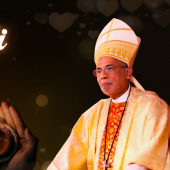
Catholics must make the Eucharist the center of their personal, family, parish, and diocesan lives, drawing strength from Christ in the Blessed Sacrament to serve others with compassion and love, Cardinal Philip Neri Ferrão, Archbishop of Goa and Daman, said in Northeast India.
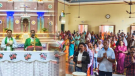
Addressing more than 100,000 faithful at the annual Eucharistic procession of the Archdiocese of Shillong in Meghalaya on November 8, the cardinal said the public procession was a visible expression of the faithful's love for Jesus in the Blessed Sacrament.
He reminded the participants that Christ journeys with His people, listens to their concerns, and strengthens them amid life's challenges.
Drawing a connection between Eucharistic devotion and service to humanity, Cardinal Ferrão recalled an incident involving the late Archbishop Henry D'Souza of Kolkata and St. Teresa of Calcutta during the Bangladesh Liberation War in the early 1970s.
He recounted how the Church in Kolkata organized relief camps for thousands of refugees who had fled the conflict in neighboring Bangladesh, with the Missionaries of Charity assisting those in need.
During a visit to one of the camps, Archbishop D'Souza noticed that the sisters returned to their convent at midday and came back later to continue their service. When he asked Mother Teresa about their absence, she explained that the sisters needed time for prayer before the Blessed Sacrament each day.
According to Cardinal Ferrão, Mother Teresa emphasized that time spent before the Eucharist enabled the sisters to serve refugees with the heart and mind of Jesus. Their prayer sustained their ministry of compassion, humility, and self-sacrificing love.
Reflecting on the incident, the cardinal urged Catholics to draw from the Eucharist the strength to become loving, caring, and compassionate people who build peace and communion in their families and communities.
He prayed that the Eucharistic Lord would bless the faithful and make them witnesses of Christ's compassionate love.


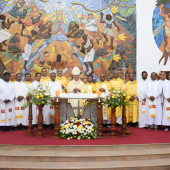
The cardinal presided over the Eucharistic celebration and imparted the final benediction following the procession, which brought together more than one lakh Catholics from the Khasi Hills, Jaintia Hills, and Ri Bhoi districts of Meghalaya.
The annual gathering also marked the conclusion of the Archdiocesan Year of the Faithful and the inauguration of the Year of the Youth.
For many Catholics living outside Shillong, the procession remains an important link with their faith and cultural heritage.
Sr. Caroline Duia, FSP, originally from Shillong and currently based in Mumbai, said watching the celebration through its online telecast brought back memories of earlier participation.
“For those of us living outside Shillong, it is a nostalgic occasion that brings back many fond memories,” she said.
Parishes from across the archdiocese participated in an organized alphabetical sequence, accompanying the procession with prayers, hymns, and musical instruments. The newly erected Christ the King Our Hope Parish of Mawkyrdep participated under its own parish banner for the second consecutive year.
The annual procession, a longstanding tradition believed to date back to the 1930s or earlier, is one of the major public expressions of Eucharistic devotion in Northeast India. It brings together parish communities after months of Eucharistic processions organized at the local level and also draws the attention of people from other religious communities.
Radio Veritas Asia (RVA), a media platform of the Catholic Church, aims to share Christ. RVA started in 1969 as a continental Catholic radio station to serve Asian countries in their respective local language, thus earning the tag “the Voice of Asian Christianity.” Responding to the emerging context, RVA embraced media platforms to connect with the global Asian audience via its 21 language websites and various social media platforms.
Latest News