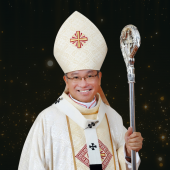
Catholic education is one of the greatest investments families and society can make for future generations, Archbishop Simon Poh of Kuching said as he outlined the Church's vision for expanding its educational mission in the Malaysian state of Sarawak.
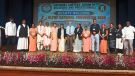
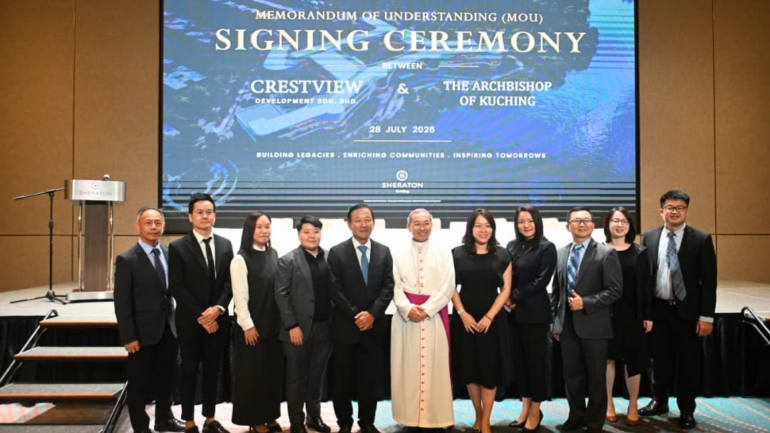
Speaking at the signing of a memorandum of understanding (MoU) between the archdiocese of Kuching and Crestview Development Sdn. Bhd. on July 28, Archbishop Poh said the planned St. Joseph's Private School in Kota Samarahan represents far more than a new educational institution.
The archbishop, who also serves as chairman of the Office of Evangelization of the Federation of Asian Bishops' Conferences (FABC), said the project reflects a shared commitment to invest in children by providing education rooted in academic excellence, sound values, and character formation.
"Today's ceremony represents far more than a formal agreement between two organizations," Archbishop Poh said.
"It reflects our shared commitment and our common belief that education is one of the greatest investments for families to invest in our children."
The agreement paves the way for the establishment of St. Joseph's Private School – Tan Sri Yee Ming Seng Campus at Marina Peninsula in Kota Samarahan, a fast-growing district near Kuching, the capital of Sarawak on the island of Borneo.
Archbishop Poh said the project continues a Catholic educational tradition that began more than a century ago with the establishment of St. Joseph's School in Kuching.
He recalled that the school's history dates back to 1882, when Mill Hill missionaries arrived in Kuching and were granted land by Rajah Charles Brooke to establish what would become one of Sarawak's best-known Catholic schools.
Since then, generations of priests, religious, teachers, and lay educators have helped shape thousands of students who have gone on to serve society in a wide range of professions.
Yet, the archbishop said, the Church measures success by more than academic achievement.
"More importantly, they have become men and women of integrity, compassion and service," he said. "It is our conviction that education transforms lives, strengthens families and contributes to nation building."
He said the new school aims to continue that mission by forming young people with wisdom, integrity, and a commitment to serve society.
Archbishop Poh noted that Kota Samarahan has become one of Sarawak's fastest-growing communities, attracting many young families seeking quality education for their children.
He thanked Crestview Development for making the project possible by providing the school site at below market value and committing RM10 million toward construction of the new campus.
"Your investment in education is also an investment into the future of our beloved Sarawak," he said.
The archbishop also announced that the campus will be named St. Joseph's Private School – Tan Sri Yee Ming Seng Campus in recognition of the businessman and philanthropist whose vision and generosity helped bring the project to fruition.
Looking beyond the construction of a new school, Archbishop Poh urged the wider Catholic community—including alumni, parents, benefactors, and friends—to support the initiative as the archdiocese works to secure government approval and raise the funds needed to fulfill its commitments.
He concluded by reflecting on the Church's responsibility to carry forward the educational legacy it has inherited.
"Every generation inherits a legacy from those who came before," he said. "Today, through this collaboration, we have the opportunity, and the responsibility, to extend this education legacy to Kota Samarahan."
He expressed hope that the new campus would become a place where young people discover their potential, develop character alongside knowledge, and receive an education that prepares them to contribute to the common good of Sarawak and Malaysia.
Radio Veritas Asia (RVA), a media platform of the Catholic Church, aims to share Christ. RVA started in 1969 as a continental Catholic radio station to serve Asian countries in their respective local language, thus earning the tag “the Voice of Asian Christianity.” Responding to the emerging context, RVA embraced media platforms to connect with the global Asian audience via its 21 language websites and various social media platforms.
Latest News