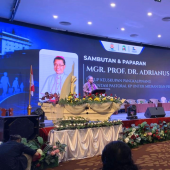



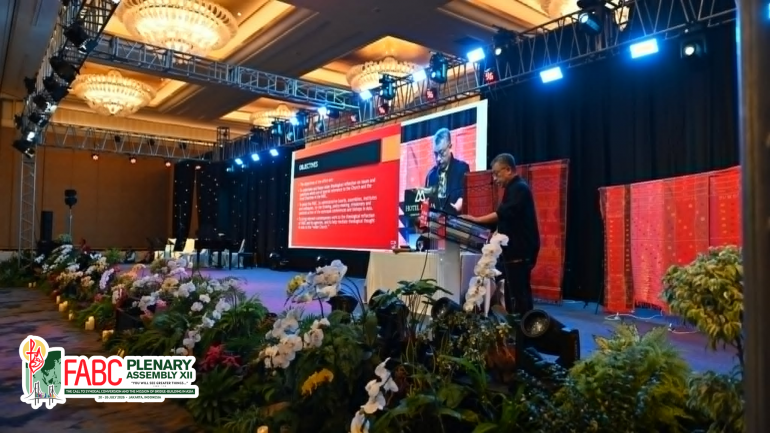
Theology in Asia must grow from the lived experiences of its people rather than remain confined to classrooms and academic debate, the Federation of Asian Bishops' Conferences (FABC) Office of Theological Concerns (OTC) said during the 12th FABC Plenary Assembly on July 21 at Hotel Mulia in Jakarta.
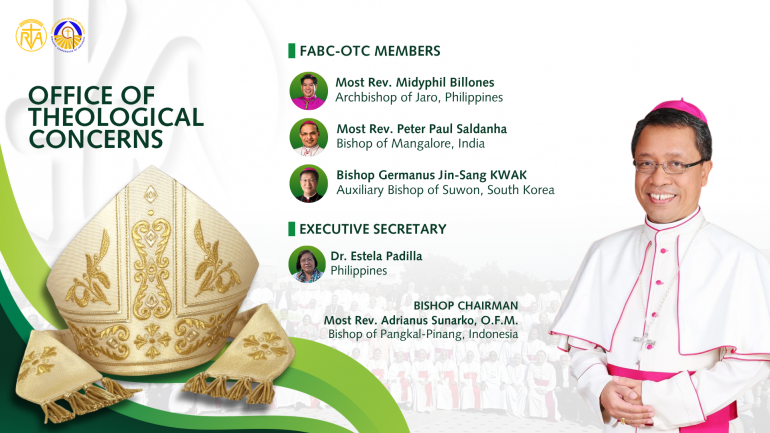
Presenting the office's report, Bishop Adrianus Sunarko, OFM, Bishop of Pangkal Pinang, Indonesia, and chairman of the FABC Office of Theological Concerns, said theology should accompany the Church's mission by listening to people, engaging local cultures, and discerning the signs of the times in Asia.
He described theologians not simply as scholars but as "fellow travelers" who journey with the People of God, helping the Church understand how the Gospel speaks to the realities of a continent marked by religious diversity, ancient cultures, rapid modernization, and complex social challenges.
The presentation echoed a defining vision of the FABC since its founding more than 50 years ago—that the Church in Asia must develop its own theological voice through dialogue with the continent's peoples, cultures, and religious traditions.
Rather than importing theological ideas developed elsewhere, the office said authentic Asian theology must emerge from the lived experience of local Churches while remaining faithful to the universal tradition of the Catholic Church. Inspired by the Second Vatican Council's Ad Gentes, the OTC continues to encourage episcopal conferences to develop theologies rooted in their own pastoral and cultural contexts.
The report also highlighted the collaborative nature of the office's work. Bringing together theologians from across Asia, including Indonesia, India, Japan, Malaysia, the Philippines, South Korea, Sri Lanka, Taiwan, Thailand, Vietnam, and Hong Kong, the OTC has become a continental network for theological reflection and discernment.
Over the past two decades, the office has published studies on religious freedom, the dignity of life, ecology, and the Church's response to the COVID-19 pandemic. Its latest publication, The Asian Face of Synodality (FABC Papers 191), explores how the Church's synodal journey is shaped by Asia's unique cultural, social, and religious realities.
The report emphasized that the process behind these publications is itself synodal. Theologians begin with prayer, silence, and communal discernment before conducting research, sharing drafts, and refining their work together—a method the office described as "synodal theologizing."
One of the report's most striking images came from The Asian Face of Synodality, which draws on the Gospel story of the disciples on the road to Emmaus. It invites the Church to move from "cold hearts, cold stares, and cold feet" to hearts set ablaze by Christ, eyes opened through encounter, and feet ready for mission.
For the office, synodality is not merely a new model of Church governance but a spiritual conversion that transforms the Church into a community journeying with Christ.
The report also stressed that theology is shaped not only through research but through shared prayer, the Eucharist, fellowship, and listening to one another. These experiences, it said, are essential foundations for authentic theological reflection.
As the FABC Plenary Assembly continues under the theme, "You Will See Greater Things" (Jn 1:50): Synodal Conversion and the Mission to Be Bridges and Bridge-Builders in Asia," the Office of Theological Concerns reaffirmed its commitment to developing a distinctly Asian theology—one that listens before it speaks, learns before it teaches, and accompanies the people of Asia in proclaiming the Gospel.
Radio Veritas Asia (RVA), a media platform of the Catholic Church, aims to share Christ. RVA started in 1969 as a continental Catholic radio station to serve Asian countries in their respective local language, thus earning the tag “the Voice of Asian Christianity.” Responding to the emerging context, RVA embraced media platforms to connect with the global Asian audience via its 21 language websites and various social media platforms.
Latest News