Goa Priest’s Doctoral Thesis Examines Why a Child Feels Out of Place in the Classroom

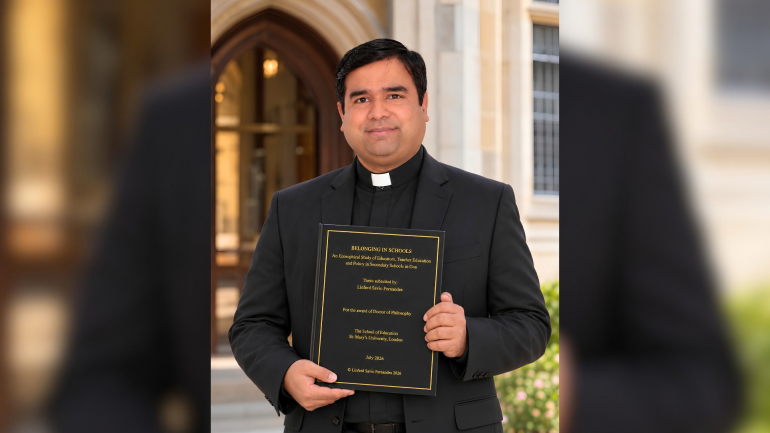
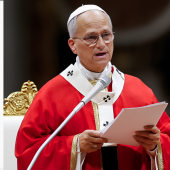
A child may attend school every day and perform well academically, yet still feel, “This is not my place.” This experience lies at the heart of the doctoral research of Fr. Linferd Savio Fernandes, a priest of the Archdiocese of Goa and Daman in western India.
Fr. Fernandes completed his doctoral research at the School of Education, St. Mary’s University, London, with his doctoral defense held on September 23, 2026.
His thesis, “Belonging in Schools: An Ecosophical Study of Educators, Teacher Education and Policy in Secondary Schools in Goa,” examines how students experience belonging and how schools can become communities where every child feels recognized and valued.
“Pastoral ministry makes one sensitive to people’s need to be recognized, accepted and valued,” Fr. Fernandes says. “Someone can be present within a community and yet feel that he or she is on the margins.”
“Inclusion can give a child access to the classroom; belonging determines how that child experiences being there,” he explains.
A child truly belongs when he or she feels “known, recognized, valued and emotionally safe.” This sense of belonging develops through everyday encounters, such as a teacher knowing a student beyond academic marks, noticing when something is wrong, listening seriously and respecting the student’s background.
His Christian understanding of human dignity also shaped the questions behind the research.
“Christianity makes a powerful claim that human dignity is not something we earn through achievement, status or ability,” he says.
Although faith did not determine his research findings, it sharpened a central question: “Do our institutions accommodate people, or do they create communities in which people know that they matter?”
Fr. Fernandes identifies teachers as central to creating a sense of belonging. They foster it by knowing their students, treating them fairly, recognizing differences, building trust and ensuring that students do not fear humiliation or exclusion.
However, teacher education does not always adequately prepare educators for this relational and emotional dimension of their work.
“If we believe belonging matters, therefore, it cannot depend only upon the presence of a particularly caring teacher. We also have to form and support teachers for this dimension of their vocation,” he says.
His research introduces the concept of a “Belonging Ecosystem,” emphasizing that belonging depends on the combined efforts of teachers, school leadership, teacher formation, social realities and educational policy.
“A caring teacher working within an unsupportive system can only do so much,” he observes. “Equally, an excellent inclusion policy means little if a child feels humiliated or invisible in the classroom.”
Goa’s multilingualism, migration and cultural diversity provide an important context for the study. Language can shape students’ identity, confidence and participation, while cultural differences can become opportunities for learning and encounter.
“The question is whether schools allow difference to create boundaries between ‘us’ and ‘them’, or transform difference into encounter and community,” Fr. Fernandes says.
The research connects the experiences of educators and school management with teacher education and India’s National Education Policy 2020, examining how policy and teacher formation can support belonging in schools.
His research was supervised by Prof. Anna Lise Gordon, Dr. Mark Price and Dr. Shalini Bhorkar of St. Mary’s University, London.
Fr. Fernandes says parents, teachers, school leaders and the Church all have a role in ensuring that children experience dignity and acceptance.
Schools, he suggests, should ask themselves: “What does it feel like to be a child in our school?”
When a child can say, “I am known here. I am valued here. I am safe here. I have a place here,” education has achieved something that no examination result alone can measure.
Radio Veritas Asia (RVA), a media platform of the Catholic Church, aims to share Christ. RVA started in 1969 as a continental Catholic radio station to serve Asian countries in their respective local language, thus earning the tag “the Voice of Asian Christianity.” Responding to the emerging context, RVA embraced media platforms to connect with the global Asian audience via its 21 language websites and various social media platforms.
Latest News