India: Historic Eucharistic Procession Draws Over 10,000 Faithful in Senapati, Manipur

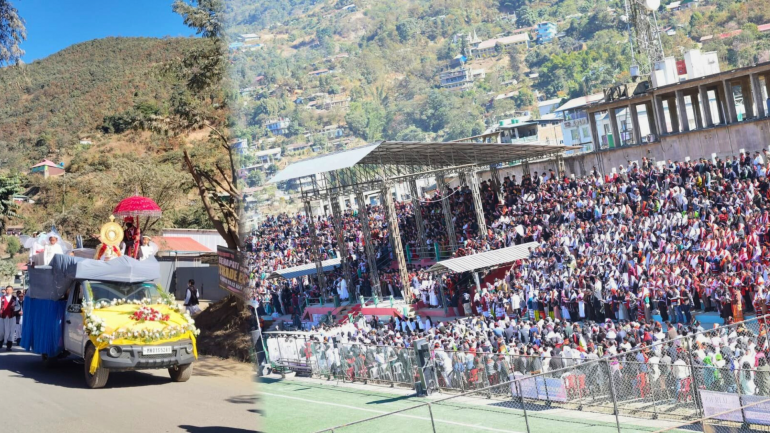
On December 14, the Senapati District Catholic Union (SDCU), in collaboration with the Archdiocese of Imphal, organized a historic Eucharistic Procession in the district headquarters town of Senapati, Manipur, in eastern India.
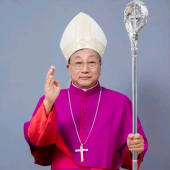
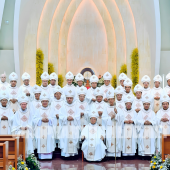
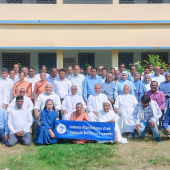
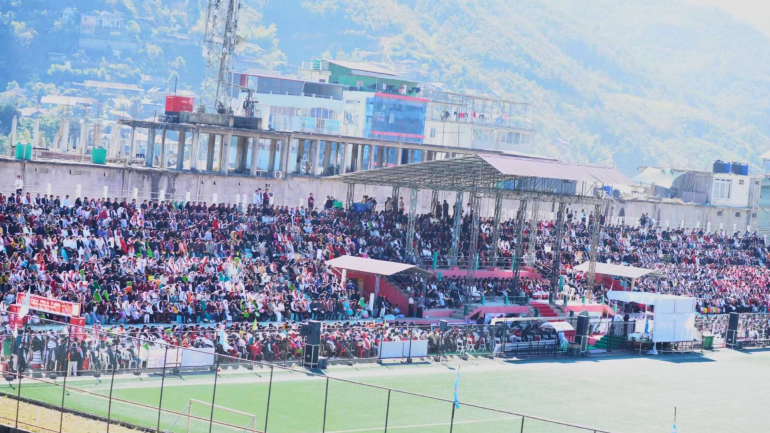
The solemn Eucharistic celebration, held at the town stadium in the heart of Senapati, was presided over by Archbishop Linus Neli of Imphal. The grand event witnessed the participation of more than 10,000 faithful, along with over 50 priests and 80 nuns from across Manipur.
Faithful from distant parishes of the district gathered in unity for this solemn occasion, the second event of its kind after the Great Jubilee gathering in the year 2000. Once again, the faithful came together during another Jubilee Year, 2025. In a region historically marked by the presence of multiple Christian denominations, the event stood as a powerful witness to the centrality of the Eucharist in Catholic faith, with a massive gathering worshipping as one family.
In his homily, Archbishop Neli emphasized the real presence of Jesus in the Eucharistic Sacrament. “Today, we take Jesus, who is present in the Holy Eucharist, to the streets, one of the beautiful practices of the Catholic Church,” he said. “In the procession with the Blessed Sacrament, God is walking with us. Jesus is not only in the church; He is with us wherever we go, in the market, in our homes, and on the streets. Jesus is the food for our heavenly journey.”
Quoting Pope Saint John Paul II, the Archbishop recalled that when the Pope was once asked why he was so fond of processions, he replied, “Jesus likes to walk with people, and people like to walk with Jesus.”

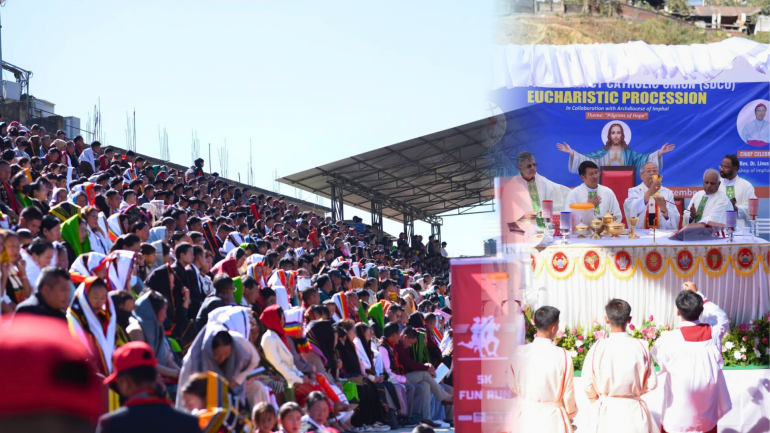
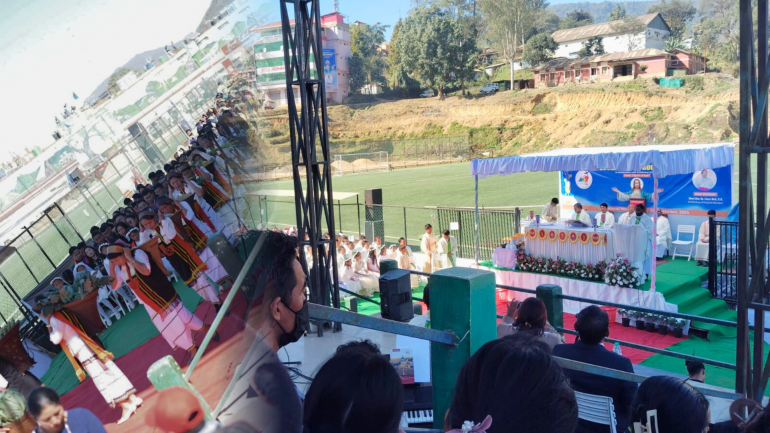
The Archbishop further explained that the Eucharistic procession signifies that the ultimate destination of believers is heaven, and the Eucharist is a foretaste of that heavenly bliss. He stressed that the Eucharistic procession is not merely devotional but sacramental in its effect. “In a world where faith is often ignored, where God’s name is misused, where secularism is growing and families are broken, only God can restore and redeem us,” he said.
Archbishop Neli also offered a heartfelt prayer for the state and its people. Referring to the violence Manipur has witnessed in recent years, during which many churches were destroyed, and many lives were lost, he prayed: “Today, we pray in a special way for Manipur, for the people of Manipur, for the land of Manipur, and for the environment of Manipur. We pray for unity, peaceful coexistence, development, lasting political solutions, and that Manipur may become a centre of peace.”
The grand Eucharistic procession stood as a strong public witness of faith and a collective plea for peace, healing, and harmony. The prayerful participation of the young and old throughout the three-kilometre procession reflected the deep-rooted spiritual heritage of the Catholic community in the region.
Mr. Albert, a local resident, said, “Today, the Eucharistic procession has shown people of other denominations how Catholics share a uniform and universal practice all over the world. I am very proud to be a Catholic.” Another participant expressed hope that “this event may draw many more to the Catholic Church.”
Faithful from different parishes and communities shared that the event was not only historic in scale but also deeply meaningful, renewing hope and strengthening their resolve to work for unity and peace in Manipur. “I was impressed by the huge participation and deeply moved by the fervour shown by the faithful throughout the procession,” said S. Adani Joseph, President of the Mao Catholic Association.
The solemn Eucharistic procession concluded with a Benediction led by Fr. Dinny Paul, VC, Director of the Divine Glory Prayer Tower, Maram Khunou, Senapati, Manipur.
Radio Veritas Asia (RVA), a media platform of the Catholic Church, aims to share Christ. RVA started in 1969 as a continental Catholic radio station to serve Asian countries in their respective local language, thus earning the tag “the Voice of Asian Christianity.” Responding to the emerging context, RVA embraced media platforms to connect with the global Asian audience via its 21 language websites and various social media platforms.
Latest News