India: Tamil Nadu Bishops Seek Reservation for Christians from Marginalized Caste Communities

The Tamil Nadu Bishops’ Council (TNBC) has appealed to the southern Indian state government of Tamil Nadu to introduce an internal reservation for Dalit Christians, urging concrete measures to ensure social justice and equal opportunities for the marginalized community.
Dalits are communities in India historically placed at the bottom of the traditional caste hierarchy and subjected to social exclusion and discrimination.
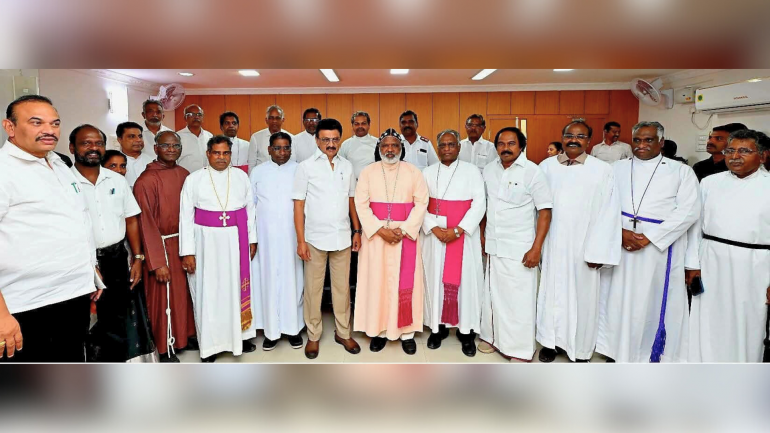
The appeal was formally submitted on February 24 in Kanyakumari, the southernmost district of mainland India, by Fr. Nithiya Sagayam, OFM Cap, secretary of the TNBC’s Commission for Scheduled Castes and Scheduled Tribes (SC/ST). He met Chief Minister M. K. Stalin on behalf of the commission’s chairman, Bishop Jeevanandam.
Through its SC/ST Commission, the Council presented a memorandum to the state government requesting a 4.6 percent internal quota for Dalit Christians within the existing Backward Classes (BC) reservation framework.
In India, the reservation system provides constitutionally mandated quotas in education, public employment, and welfare schemes for historically disadvantaged communities. While Dalits who belong to Hindu, Sikh, or Buddhist communities are recognized as Scheduled Castes and receive reservation benefits, Dalits who convert to Christianity or Islam lose their Scheduled Caste status under the Constitution (Scheduled Castes) Order of 1950.
Church leaders emphasized that Dalit Christians continue to face social and economic discrimination similar to other Scheduled Caste communities, despite their change of religion. However, they remain excluded from Scheduled Caste reservation benefits because of their religious identity.
The bishops clarified that their demand is not for a new or additional quota, but for an internal allocation within the existing Backward Classes category. They said this would ensure equitable access to higher education, government employment, welfare schemes, and social and economic empowerment programs.
According to the memorandum, the proposed 4.6 percent allocation is based on demographic data. Christians constitute around 6 percent of Tamil Nadu’s population, and nearly 65 percent of them are of Dalit origin. This translates to approximately 4.6 percent of the state’s population, a figure the bishops say justifies the internal reservation.
“Reservation is a tool of social justice, not a religious benefit,” the bishops stated. “Dalit Christians should not be excluded from the Scheduled Caste status. We urge the government to amend the Constitution (Scheduled Castes) Order, 1950, and restore dignity to thousands who remain marginalized.”
Fr. Manoj Nayak, a human rights advocate from the eastern Indian state of Odisha, also expressed support for the demand. “Through this memorandum, we respectfully urge the government to act with compassion and constitutional responsibility. Justice delayed for Dalit Christians is justice denied,” he said.
Church leaders noted that several Indian states have implemented internal reservations for specific communities within broader categories, and said Tamil Nadu could adopt a similar model to address long-standing inequalities.
The TNBC’s SC/ST Commission has also conducted a statewide awareness campaign highlighting the socio-economic challenges faced by Dalit Christians. Organizers report that more than 100,000 signatures have been collected in support of the demand. The signatures are expected to be submitted to the state government to demonstrate public backing.
The Tamil Nadu Bishops’ Council stressed that their appeal is rooted in the principles of equality and human dignity.
“This is not a demand for privilege, but a call for justice, dignity, and equal opportunity,” the bishops said, urging the state government to initiate dialogue with stakeholders and work toward a sustainable solution.
Radio Veritas Asia (RVA), a media platform of the Catholic Church, aims to share Christ. RVA started in 1969 as a continental Catholic radio station to serve Asian countries in their respective local language, thus earning the tag “the Voice of Asian Christianity.” Responding to the emerging context, RVA embraced media platforms to connect with the global Asian audience via its 21 language websites and various social media platforms.
Latest News