


The Catholic Bishops’ Conference of India (CBCI) has submitted a memorandum to Union Home Minister Amit Shah on July 10, expressing concerns over the proposed Foreign Contribution (Regulation) Amendment Bill, 2026, its possible impact on religious freedom and charitable institutions, and the ongoing humanitarian situation in Manipur, a northeastern state of India.
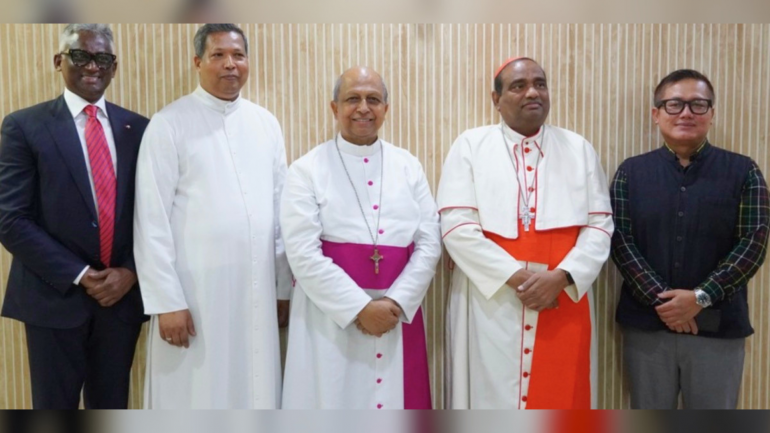
The memorandum, signed by CBCI President Cardinal Anthony Poola and Secretary General Archbishop Anil Couto, was presented by a delegation that included CBCI Deputy Secretary Fr. Mathew Koyickal.
The CBCI reaffirmed the Catholic Church’s commitment to serving communities across India through education, healthcare, disaster relief, rural development, tribal welfare, and other social services. It emphasized that these services are provided to all people regardless of religion, caste, language, or region.
The bishops expressed concern that certain provisions in the proposed FCRA Amendment Bill and recently notified rules could affect charitable institutions that have served vulnerable communities for decades.
The CBCI urged the government to reconsider the proposed amendments and conduct wider consultations before introducing a revised legal framework. It stressed that any changes should protect existing rights, lawfully acquired assets, and ongoing charitable activities.
The memorandum also called for independent judicial oversight in matters related to the Foreign Contribution (Regulation) Act (FCRA) and sought safeguards against the arbitrary takeover or transfer of institutional assets. It recommended that the law distinguish between minor procedural violations and serious offences, ensuring that donated resources continue to be used for their intended purposes.
The bishops further requested the removal of the undefined term “proselytization” from the rules, saying it could lead to possible misuse, and suggested that the term “key functionary” be limited to trustees and members of an organization’s governing body.
According to the CBCI, these measures would promote transparency and accountability while protecting legitimate charitable organizations involved in social service.
The bishops also raised concerns about the continuing crisis in Manipur, noting that thousands of farming families have lost livelihoods, students have faced disruptions in education, and many people have been displaced due to prolonged violence.
The CBCI appealed to the Ministry of Home Affairs to take steps to restore peace, harmony, and normalcy in the northeastern state. It reiterated the Church’s willingness to work with the government in promoting reconciliation, humanitarian assistance, and social healing.
The Conference concluded by expressing its commitment to continue collaborating with the government in advancing peace, justice, humanitarian service, and the common good, while urging that regulatory reforms strengthen transparency without weakening institutions serving vulnerable communities across India.
Radio Veritas Asia (RVA), a media platform of the Catholic Church, aims to share Christ. RVA started in 1969 as a continental Catholic radio station to serve Asian countries in their respective local language, thus earning the tag “the Voice of Asian Christianity.” Responding to the emerging context, RVA embraced media platforms to connect with the global Asian audience via its 21 language websites and various social media platforms.
Latest News