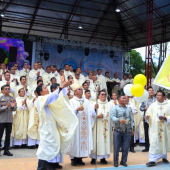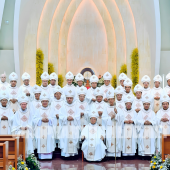



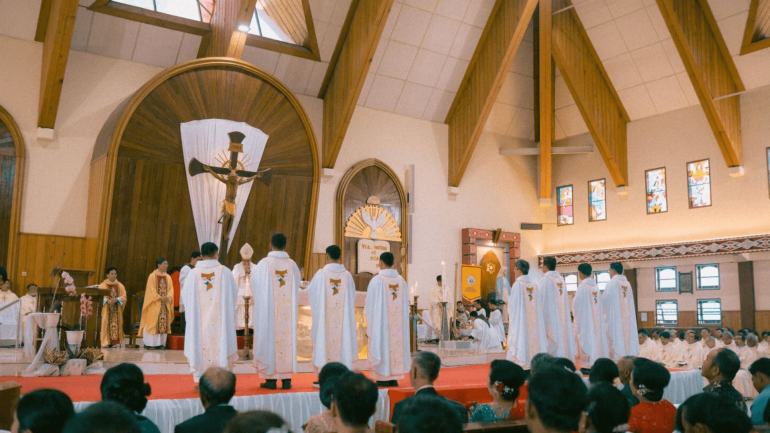
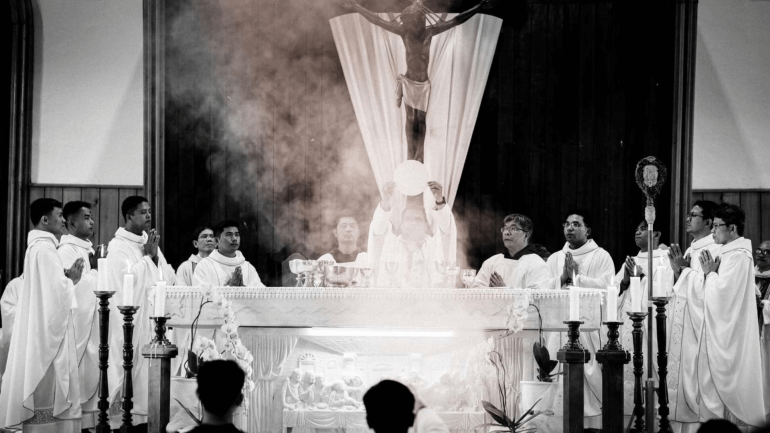
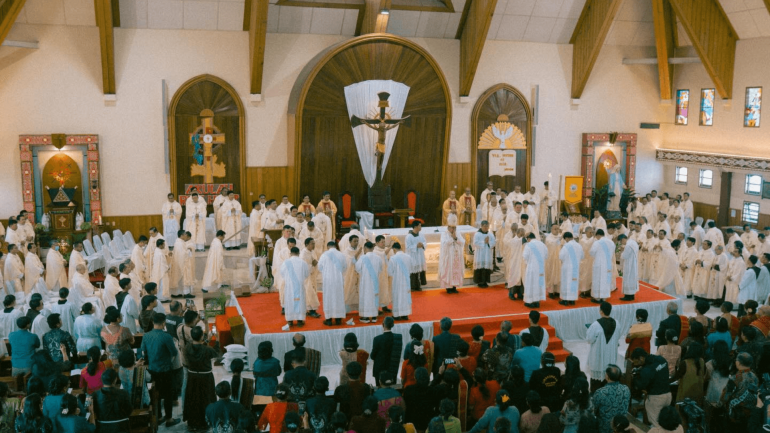
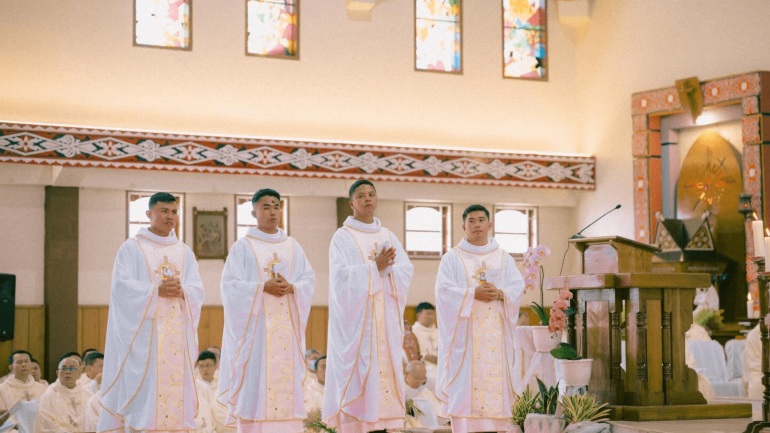
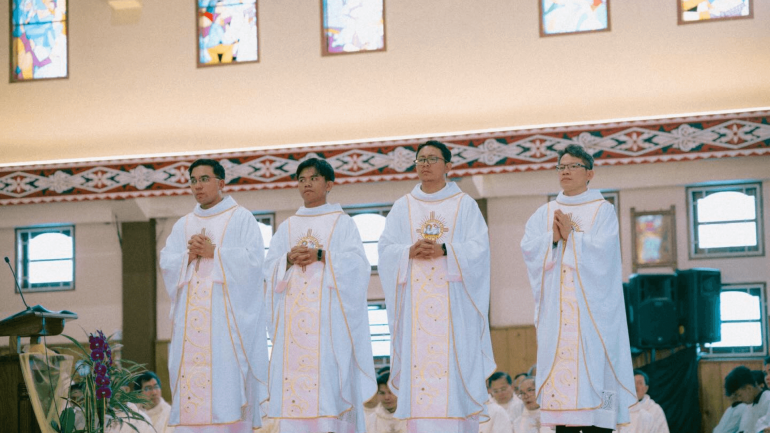
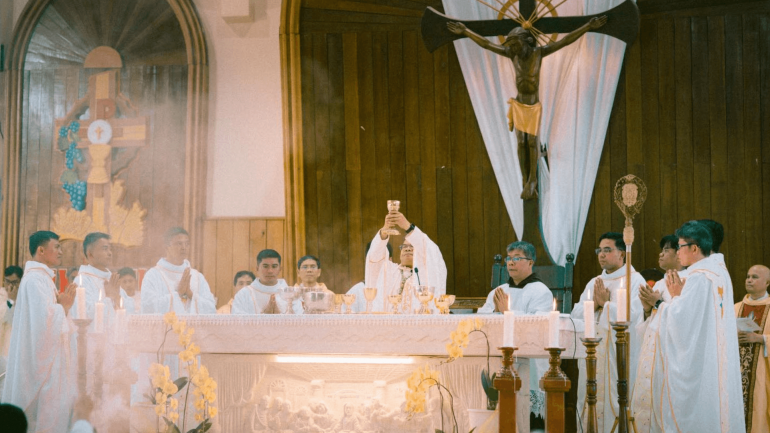
In a development that added special significance to the Year of St. Francis, Archbishop Kornelius Sipayung, OFMCap, of Medan ordained eight new priests of the Order of Friars Minor Capuchin (OFMCap) on January 24. The ordination took place during a solemn Eucharistic celebration at St. Francis of Assisi Church, Sempajaya, Berastagi Parish, in North Sumatra Province.
During the liturgy, the archbishop exhorted the newly ordained priests to emulate the humility, simplicity, and pastoral spirit of St. Francis of Assisi, while firmly warning them against the dangers of clericalism.
Berastagi Parish is located approximately a two-hour drive from Medan, the provincial capital of North Sumatra.
Any potential serious “challenges” to abort priestly ordination
Prior to the ordination, the Capuchin Provincial Minister of Medan, Fr. Josaphat Ivo Sinaga OFMCap, issued an official public announcement on December 23, 2025, inviting anyone who might be aware of any canonical impediments or irregularities in the candidates’ religious life to report them to the Capuchin superiors.
“Thus, we convey this announcement and humbly ask for your prayers and support. Thank you for your attention and cooperation,” Fr. Sinaga wrote.
Attendance of Local Government officials
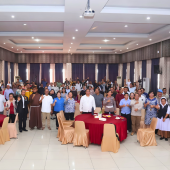
The ordination mass was also attended by the Regent of Karo District, Dr. Antonius Ginting, along with representatives of the Indonesian National Police and Armed Forces. “On behalf of the Karo District Government, I extend my congratulations on the ordination of the new Capuchin priests. May their ministry bring blessings to the wider community,” the Regent said in his remarks.
The Church’s joy and the call to service
In his homily, Archbishop Msgr. Kornelius emphasized that the Church rejoices because God continues to grant new shepherds to His people. “Today the Church rejoices not merely because the number of priests increases, but because these eight men who stand here, freely and consciously offer their lives in service to God’s people,” he said.
According to the Archbishop, the foundation of this joy lies in the conviction that priests are first called to safeguard their interior spiritual life before God, from which pastoral love flows.
He recalled St. Paul’s message to the elders of Ephesus: to watch over themselves before watching over the flock. “The order is crucial: first take care of yourselves, then care for the flock. A shepherd who fails to guard his own life will, sooner or later, wound the flock,” he warned.
Learning from St. Francis of Assisi
As a Capuchin Franciscan himself, Archbishop Kornelius stressed that the priesthood is not a position, but a vocation to serve. Priests are called to live humbly, remain faithful to the Gospel, and be present among the people—especially the poor, the small, and the marginalized. “A Capuchin priest is called to live the spirituality of St. Francis of Assisi: a simple life, closeness to the people, and being a bearer of peace,” he said.
Describing the ordination of the eight men as a concrete sign of God's blessing, the archbishop encouraged the faithful to keep the newly ordained priests in their prayers that they may remain faithful to their calling and be granted health, perseverance, and courage in proclaiming Christ’s love.
Warning against clericalism
Addressing contemporary challenges, Archbishop Kornelius warned the new priests against the danger of clericalism, a distorted mindset that views ordination as a rise in status rather than a call to service. “When ordination is understood as a rank, a priest may feel superior and become resistant to correction. Ordination, however, is not meant to exalt oneself, but to follow Christ who washed feet and gave His life,” he stressed.
He added that clericalism often enters subtly through comfort and small choices that distance priests from genuine service. He also highlighted the temptation of power and popularity, especially in the age of social media. Popularity becomes dangerous when it replaces Christ as the source of a priest’s identity.
In closing, Archbishop Kornelius reaffirmed that the faithful belong to God, redeemed by the blood of Christ, and must never become objects of power or manipulation.
“A true shepherd remains with the people because he loves them. This is the test of priesthood today: to remain faithful when ministry becomes heavy and the cross is truly felt,” he concluded.
Radio Veritas Asia (RVA), a media platform of the Catholic Church, aims to share Christ. RVA started in 1969 as a continental Catholic radio station to serve Asian countries in their respective local language, thus earning the tag “the Voice of Asian Christianity.” Responding to the emerging context, RVA embraced media platforms to connect with the global Asian audience via its 21 language websites and various social media platforms.
Latest News