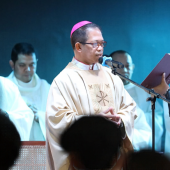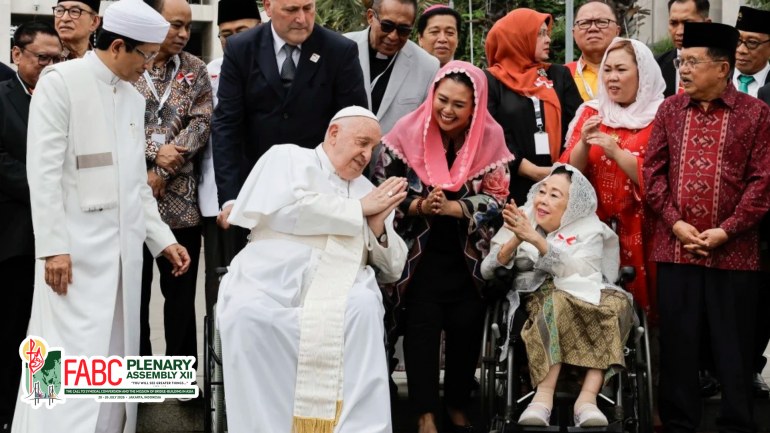
As the Federation of Asian Bishops' Conferences (FABC) prepares to hold its XII Plenary Assembly in Jakarta from July 20 to 26, 2026, the Catholic Church in Indonesia stands ready to share a unique ecclesial experience shaped by dialogue, diversity, and service.
Under the theme, "You Will See Greater Things" (Jn 1:50): The Call to Synodal Conversion and the Mission to Be Bridges and Bridge-Builders in Asia, bishops from across Asia will gather in Jakarta to pray, discern, and renew the Church's missionary commitment.
For the Catholic Church in Indonesia, this vision is far from unfamiliar. Living as a minority community within one of the world's most religiously and culturally diverse nations, Indonesian Catholics have long cultivated dialogue, fraternity, and cooperation across differences. This lived experience has become one of Indonesia's distinctive contributions to the Church in Asia.
A Church Living in Diversity
Indonesia is home to thousands of islands, hundreds of ethnic groups, local languages, and diverse religious traditions. Catholics make up about three percent of the country's population. As a minority, the Church has learned to witness to the Gospel through openness, respect for diversity, and sustained dialogue with people of different faiths and cultures.
This experience closely reflects the vision that has guided the FABC since its establishment in 1970: building a truly Asian Church through dialogue with cultures, religions, peoples, especially the poor, and those living on the margins of society.
The theme of the XII Plenary Assembly also builds on the spirit of the FABC 50 General Conference held in Bangkok in 2022, which invited the Church to continue "Journeying Together as Peoples of Asia" by listening to the voices of the poor, young people, migrants, Indigenous communities, and a creation wounded by ecological crises.
Becoming a Church That Builds Bridges
Within the FABC's pastoral vision, becoming a bridge-builder extends beyond promoting interreligious dialogue.
Internally, the Church is called to build bridges through listening, participation, transparency, accountability, and the active involvement of the entire People of God. Externally, the Church is invited to become an instrument of dialogue, reconciliation, and peace.
Here, the Indonesian experience offers valuable insights. Living alongside Muslims, Protestants, Hindus, Buddhists, Confucians, and Indigenous communities has nurtured a culture of cooperation expressed through Catholic schools, health care services, disaster response, humanitarian initiatives, and social ministries that serve all people regardless of faith or background.
Indonesia has also developed a rich tradition of inculturation, integrating local languages, music, artistic expressions, and cultural traditions into the liturgy while remaining faithful to the universal Church. The values embodied in Pancasila—respect for human dignity, national unity, deliberative democracy, and social justice—have likewise provided fertile ground for promoting fraternity and solidarity.
Across the country, thousands of Catholic schools, hospitals, orphanages, homes for the elderly, and charitable institutions testify that evangelization is expressed not only through preaching but also through compassionate service that upholds human dignity.
Opportunities and Challenges
Rapid digital transformation and Indonesia's youthful population present new opportunities for evangelization and dialogue. Young Catholics are increasingly called to become active partners in fostering a synodal Church through innovation, communication, and missionary outreach.
Indonesia's extraordinary biodiversity and its vulnerability to climate change also place the Church in a strategic position to witness to ecological conversion. Caring for creation has become an integral dimension of its mission to protect our common home and stand in solidarity with communities most affected by environmental degradation.
At the same time, the Church continues to face pastoral challenges, including secularization, individualism, artificial intelligence, misinformation, social polarization, and changing patterns of communication. Synodal conversion also calls for greater participation of the laity, the empowerment of young people, the inclusion of women in leadership and decision-making, transparent governance, and more participatory structures.
Poverty, migration, human trafficking, economic inequality, and the ecological crisis likewise require deeper collaboration between the Church, governments, civil society, and people of different faith traditions.
Walking Together
Hosting the FABC XII Plenary Assembly offers the Catholic Church in Indonesia an opportunity to share its experience with local Churches across Asia. More than presenting a pastoral model, Indonesia offers a living witness of a Church that has learned to flourish through dialogue, service, solidarity, and fraternity amid diversity.
Faithful to Christ's promise, "You will see greater things" (Jn 1:50), the Churches of Asia are invited to continue their journey of synodal conversion and become bridges that reconnect humanity with God, foster reconciliation among peoples, and inspire a renewed commitment to caring for creation.
From Indonesia, this message is offered to the whole of Asia: that a Church walking together in faith, hope, and love can become an ever more credible sign of peace, justice, and communion in a rapidly changing world.
Radio Veritas Asia (RVA), a media platform of the Catholic Church, aims to share Christ. RVA started in 1969 as a continental Catholic radio station to serve Asian countries in their respective local language, thus earning the tag “the Voice of Asian Christianity.” Responding to the emerging context, RVA embraced media platforms to connect with the global Asian audience via its 21 language websites and various social media platforms.
Latest News