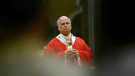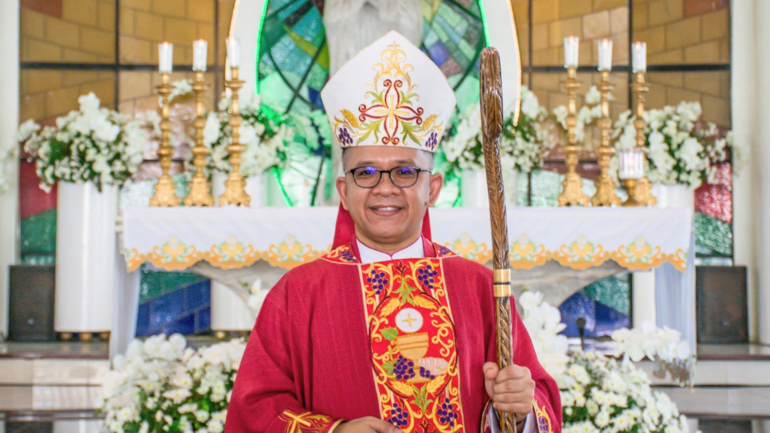
Bishop Moises M. Cuevas of Calapan has called on Catholics to turn their faith into concrete action for the protection of creation, saying care for the environment is an essential expression of Christian life.
Speaking during the 2026 Season of Creation, whose theme is “Living Water,” the bishop said Christians should move beyond awareness of environmental problems and actively work to protect water, forests, coastal ecosystems and the communities that depend on them. The Season of Creation is observed by Christians worldwide from September 1 to Oct. 4.
Calapan is the capital of Oriental Mindoro in the central Philippines.
“Water is one of God’s precious gifts. It sustains life, gives nourishment to our community, and irrigates the fields,” Cuevas said.
He noted that polluted rivers, damaged watersheds and degraded marine ecosystems have made water an increasing concern for communities. Creation, he said, should not be treated merely as a resource to be exploited, bought or consumed.
“Creation ultimately belongs to God,” he said, stressing that seas, rivers, watersheds, coastlines and oceans are part of God’s creation and require reverence and care.
Bishop Cuevas, who chairs the Episcopal Commission on Indigenous Peoples of the Catholic Bishops’ Conference of the Philippines, said Indigenous communities offer an important perspective on humanity’s relationship with nature.
He said Christians should respond to the environmental crisis not with fear or resignation but with faith-inspired action and a willingness to sacrifice for the common good.
“It is good to pray the Rosary. It is good to pray a novena. But this, too, is participation in God’s ongoing work of sustaining and renewing creation,” he said.
The bishop also called for genuine consultation with communities, particularly Indigenous peoples, when development projects affect watersheds, agricultural lands, ancestral territories and coastal ecosystems. He said processes such as free, prior and informed consent should not be weakened.
He cited the opposition of Indigenous peoples, local communities, Church representatives and government officials in Oriental Mindoro to the proposed Mineral Mindoro Nickel project as an example of communities seeking to protect their environment and livelihoods.
Bishop Cuevas also raised concerns about critical-minerals development linked to the global energy transition, warning against addressing one environmental problem while creating another.
His remarks came amid new Philippine government efforts to develop the critical minerals industry under Executive Order No. 122, which establishes a national policy framework for the sector and promotes value-added processing and downstream industries.
Drawing on Pope Francis’ teaching, Bishop Cuevas said development should be measured by whether it improves human life and contributes to a better world.
“There may be something we can do. That is what is important,” he said, urging Catholics to respond through concrete acts of care for creation.
Radio Veritas Asia (RVA), a media platform of the Catholic Church, aims to share Christ. RVA started in 1969 as a continental Catholic radio station to serve Asian countries in their respective local language, thus earning the tag “the Voice of Asian Christianity.” Responding to the emerging context, RVA embraced media platforms to connect with the global Asian audience via its 21 language websites and various social media platforms.
Latest News