

‘Wisdom of the Heart’ Must Guide Church’s Evangelization Amid AI, Says IT Expert at Macau Assembly

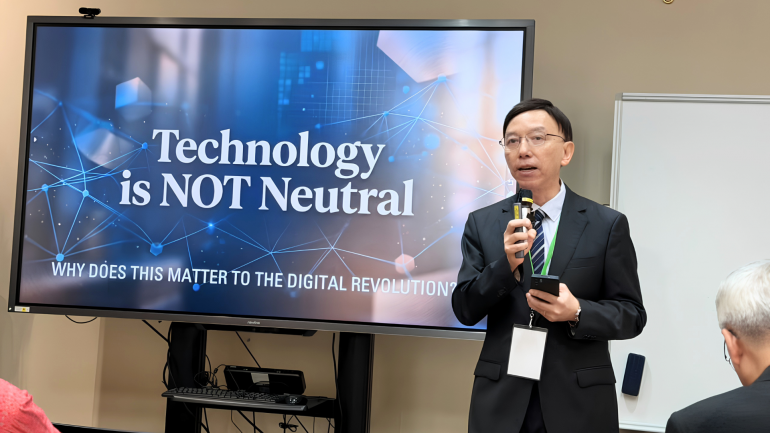
The Church must bring the “wisdom of the heart” into the digital world, using artificial intelligence (AI) to reach people while guiding them toward authentic human relationships and the life of the Church, Dr. Victor Lam said at the opening of the Federation of Asian Bishops’ Conferences Office of Social Communication (FABC-OSC) meeting in Macau on October 28.
In his bridging talk, “From Pastoral to Evangelizing, from HK to Macau,” Dr. Lam linked last year’s discussions on AI and its impact on humanity at the FABC-OSC meeting in Hong Kong with this year’s focus on evangelization. He called for a shift from viewing digital technology mainly as a pastoral tool to recognizing the digital world as a mission territory.
Dr. Victor Lam is a retired Hong Kong government official with extensive experience in e-governance. He advises the Catholic Diocese of Hong Kong on catechism and IT, and he has also been involved in the catechetical ministry for over 40 years.
Building on Pope Francis’ call for the “wisdom of the heart” and Pope Leo XIV’s vision of Magnifica Humanitas, Lam said technological progress must be guided by human dignity, solidarity, and a commitment to the common good, rather than efficiency, profit, or manipulation.
AI can offer significant opportunities, he said, but it is not morally neutral. Its design and use can embed biases and shape human behavior, making ethical vigilance and concrete social action essential.
Drawing on the biblical accounts of the Tower of Babel and the rebuilding of Jerusalem’s walls, Dr. Lam contrasted technology used to pursue dominance and uniformity with technology directed toward collaboration, compassion, and restoration. The question is not simply whether to use AI, he said, but what kind of society people are building through it.
Dr. Lam also cautioned against approaches that treat human limitations and vulnerability as problems to be eliminated through technological optimization. Authentic humanism, he argued, recognizes that human flourishing depends on relationships, moral responsibility, and the willingness to give oneself for others.
For the Church, this means entering the digital world not merely to manage technology or increase online engagement, but to evangelize. “Our mandate is to carry the language of the Gospel into this space,” Dr. Lam said, describing the digital sphere as a “digital continent” where people, especially young people, increasingly live and interact.
He called for the formation of digital missionaries who see online encounters as opportunities for meaningful evangelization, rather than simply pursuing likes, followers, or algorithmic trends.
Dr. Lam outlined three priorities for this mission: educating young people to use technology responsibly and freely, cultivating real human relationships that digital connections cannot replace, and ensuring that technology promotes justice, peace, and the common good.
Referring to St. Francis of Assisi as a model, he emphasized that peace and evangelization require personal encounter, dialogue, and embodied love. Digital tools can initiate contact, but the ultimate goal is to accompany people beyond the screen into real relationships and the sacramental life of the Church.
The October 27–31 meeting brings Asian bishops and Church communicators together under the theme “Magnifica Humanitas and the Synodal Ways of Evangelization in Asia: Communicating Christ in the Age of Artificial Intelligence.” Dr. Lam’s presentation connected the previous meeting in Hong Kong with the current assembly’s emphasis on moving from reflection on AI’s effects to an active missionary response.
Radio Veritas Asia (RVA), a media platform of the Catholic Church, aims to share Christ. RVA started in 1969 as a continental Catholic radio station to serve Asian countries in their respective local language, thus earning the tag “the Voice of Asian Christianity.” Responding to the emerging context, RVA embraced media platforms to connect with the global Asian audience via its 21 language websites and various social media platforms.
Latest News