Philippines: CBCP backs jailing of corrupt officials, expands monitoring of government projects

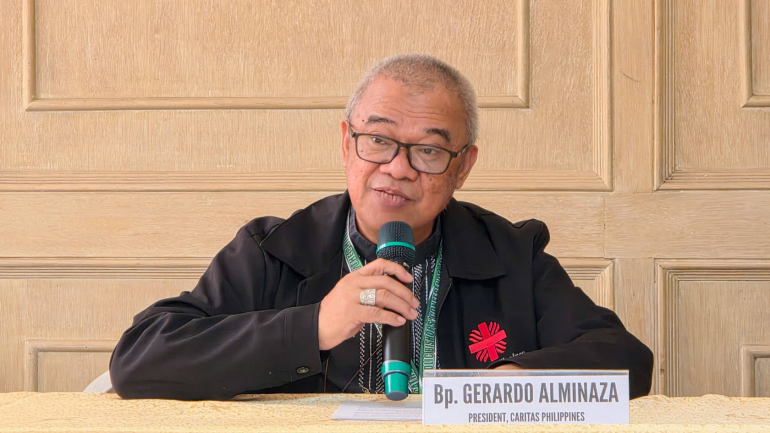
The Catholic Bishops’ Conference of the Philippines (CBCP) expressed support for jailing corrupt officials and announced plans to expand Church involvement in monitoring government projects, as Church leaders responded to growing public frustration over governance and corruption.
Speaking at a press conference on 26 Jan during the 131st CBCP Plenary Assembly, Bishop Gerardo Alminaza, head of the CBCP Episcopal Commission on Social Action, Justice, and Peace, said the Church would continue and broaden its advocacy on good governance beyond its existing partnerships.
Alminaza recalled that under the previous leadership of Bishop Jose Colin Bagaforo, the commission entered into a memorandum of cooperation with the Department of Public Works and Highways (DPWH) and several local government units to help monitor the implementation of infrastructure projects.
“In my term, we would like to expand that not just with DPWH but also with other agencies such as the Department of Social Welfare and Development, the Department of the Interior and Local Government, the Department of Health, and the Department of Education,” Alminaza said.
He stressed that the Church’s engagement was driven not only by bishops and clergy but by the lived experiences of ordinary Filipinos.
“The grievances are not limited to bishops and priests. Many people share them, and Filipinos deeply feel the country’s present situation,” Alminaza said.
In a separate statement, Bishop Bagaforo, now chair of the CBCP Episcopal Commission on Inter-Religious Dialogue, voiced strong support for calls to hold corrupt officials accountable, including through imprisonment.
“The Church stands with the call of the majority to jail corrupt officials,” Bagaforo said, adding that political dynasties should also be dismantled.
“And political dynasties should be dismantled,” he said.
CBCP President Archbishop Gilbert Garcera, meanwhile, framed corruption as a moral issue rooted in conscience, underscoring the need for personal and societal conversion alongside legal and institutional reforms.
“First of all, the primacy of conscience is essential,” Garcera said, stressing that statements and policies are ineffective if not guided by moral awareness.
He said the Church continues to pray for the “conversion of the heart” of individuals—whether political leaders or ordinary citizens—so that they may be guided by moral responsibility and openness to the Holy Spirit.
Garcera added that genuine reform requires not only accountability mechanisms but also inner transformation, which he linked to the Church’s call for synodality, or collective discernment.
The statements came as the CBCP plenary assembly gathers bishops from across the country to discuss pastoral priorities, social concerns, and the Church’s role in public life amid ongoing debates on corruption, governance, and political reform.
Radio Veritas Asia (RVA), a media platform of the Catholic Church, aims to share Christ. RVA started in 1969 as a continental Catholic radio station to serve Asian countries in their respective local language, thus earning the tag “the Voice of Asian Christianity.” Responding to the emerging context, RVA embraced media platforms to connect with the global Asian audience via its 21 language websites and various social media platforms.
Latest News