Philippines: Unconventional Nativity Scene in Augustinian-Run Cebu Parish Reflects Hope After Typhoon

When the Philippine Atmospheric, Geophysical and Astronomical Services Administration (PAGASA) began issuing weather advisories on November 2, 2025, regarding the intensifying Tropical Cyclone Kalmaegi, residents of low-lying areas, particularly those near coastlines, rivers, and steep slopes, paid close attention. Many began seeking temporary shelter as a precaution.
In Barangay Mohon, Talisay City, the Augustinian friars who administer the Santo Niño de Cebu Parish opened their doors to more than 70 families, comprising around 200 individuals. The parish provided shelter within the church compound, while food and water were made available through the generosity of parishioners and benefactors.
Mohon Parish serves an estimated 50,000 Catholics across five villages, Linao, Pooc, Mohon, Biasong, and Lawaan. The Augustinian friary, composed of five friars, is led by Father Roy Espara, OSA.
A Nativity Scene That Speaks of Reality and Hope
Nothing brings the Christmas story to life quite like a Nativity scene. Reflecting on what Christmas looks like in the aftermath of Typhoon Tino, Father Roy shared with Radio Veritas Asia that, at the start of the nine-day dawn Masses (Misa de Gallo), he envisioned a Nativity display that would mirror the lived experiences of those affected by the floods. He tasked the parish maintenance staff with bringing this concept to life.
The Nativity scene, locally known as the Belen, was unveiled to the public on December 15, 2025, coinciding with the lighting of the parish’s Christmas decorations.
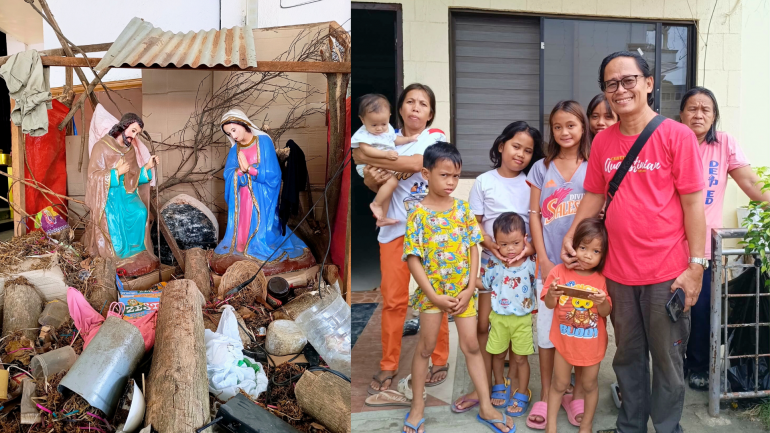
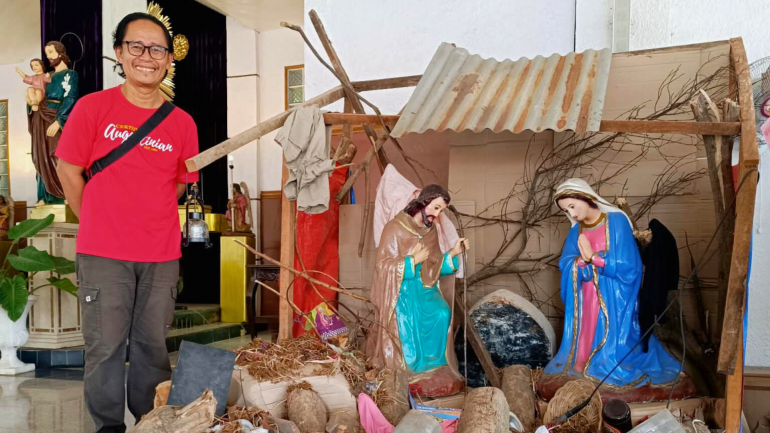
Instead of the usual glittering ornaments, colored lights, and faux snow, the Belen was stark and unsettling. It was strewn with debris: broken branches and weathered logs, a lone slipper, a torn T-shirt, a mud-covered backpack, rusted iron sheets, empty plastic bottles, and remnants of destroyed homes, many collected from the Mananga River, which had overflowed during the height of Typhoon Tino due to days of relentless rain.
Father Roy explained that the realism was intentional. “I wanted the Nativity scene to remind people that there is still hope, because God is in the midst of their suffering,” he said.
Initial reactions from parishioners ranged from confusion to discomfort. One parishioner wrote on social media that the Nativity scene was “pitiful to look at” and seemed “unfinished.”
In response, Rev. Fr. Keith Laurence Ermac, OSA, addressed the parishioners during his homily on December 15.
“Tanan nga inyung nakita, pulos mga butang nga pinunit gikan sa mga naanod sa baha sa Bagyong Tino. Ang mensahe ana nga Belen nagpasabot nga si Jesus dili mobiya kanato taliwala sa katalagman. (All that you see are objects collected from debris carried by the floods of Typhoon Tino. The message of this Nativity scene is that Jesus does not abandon us in times of disaster. Like the first Nativity, born in a humble and uncomfortable place, this one shows that hope can emerge from the ruins of hardship.)
Asked how Pope Leo XIV, an Augustinian, might react to such a Nativity scene, Father Roy chuckled and said he could not speculate, but added, “I believe he would be happy, given his deep love for the poor and the vulnerable.”
Father Roy recalled that the Holy Father, then Fr. Robert Prevost, OSA, Prior General of the Augustinian Order, visited the Mohon Friary in 2004 and blessed the newly built parish convent. Fr. Prevost returned to Cebu in 2010 to attend an important Augustinian gathering.
Augustinian Roots in the Philippines
The Augustinians arrived in the Philippines from Spain and Mexico in 1565 and established the Provincia Agustiniana del Santísimo Nombre de Jesús de Filipinas in 1575. After more than four centuries, the Filipino Augustinian Province of Santo Niño de Cebu, Philippines, was canonically established in 1983, with its headquarters at the Basilica Minore del Santo Niño. The Mohon Friary was founded two years later, in 1985.
Radio Veritas Asia (RVA), a media platform of the Catholic Church, aims to share Christ. RVA started in 1969 as a continental Catholic radio station to serve Asian countries in their respective local language, thus earning the tag “the Voice of Asian Christianity.” Responding to the emerging context, RVA embraced media platforms to connect with the global Asian audience via its 21 language websites and various social media platforms.
Latest News