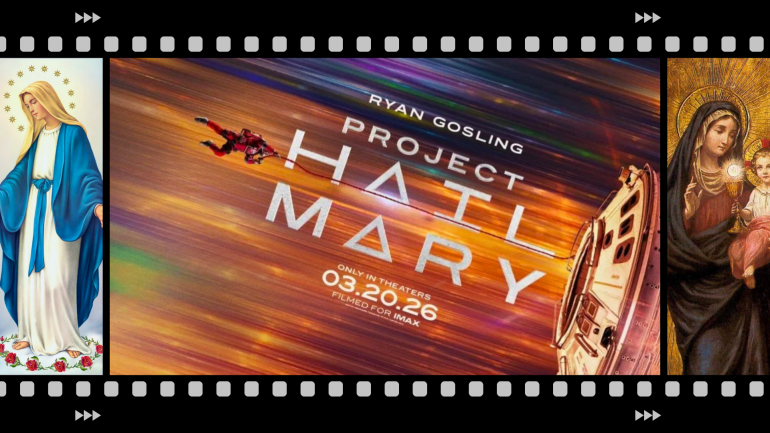
The year is 2026, and the sun is losing its luster, literally. In Phil Lord and Christopher Miller’s latest cinematic voyage, Project Hail Mary, we find Ryland Grace (Ryan Gosling) waking up on a spaceship with a serious case of “selective amnesia” and two very dead roommates. As his memories trickle back like a leaky faucet, he realizes he isn’t a high-flying astronaut but a middle-school science teacher tasked with saving humanity from “Astrophages”, tiny space-critters eating our sun’s energy.
Directed by the duo behind The Lego Movie and 22 Jump Street, this 156-minute epic is a visual feast, thanks to the textured cinematography of Greig Fraser and a pulsing, ethereal score by Daniel Pemberton. While it has soared at the box office and garnered praise for its technical execution, the film hasn’t escaped controversy. Some critics have called it a “messy space buddy comedy,” while others are up in arms over the “unethical” treatment of the protagonist’s free will. Yet, through the humor and the green vapor of deep space, lies a story that feels less like a science experiment and more like a liturgy of the stars.
In the flickering light of the spaceship “Hail Mary,” we see a strange parallel to a young woman in Nazareth. In the biblical narrative, Mary says “Yes” (her Fiat) to a mission that would change the cosmos. Ryland Grace, however, is a bit more... modern. As it turns out, Grace didn’t exactly sign up for a suicide mission; he was coerced, drugged, and sent into the void by the cold, calculating Eva Stratt (Sandra Hüller).
Theologically, this brings us to an uncomfortable reflection on Grace and Consent. While the film has been criticized for “normalizing” Stratt’s behavior, there is a profound Catholic lens to be found in the wreckage. Sometimes, we are “thrown” into our vocations. We find ourselves in “ships” we didn’t build, heading toward “stars” we didn’t choose. Grace’s initial “No” was overridden by the needs of the world, but his subsequent actions, his choice to solve the problem, to care for his ship, and eventually to sacrifice his own safety, became a series of “Yeses.” It is the “Word becoming flesh” in the mundane act of fixing a fuel line. He moves from a coerced victim to a man who chooses to embrace his cross.
The heart of the film beats when Grace meets Rocky, a five-legged, rock-shaped alien scientist who is just as lonely and desperate as he is. In one of the most poignant exchanges, the language barrier dissolves into a shared realization of their predicament. They aren’t just two individuals; they are a community of two.
This echoes the profound biblical theme: “Greater love has no one than this: to lay down one’s life for one’s friends” (John 15:13). In the vast, cold vacuum of space, Lord and Miller show us that “human” isn’t a biological category, it’s a relational one. When Grace vents about his “roommate” being messy, and Rocky responds with a clicking query about the “dirty, dirty” room, we see the Image of God reflected in the most unlikely of mirrors, a piece of living stone.
If the “Word became flesh” so that God could die for His friends, then Grace’s evolution into a man willing to stay in the dark so another might have light is the ultimate imitative act. The film suggests that salvation isn’t just about surviving; it’s about companionship. We are never truly “I alone” when we are “We alone.” Even in a galaxy of dying stars, the presence of the “Other” creates a sanctuary.
The movie’s ending, which some find too long or “neat”, actually serves a higher purpose. It insists on hope. It suggests that even if you were forced onto the ship, and even if you are trillions of miles from home, your life has a signature. You are not just a “product” or a “disposable scientist.” You are a participant in a grand, cosmic repair.
Gosling plays Grace with a “vulnerability that grounds every moment,” making us believe that a middle-school teacher is exactly who should save the universe. It’s a reminder that God rarely calls the equipped; He equips the called, even if He has to use a very determined Sandra Hüller and a lot of sedative to do it.
The movie lets us ponder on this question:
If you woke up tomorrow in the “tin can” of a life you didn’t perfectly choose, would you spend your time mourning your lost “No,” or would you start looking for the “Rocky” next to you, ready to say “Yes” to the mission of today?
Radio Veritas Asia (RVA), a media platform of the Catholic Church, aims to share Christ. RVA started in 1969 as a continental Catholic radio station to serve Asian countries in their respective local language, thus earning the tag “the Voice of Asian Christianity.” Responding to the emerging context, RVA embraced media platforms to connect with the global Asian audience via its 21 language websites and various social media platforms.
Latest News