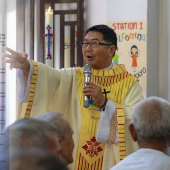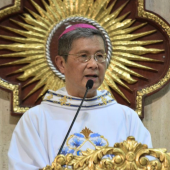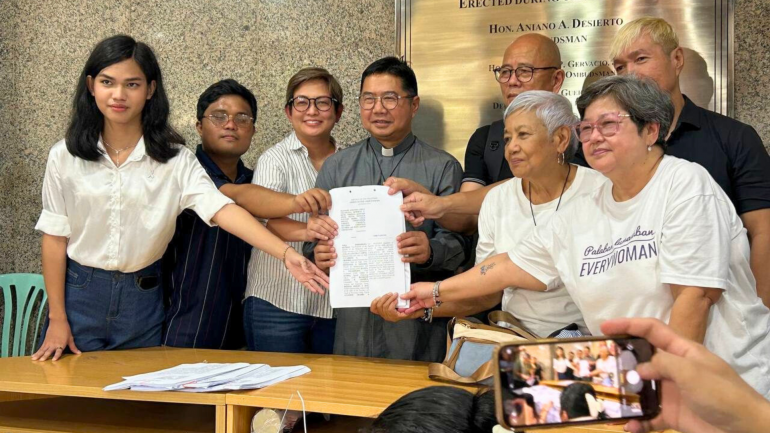
The recent decision of two Filipino priests, Fr. Flavie Villanueva and Fr. Roberto Reyes, to join civil society groups in filing a plunder complaint against Philippine Vice President Sara Duterte on December 12 has sparked intense public debate. While their action drew widespread online harassment and hate speech from netizens opposed to the case, it also raised deeper questions among well-meaning Catholics: should members of the clergy engage so openly in public action, especially when it involves challenging those in power?
Citing Scripture, some insist that religious figures should “keep out of politics” whenever a priest or a nun speaks against corruption, abuse of power, injustice, or the betrayal of national sovereignty. Yet this claim rests on a misunderstanding of the doctrine of separation of Church and State.
Religious leaders do not violate this doctrine when they speak for good governance, the welfare of citizens, human dignity, and public accountability. So long as priests or nuns remain non-partisan, do not seek public office, and do not aim to take over the roles of political leaders, their engagement in public issues remains within the doctrine of separation of Church and State, a point long established in constitutional and theological discussions.
Speaking truth to power is a moral obligation of the Church and its leaders. This is not a modern invention but a pattern firmly rooted in biblical and Christian tradition. The prophet Nathan confronted King David for the abuse of power and the murder of Uriah. Elijah denounced King Ahab for injustice and bloodshed in the seizure of Naboth’s vineyard. John the Baptist publicly rebuked Herod for an immoral and unlawful marriage, an act of personal corruption by a political ruler.
These prophets did not seek public office; they spoke truth to power.
In the Philippine context, religious leaders who speak out against the corruption of public funds, abuse of power, disinformation, and other issues affecting the welfare of the people and the nation do not seek to replace the State. Rather, they remind it of its moral limits, responsibilities, and accountability.
The doctrine of separation of Church and State does not exist to silence the Church or its leaders on public issues. Moral witness is not a political takeover.
Some insist that priests and nuns should confine themselves to “pure ministry” and stay out of politics, by which they often mean refusing to join civil society in holding corrupt public officials to account. This framing turns moral responsibility into political contamination.
But no such prohibition exists. Neither Philippine law nor canon law forbids a priest or a nun from filing a legal complaint against a government official. Claims to the contrary are not rooted in law but in discomfort with clergy who refuse to remain silent in the face of injustice.
There are also those who respond with online hostility when priests and nuns speak and stand for truth, especially when such criticism touches leaders they favor. At times, this hostility descends into name-calling, with priests labeled as “demons in white and crucifix.”
Others argue that a priest or a nun cannot credibly speak of justice unless he confronts every government official suspected of corruption. Yet prophetic witness has never meant confronting all injustice at once. Even in Scripture, truth is spoken where it is heard and where the speaker is sent. To demand that a prophet denounce everything is often a way of ensuring that nothing is said at all.
Accountability does not require fighting all battles simultaneously. No individual, cleric or otherwise, has the capacity to pursue every case at once. Legal action demands specific evidence and standing. Acting where evidence is strongest is not selective; it is how justice moves forward. Other cases should also be pursued, but one does not cancel the other.
It is worth remembering that when Jesus spoke of Herod, He did not remain silent. He called him “that fox.”
Radio Veritas Asia (RVA), a media platform of the Catholic Church, aims to share Christ. RVA started in 1969 as a continental Catholic radio station to serve Asian countries in their respective local language, thus earning the tag “the Voice of Asian Christianity.” Responding to the emerging context, RVA embraced media platforms to connect with the global Asian audience via its 21 language websites and various social media platforms.
Latest News