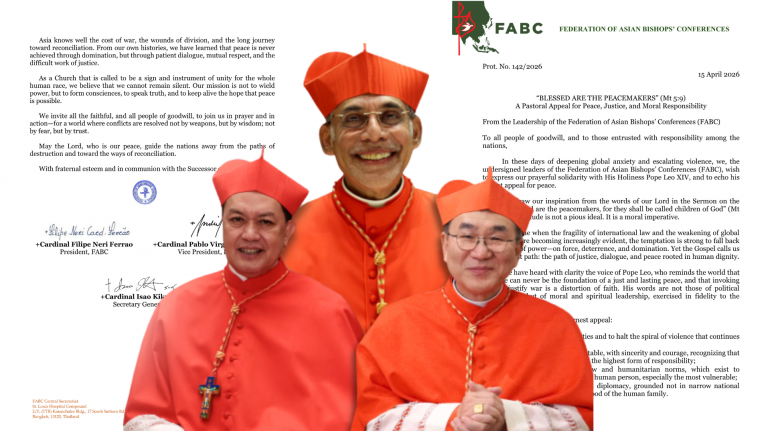
In a world increasingly defined by war, division, and moral uncertainty, the Federation of Asian Bishops’ Conferences (FABC) has issued a timely and prophetic appeal for peace. Titled “Blessed Are the Peacemakers” (Mt 5:9), the pastoral statement is both a spiritual exhortation and a moral compass for a fractured global order.
Echoing the urgent call of Pope Leo XIV, the bishops of Asia remind the world that peace is not merely a diplomatic aspiration but a sacred duty rooted in human dignity and divine truth. Their message resonates with clarity and courage at a time when the fragility of international law and the erosion of global institutions threaten to plunge humanity into deeper instability.
Drawing inspiration from Christ’s Sermon on the Mount, the FABC underscores a timeless truth: “Blessed are the peacemakers, for they shall be called children of God.” This Beatitude, the bishops insist, is not a pious ideal but a moral imperative. It challenges nations and leaders to reject the logic of violence and embrace the path of justice, dialogue, and reconciliation.
At a time when geopolitical tensions are escalating, from Eastern Europe to the Middle East, and from the South China Sea to the Korean Peninsula, the Church in Asia has chosen not to remain silent. Instead, it has spoken with a unified and compassionate voice, affirming that violence can never serve as the foundation for a just and lasting peace.
A Moral Voice in Troubled Times
The FABC’s appeal aligns closely with Pope Leo XIV’s steadfast stance against war and the misuse of religion to justify violence. The Holy Father’s warning that invoking God to sanction conflict constitutes a distortion of faith strikes at the heart of humanity’s recurring moral failures.
Such clarity is especially vital today. Across the globe, military rhetoric has intensified, defence budgets have soared, and diplomacy has too often yielded to aggression. In this volatile climate, the bishops’ call serves as a reminder that the true measure of civilization lies not in its capacity for destruction, but in its commitment to justice and peace.
Their appeal urges an end to ongoing hostilities, a sincere return to negotiations, and respect for international law and humanitarian norms.
By advocating for what they term “moral diplomacy,” the bishops challenge world leaders to rise above narrow national interests and pursue the common good of the human family.
Asia’s Unique Witness
Asia’s voice in the global peace discourse carries particular weight. The continent has endured the scars of colonialism, war, and ideological conflict. From Hiroshima and Nagasaki to the Killing Fields of Cambodia, from the Korean War to the ongoing struggles in Myanmar, Asia knows the devastating cost of violence.
Yet it is also a region marked by resilience, diversity, and spiritual depth. The FABC’s appeal draws from this rich historical and cultural heritage, emphasising that peace is achieved not through domination but through dialogue, mutual respect, and justice.
“Asia knows well the cost of war,” the bishops declare. These words carry the authority of lived experience. They reflect a collective memory shaped by suffering and a shared aspiration for harmony among nations and religions.
A Church That Forms Consciences
The FABC’s message reaffirms the Church’s mission as a sign and instrument of unity for the entire human family. Its role, the bishops emphasise, is not to wield political power but to form consciences, speak truth, and sustain hope.
The emphasis on prayer and action invites Catholics, and all people of goodwill, to become agents of reconciliation. It challenges believers to transcend indifference and to work toward a world where conflicts are resolved not by weapons but by wisdom, not by fear but by trust.
In an era marked by polarisation and mistrust, such a call is both radical and necessary.
The Urgency of Moral Diplomacy
The FABC’s appeal for moral diplomacy is particularly relevant in today’s geopolitical landscape. As alliances shift and tensions escalate, there is a growing temptation for nations to prioritize power over principle. Yet history has repeatedly shown that wars seldom deliver lasting solutions.
Diplomacy grounded in ethical responsibility offers a path forward. By advocating for respect of international law and humanitarian norms, the bishops emphasise that true peace is inseparable from justice.
A Call to Prayer
The pastoral appeal concludes with a prayerful invitation: that the Lord, who is our peace, may guide the nations away from destruction and toward reconciliation. It is a message that transcends borders, religions, and ideologies.
In a world weary of war, the Church in Asia offers a vision rooted in hope, a vision where justice triumphs over oppression and peace prevails over violence.
As the FABC’s appeal reverberates across the continent, it challenges the global community to reflect on its moral responsibilities. It reminds us that peace is not the absence of war but the presence of justice, compassion, and truth.