



Before sunrise, a woman slips off her shoes and puts them into her bag. She presses her palm to the pavement, whispering a prayer before joining the slow, tightening crowd. Around her, bodies sway and surge. Someone offers water. Another grips a thick rope. The air is heavy with sweat, incense, and murmured petitions. For hours, she will walk barefoot—not to prove anything, she says later, but to carry what she can no longer carry alone.
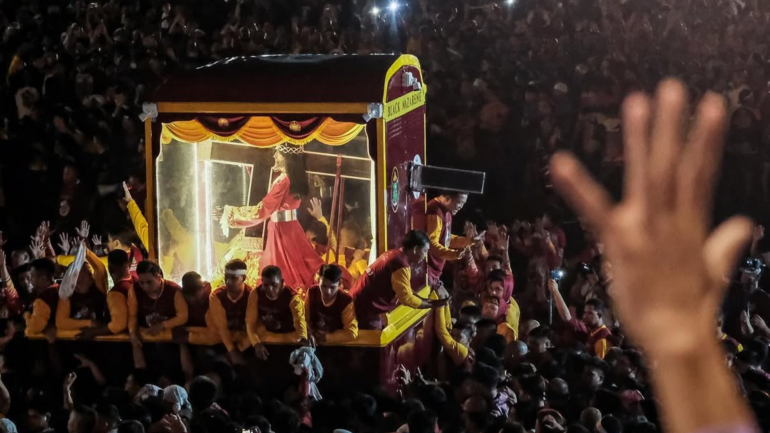
Every January 9, millions gather around Quiapo Church, Manila, Philippines, bringing prayers shaped by illness, debt, grief, and hope. Devotion to the Black Nazarene is often described as intensely personal—a private vow fulfilled in public. Yet to see it only this way is to miss its deeper resonance. This devotion is also about how Filipinos live with their country. To walk with the Black Nazarene is to walk through the Philippines as it is.
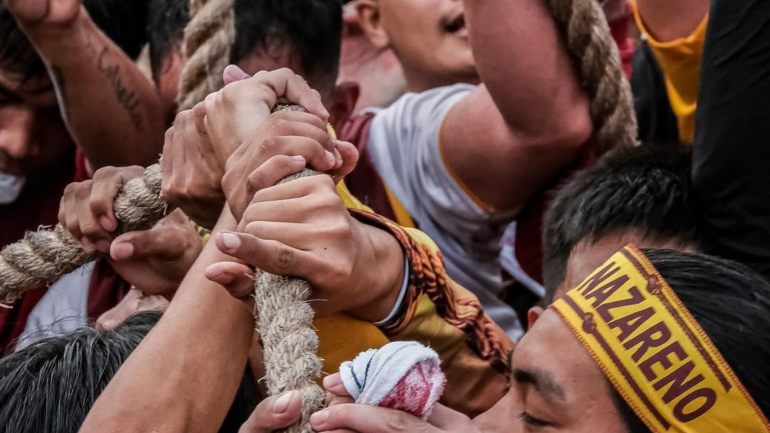
The procession moves through crowded streets under heat and exhaustion. Devotees do not escape these conditions; they submit themselves to them. Bare feet meet asphalt. Bodies lean on strangers to keep from falling. The movement mirrors daily life for many whose survival depends on patience, cooperation, and endurance—qualities learned in necessity.
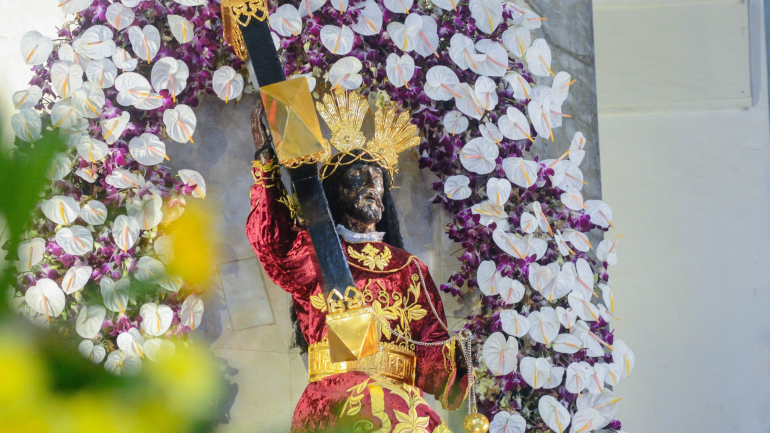
The Black Nazarene is a Christ who falls. His darkened, wounded body resonates in a nation marked by colonization, disaster, inequality, resilience, and disinformation. This is not a triumphant Christ, distant and serene, but one bent low beneath the cross. Many devotees see in Him not escape from suffering, but recognition: a God who does not hover above their struggles but collapses under them, again and again. Loving this Christ becomes inseparable from loving a people who have learned to rise without guarantees.
Along the route, a middle-aged man explains why he returns every year. “Hindi nawawala ang problema,” he says. The problems do not disappear. “Pero dito, natututo akong magtiis—at mag-isip.” Here, he learns to endure—and to think. A volunteer marshal, who has served for over a decade, notices the same thing. “Hindi lang dasal ang dala ng mga tao,” she says. People carry more than prayers. “May bigat ng bansa.”
But honesty demands more. Many of the sufferings brought to the Nazarene are not mysterious acts of God. They have roots in poor governance, unequal systems, and long-standing neglect. Hunger, preventable illness, unsafe work, and inadequate housing are not crosses sent from heaven. Devotion may help people endure these realities, but it must never be used to explain them away. Faith should not function as anesthesia.
Resilience, often praised as a national virtue, becomes dangerous when it excuses injustice. A Christ who keeps falling in our streets invites a harder question: who keeps placing the obstacles?
There is also another burden many devotees carry. Like all of us, some live within an information landscape shaped by disinformation—stories that distort history or excuse abuse. Those misled are often victims of broken trust. Yet there is another, quieter struggle: at times, we turn our backs on truth not because we do not recognize it, but because admitting we were misled can feel like a loss of face, a source of shame. Perhaps this, too, is a prayer carried to the Black Nazarene—that devotion may humble the heart enough to choose truth over pride, and begin again with clearer eyes.
In recent years, some devotees have also encountered narratives that discredit priests and church workers who speak for truth and love of country. These stories trade in suspicion and half-truths, weakening trust where moral courage is needed most. Devotion, at its best, can become a school of restraint and discernment—the grace to pause before sharing, to listen more deeply, and to recognize lies that divide rather than heal.
This is where devotion quietly becomes love of country—not the loud, flag-waving kind, but a moral commitment that refuses denial. To walk barefoot is to say: this pain is real, and it belongs to us.
Perhaps the Black Nazarene would not be angered to see devotees channel their fervor beyond the procession—standing firm against disinformation, refusing corruption, caring for what has been wounded, and helping rebuild lives broken by neglect and disaster. A Christ who carries the cross through the streets does not ask only for touch or tears; He asks for conversion that continues after the crowd disperses.
As the procession thins, the woman who walked barefoot puts her shoes back on. She heads home to the same unresolved problems. Yet something lingers: the knowledge that suffering was not carried alone—and the conviction that faith, if it is to be honest, must keep walking where truth is hard, justice costly, and hope a shared responsibility.
Perhaps Christ keeps falling in our streets because we are still learning how to rise—rising from disinformation, from corruption, and from the quiet pride that keeps us from admitting we were misled.