



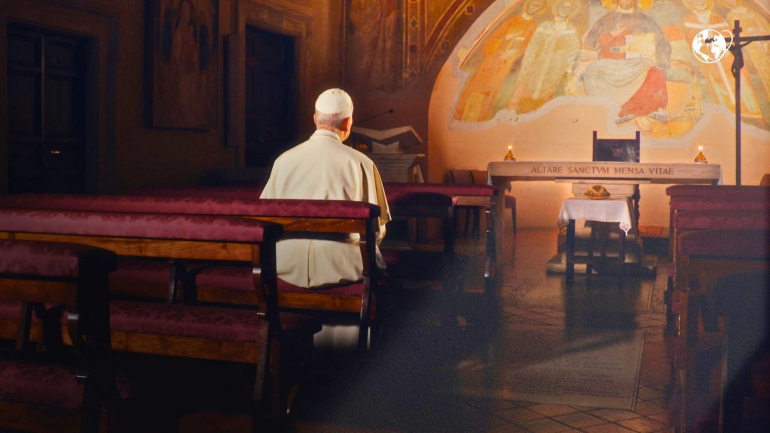
The Pope’s prayer intention for May is simple: that everyone might have food and that food is not wasted. It sounds ordinary, almost too simple to notice. Yet it speaks into a world where something deeply disproportionate has become normal.
We now live with two realities that no longer disturb each other. On one side, hunger remains widespread and severe. On the other, food is discarded daily in vast quantities, often without reflection. The tension is no longer denied; it is simply no longer felt.
The Pope’s intention, then, is not only a prayer for provision. It is a call to conversion: to recover gratitude, relearn restraint, and recognize food as something entrusted rather than merely consumed.
A Culture of Convenience
Food today is rarely far away. It can be ordered at any hour, delivered within minutes, and tailored endlessly to preference. Season and geography have been softened by global supply chains. What was once rare is now routine.
With this ease comes a quiet shift in perception. What is always available feels less precious. What is easily replaced is less carefully kept. Waste no longer appears as loss; it becomes part of the background logic of abundance.
This is most visible not in excess, but in ordinary neglect: food forgotten in refrigerators, meals prepared too generously, shopping done without checking what is already there. Each act seems small. Together, they form a pattern that becomes normal.
When Waste Becomes Visible
At times, that pattern becomes unmistakable.
Working in the supply chain industry, I once encountered a consignment of milk that had been properly produced and safely packaged but mislabeled for a different supermarket. The product itself was entirely fit for consumption. Nothing was wrong with it. Yet because it could not enter the correct distribution channel, the entire delivery was destroyed.
There were 6,800 cartons, over 13,000 liters of milk, enough to supply a small town for a day.
Nothing had failed in the product. The failure was procedural. That gap between what is intact and what is discarded is difficult to forget once seen.
The Scale We Live Beside
This is not an isolated case, but part of a wider global pattern. According to the United Nations Environment Programme Food Waste Index (2024), around one-fifth of all food produced for human consumption is lost or wasted each year, roughly one billion meals every day.
The difficulty in grasping this figure is not its size, but its distribution. It accumulates across countless small acts in homes, supermarkets, restaurants, and supply chains. It is repetition rather than event.
The financial cost approaches one trillion US dollars annually. Environmentally, food waste accounts for about 10 percent of global greenhouse gas emissions, more than aviation and shipping combined.
Most telling is where it happens: around 60 percent of food waste occurs in households. The center of gravity is domestic, close enough that it rarely draws attention.
What Scripture Refuses to Let Us Ignore
Scripture approaches this question with clarity. After the multiplication of the loaves, Christ instructs: “Gather up the fragments left over, so that nothing may be lost.” Even in abundance, what remains still matters. Gift does not cancel responsibility; it extends it.
The Epistle of James is direct: faith without works is dead. If someone lacks food, words alone are not enough. In the Gospel of Matthew, the measure is simple: “I was hungry and you gave me food.” What is believed is revealed in what is done.
Across these passages, a single truth holds: what is done with bread is inseparable from what is believed about God and neighbor.
When Waste Becomes a Moral Question
At a certain point, the issue can no longer remain technical. Pope Francis has called the coexistence of hunger and waste a “genuine scandal.” When food is thrown away, he says, “it is as if it were stolen from the table of the poor.”
In that light, waste is no longer private. The Catechism of the Catholic Church links excess and waste to failures of temperance and justice. Food is never only possession; it carries obligation.
Once this is recognized, waste is no longer morally invisible. When it becomes routine, it reshapes how abundance itself is understood, and what it quietly excludes.
From Awareness to Habit
Most people already know that food is wasted. The difficulty is not knowledge, but attention, and attention is eroded by habit.
Change begins not with scale, but with discipline: buying only what is needed, checking what is already available, planning meals carefully, treating leftovers as ordinary food, preserving what can still be used, supporting food banks, and pausing before discarding food to ask whether it still has value.
None of this is dramatic. But then neither is the problem.
A New Heart
The contradiction between hunger and waste is no longer hidden. It is woven into everyday life, repeated so often that it risks no longer being seen.
In his prayer intention, the Holy Father turns to Christ: “You who sent us Your beloved Son Jesus, broken bread for the life of the world… give us a new heart, hungry for justice and thirsty for fraternity.” Bread is not only received, it is meant to be shared.
To ask that everyone might have food is to ask for a change in how we see what we already have. It shifts the question from systems alone to the way we live with what is placed in our hands.
Because the real issue is not only that hunger and waste exist side by side. It is how easily we have learned to live as if that were normal. And perhaps the beginning of change is not first action, but attention: to ask for a new heart, and to mean it in the way we eat, keep, and share.