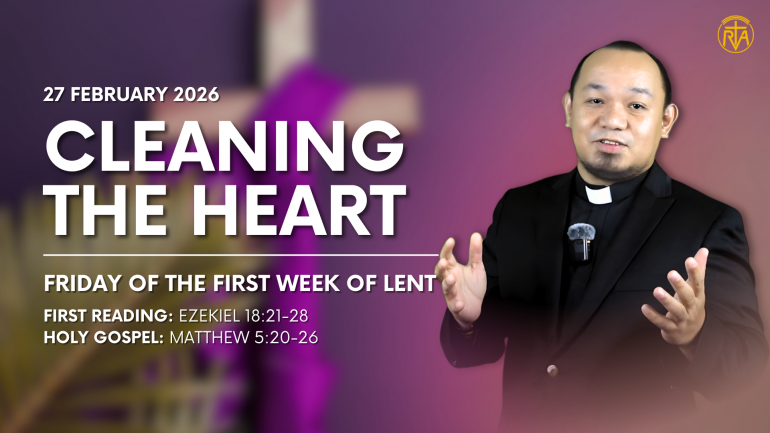
Reflection Date: February 27, 2026 | Friday of the First Week of Lent
Daily Readings: Ezekiel 18:21-28; Matthew 5:20-26
Children of God:
In Jewish tradition, there is a sacred period known as the “Days of Awe.”
It is the 10-day period between Rosh Hashanah (Jewish New Year, marking the beginning of the High Holy Days) and Yom Kippur (the Day of Atonement).
During this ten-day period, individuals intentionally reach out to friends, relatives, and colleagues.
They sincerely apologize for wrongs they have committed throughout the year.
The goal is to repair broken relationships before the Day of Atonement or Yom Kippur arrives.
People understand that asking forgiveness from God also requires seeking forgiveness from one another.
By the time Yom Kippur begins, many strive to stand before God with a clear conscience.
In the gospel story of Matthew, Jesus raised the standard of righteousness beyond external compliance. He told his listeners that
their righteousness must surpass that of the scribes and Pharisees (Matthew 5:20).
He warned that anger toward a brother or sister had serious consequences (Matthew 5:22).
What are our inspirations for today?
First, fixing broken relationships before worship.
Jesus described a worshiper who was already at the altar when he remembered a conflict (Matthew 5:23).
Instead of proceeding with the ritual, he instructed him to leave the gift and seek reconciliation first (Matthew 5:24).
Relationship repair took priority over religious performance.
This teaching shocked his listeners because altar offerings were sacred acts.
Yet Jesus emphasized that unresolved anger and broken relationships affected one’s standing before God.
External worship could not compensate for internal resentment.
Today, we are invited to examine whether our prayers and church attendance are matched by efforts to heal conflicts.
Before presenting our offerings, we are called to mend what has been damaged.
True devotion includes the courage to say, “I am sorry.”
Second, address the anger before it turns into danger.
Jesus equated unchecked anger with a path toward judgment (Matthew 5:22).
He showed that violence begins in the heart long before it appears in action.
Words of insult and contempt already wounded the dignity of others.
By urging quick settlement with an opponent (Matthew 5:25), Jesus encouraged proactive reconciliation.
Once forgiveness is delayed, the bitterness is also allowed to grow more.
Today, we are invited to confront anger early.
Addressing anger protects not only relationships but also our own peace.
We might as well ask ourselves today: Is there someone you need to approach for reconciliation? Are you holding onto anger that is quietly shaping your attitudes and actions?
Children of God:
Anger may feel justified, but it often imprisons the one who holds it.
Worship without forgiveness becomes incomplete.
The altar calls us not only to prayer but also to peace.
Settling conflicts early prevents deeper wounds later. And mind you, when relationships are healed, worship becomes all the more authentic and heart-felt.
May we clear our hearts before we come to the court of God.
Radio Veritas Asia (RVA), a media platform of the Catholic Church, aims to share Christ. RVA started in 1969 as a continental Catholic radio station to serve Asian countries in their respective local language, thus earning the tag “the Voice of Asian Christianity.” Responding to the emerging context, RVA embraced media platforms to connect with the global Asian audience via its 21 language websites and various social media platforms.
Latest News