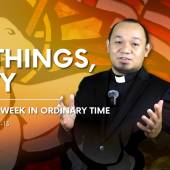
January 08, 2026 Thursday after Epiphany
Daily Readings: 1 John 4:19–5:4; Luke 4:14-22
Children of God: throughout history, many civilizations believed in the theory of Divine Right: the idea that kings ruled because they were chosen directly by God and therefore could not be questioned. In medieval Europe, monarchs claimed absolute authority by divine mandate. In ancient China, emperors ruled under the “Mandate of Heaven,” believing their power was sacred as long as order was maintained. Even in parts of Asia and the Middle East, rulers often linked political power with divine approval. In many cases, this belief strengthened authority, but it also justified oppression, inequality, and silence among the poor.
When Jesus returned to Nazareth and entered the synagogue, he did not claim authority like kings or emperors. Instead, He opened the scroll of the prophet Isaiah and read: “The Spirit of the Lord is upon me, because he has anointed me to bring good news to the poor” (Luke 4:18). Jesus revealed a radically different understanding of divine authority, not one that dominates, but one that serves, heals, and restores dignity.
Jesus speaks of sight for the blind, freedom for captives, and liberation for the oppressed (Luke 4:18–19). This is not the language of palace power or imperial control. This is the language of mercy. Authority, in Jesus, is not about privilege but about mission. God’s power is revealed not in force, but in compassion that lifts up those pushed to the margins.
When Jesus returned to Nazareth and entered the synagogue, the people in the synagogue marvel at His gracious words (Luke 4:22), yet this amazement will soon turn into resistance. Why? Because the authority Jesus claims challenges comfortable systems. Divine power that liberates the poor and unsettles injustice is often harder to accept than authority that simply maintains order.
Children of God: Jesus shows us that true divine authority does not silence consciences or protect the powerful; it heals wounds and restores hope. As followers of Christ, we are invited to mirror this authority—not by control, but by service; not by domination, but by love.
Radio Veritas Asia (RVA), a media platform of the Catholic Church, aims to share Christ. RVA started in 1969 as a continental Catholic radio station to serve Asian countries in their respective local language, thus earning the tag “the Voice of Asian Christianity.” Responding to the emerging context, RVA embraced media platforms to connect with the global Asian audience via its 21 language websites and various social media platforms.
Latest News