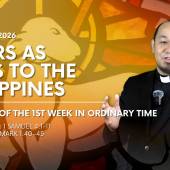
January 16, 2026 Friday of the First Week in Ordinary Time
Daily Readings: 1 Samuel 8:4-7, 10-22a; Mark 2:1–12
Children of God: What causes paralysis? I asked my doctor friend about this and I like the way he explained it to me as a communicator. He said that paralysis happens when communication between the brain and the body is interrupted. This can be caused by damage to the brain, spinal cord, or nerves due to stroke, trauma, infection, tumors, or degenerative diseases. Sometimes the muscles are healthy, but the signals that tell them to move never arrive. In medicine, paralysis is not only about immobility; it is about a broken connection. Something essential is blocked, and the body can no longer respond as it was created to do.
In the gospel story of Mark, a paralyzed man is brought to Jesus, lowered through the roof by friends who refuse to give up (Mark 2:1–12). This story invites us to look beyond physical paralysis and ask deeper questions. What kinds of paralysis exist in our spiritual lives?
First, spiritual paralysis often begins when sin and fear block our relationship with God. In the gospel of Mark, Jesus’ first words to the paralyzed man are surprising: “Child, your sins are forgiven” (Mark 2:5). Before healing the body, Jesus heals what is deeper, the broken relationship between the man and God.
Just as damaged nerves prevent movement, unconfessed sin, guilt, and fear can prevent spiritual growth. A person may want to change, forgive, or begin again, but something inside feels stuck.
Jesus reveals that true healing starts from within. When the heart is freed, the body and life can begin to move again toward wholeness.
Second, faith-filled community helps carry us when we cannot move on our own.
The paralyzed man does not come to Jesus by himself. He is carried by friends who believe, who act, and who are willing to tear open a roof to reach Christ (Mark 2:3–4).
Paralysis isolates, but faith creates connection. When we are spiritually weak, God often sends people—family, friends, communities—to carry us in prayer and encouragement. Jesus sees not only the faith of the paralyzed man, but also the faith of those who brought him (Mark 2:5). Healing becomes a shared miracle.
Children of God: The gospel of Mark teaches us that paralysis is not only a medical condition; it can be spiritual, emotional, and relational. Jesus heals both the broken body and the blocked heart, restoring movement, dignity, and hope.
Radio Veritas Asia (RVA), a media platform of the Catholic Church, aims to share Christ. RVA started in 1969 as a continental Catholic radio station to serve Asian countries in their respective local language, thus earning the tag “the Voice of Asian Christianity.” Responding to the emerging context, RVA embraced media platforms to connect with the global Asian audience via its 21 language websites and various social media platforms.
Latest News