Reflection Date: May 13, 2026 | Wednesday of the Sixth Week of Easter
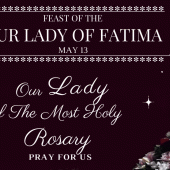
Memorial of Our Lady of Fatima
Daily Readings: Acts 15:1-6; John 16:12-15
Children of God:
In the year 381 AD, the Church gathered in the Council of Constantinople to address growing confusion about the Holy Spirit.
Some groups, known as the Pneumatomachi, I say it again: Pneumatomachi – translated from Greek as “fighters against the Holy Spirit.”
The Pneumatomachi questioned the Spirit’s divinity and reduced him to a lesser being.
Naturalmente, this created division and uncertainty among believers.
The Church leaders saw the need to clarify what had been handed down from the apostles.
They affirmed that the Holy Spirit was not a creature but truly God, equal with the Father and the Son.
This affirmation became a crucial step in deepening the Church’s understanding of the Trinity.
As a result, the Nicaean Creed was expanded to include clearer statements about the Holy Spirit.
It now proclaimed belief in the Spirit as “the Lord, the giver of life, who proceeds from the Father and the Son, who with the Father and the Son is adored and glorified.”
This development did not invent a new belief but clarified what was already present in the faith.
The process showed that truth sometimes needed time, prayer, and discernment to be fully expressed.
It was a moment of growth guided by the Spirit himself.
In the gospel of John, Jesus told his disciples that they were not yet ready to understand everything.
He promised that the Spirit of truth would guide them gradually.
What are our inspirations for today?
First, Jesus acknowledges our limitations.
As we always say, faith is a journey.
Jesus indicated that the disciples' current limitations.
He understood well that spiritual understanding is not an instantaneous one, but a progressive journey.
Truth was not forced upon them all at once but given according to their readiness.
This showed a patient and loving way of teaching.
The early Church experienced this same process.
Questions about the Holy Spirit did not disappear immediately.
It took time, discussion, and guidance to arrive at clarity.
The Council of Constantinople became a moment where the Church, open to the Spirit, received deeper understanding.
In our lives, we also encounter truths that take time to accept or understand.
Growth in faith does not happen overnight.
When we remain open and patient, we allow God to lead us step by step.
This openness becomes the path to deeper wisdom.
Jesus acknowledges our limitations.
Second, Jesus assures of the guidance of the Spirit.
Jesus said, “But when he comes, the Spirit of truth, he will guide you to all truth.”
The Spirit was not only a comforter but also a teacher.
He continued the work of Jesus by helping the disciples understand and live the truth.
The leaders of the Church did not rely only on their own reasoning.
They prayed, discerned, and trusted that the Spirit was guiding them.
In our daily journey, the Spirit continues to guide us.
We hear his voice in prayer, in Scripture, and in the wisdom of the Church.
When we take time to listen, we gain clarity in our decisions and direction.
The Spirit leads us not only to know the truth but to live it.
Jesus assures of the guidance of the Spirit.
As we reflect, we ask ourselves: Am I patient with my own journey of understanding, or do I expect immediate clarity?
Do I remain open to learning, even when it challenges me? Do I listen to the Spirit guiding me in my daily decisions?
Children of God:
The journey of the early Church reminds us that truth unfolds in time.
Jesus promised that the Spirit would continue to guide his followers.
This promise remains alive in our lives today.
We are not expected to know everything at once.
Instead, we are invited to grow step by step.
Radio Veritas Asia (RVA), a media platform of the Catholic Church, aims to share Christ. RVA started in 1969 as a continental Catholic radio station to serve Asian countries in their respective local language, thus earning the tag “the Voice of Asian Christianity.” Responding to the emerging context, RVA embraced media platforms to connect with the global Asian audience via its 21 language websites and various social media platforms.
Latest News