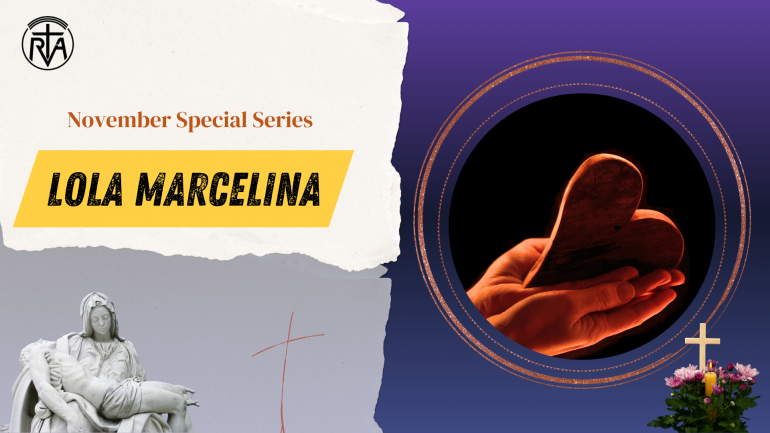
(In this “November Special Series,” RVA’s writers share memories of loved ones they have lost — a celebration of their lives, recalled with a tinge of sadness and the hope that one day there will be a reunion…… in a place where there is no death, no suffering, and where God Himself will wipe away every tear. – Editor)
My first awareness of death came in 1989. I was only eight years old. We lived in Davao del Sur, where my paternal grandparents were our neighbors. Lola Marcelina was my paternal grandmother. Before the opening of classes, my parents decided to send me to my maternal grandparents’ home in Davao del Norte so that I could transfer to another school. Before leaving, they brought me to her room. I did not fully understand what “sickness” or “old age” meant, but I felt the sadness in the air—thick, quiet, and unspoken.
I remember looking at her frail body on the bed, yet what I saw was the grandmother who, according to family stories, used to blow tobacco smoke on me whenever I had a cough—and somehow, I would feel better. She was the grandmother whose stomach became my pillow as a child, the one whose warmth brought comfort long before I understood the meaning of the word. But that day, all she could do was hold my hand.
Life moved quickly after that moment. As a second grader transferred to a new school, I had the usual adjustments to make—meeting new classmates, learning unfamiliar routines, trying to fit into a world that was not yet fully mine. But deep within me, I carried the image of my bedridden grandmother.
The days passed, and I began to settle. Then, more than a month later, a letter arrived—delayed by eight days through snail mail. The words were simple yet heavy: Lola Marcelina had died.
I remember the feeling clearly: the world suddenly paused. The letter became wet with my falling tears. Even at eight years old, I knew something irreversible had happened. Death became real—not a story, not a whispered adult conversation, but a part of my own life. Without hesitation, I told everyone that I needed to go home. I said goodbye to my teachers and my just-new classmates, left the friendships that had only begun, and traveled back to Davao del Sur. That journey home was the journey of a child trying to understand grief, trying to make sense of the loss of someone foundational to his early life.
Looking back now, I realize that death, painful as it is, becomes a teacher. It teaches us that love is finite in time but infinite in memory. It teaches us that relationships do not end at the grave—they only change form. My Lola no longer blows tobacco smoke to cure my cough, but her tenderness lives in the stories told and retold. Her stomach is no longer my pillow, yet her presence remains part of the foundation of my childhood.
Death also teaches us to value the people who are still with us— to hold them a little closer, speak a little gentler, forgive a little quicker, and love a little deeper.
It is now 2025, and thirty-six years have passed since my grandmother Marcelina left this world. Her memory has not faded. After her death, I returned to my previous school, where I was again considered a transferee. Life went on, but a part of me remained shaped by that early brush with loss.
And perhaps this is the quiet wisdom of death: it ends a life, but it strengthens the love that remains. Through remembering, we honor the ones who have gone before us, and we learn to live our own lives with greater purpose, tenderness, and faith.